
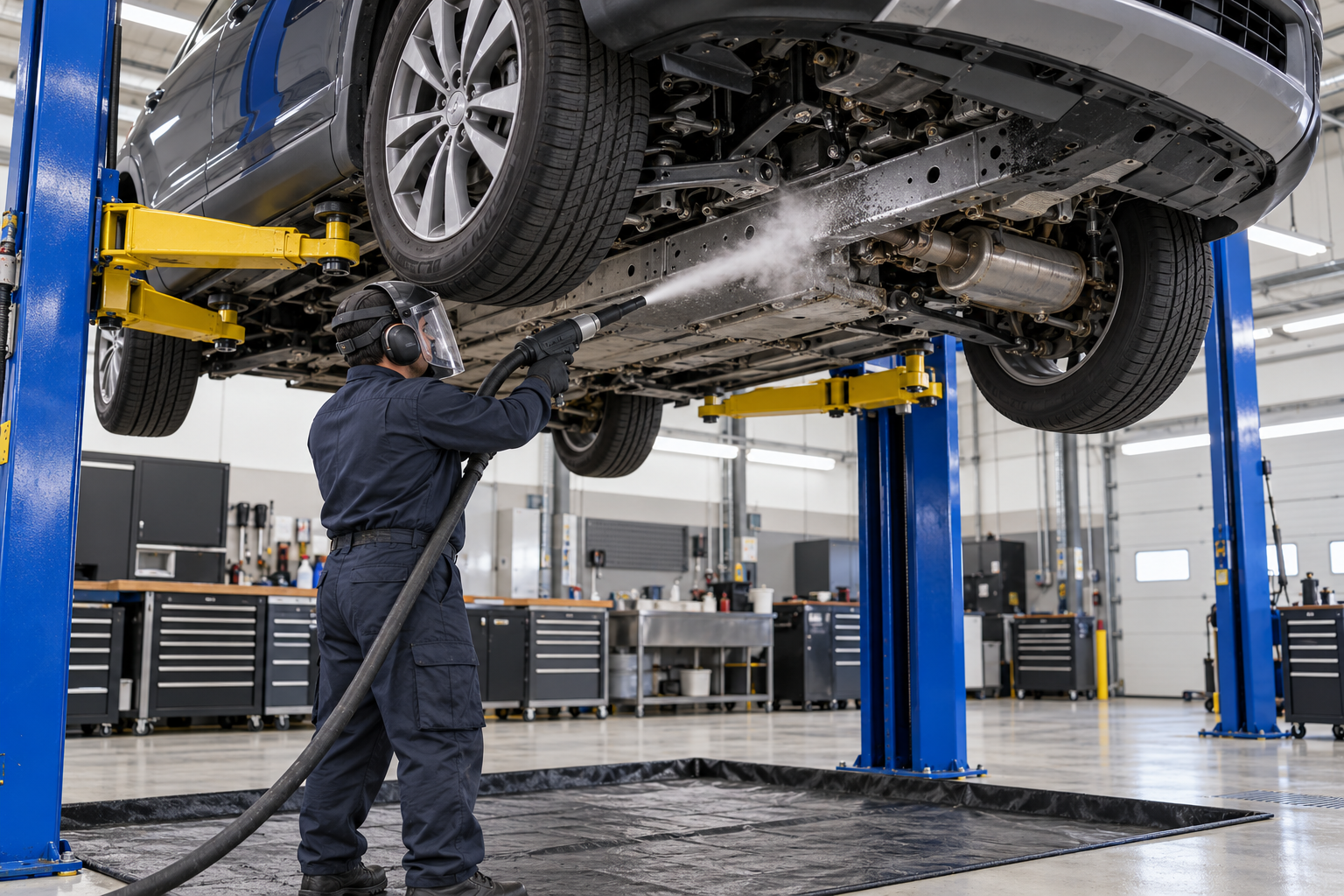
Dry ice blasting can remove grease, oil, dirt, and road grime from mapped, durable car underbody surfaces, but only after the shop decides which coatings and components must remain untouched.
That last condition is the real purchasing question. A cleaner underbody is not one universal endpoint. A preservation shop may need factory paint, wax, markings, and sound underseal to remain. A restoration shop may intentionally remove an aftermarket coating. The blaster cannot decide between those jobs. The written surface specification must.
Define the Underbody Cleaning Outcome
Start with the object, contaminant, substrate, and accepted result. “Clean the undercarriage” is too broad to qualify equipment or authorize work.
| Decision field | Inside a bounded cleaning trial | Outside or conditional |
|---|---|---|
| Cleaning object | Mapped frame rails, floorpan sections, protective plates, and robust structural metal surfaces | Brake friction surfaces, bearings, seals, boots, wiring, connectors, labels, fuel lines, sensors, and high-voltage components |
| Contaminant | Grease, oil film, dirt, and road grime | Rust, loose corrosion scale, brake dust, leaks, and unknown hazardous residue |
| Substrate | Sound OEM-coated steel and individually approved robust metal | Weak, cracked, historic, preservation-critical, or unknown coatings without a test |
| Accepted result | Documented contaminant removal with the specified coating and component condition unchanged | “Like new,” bare metal, corrosion repair, or an assumed mechanical improvement |
The stable axis is the accepted underbody condition. Contaminant, coating condition, air delivery, particle feed, nozzle, distance, angle, and dwell are change axes. If the work crosses into rust treatment, coating stripping, brake service, leak repair, or high-voltage work, it has crossed the rewrite boundary into another qualified process.
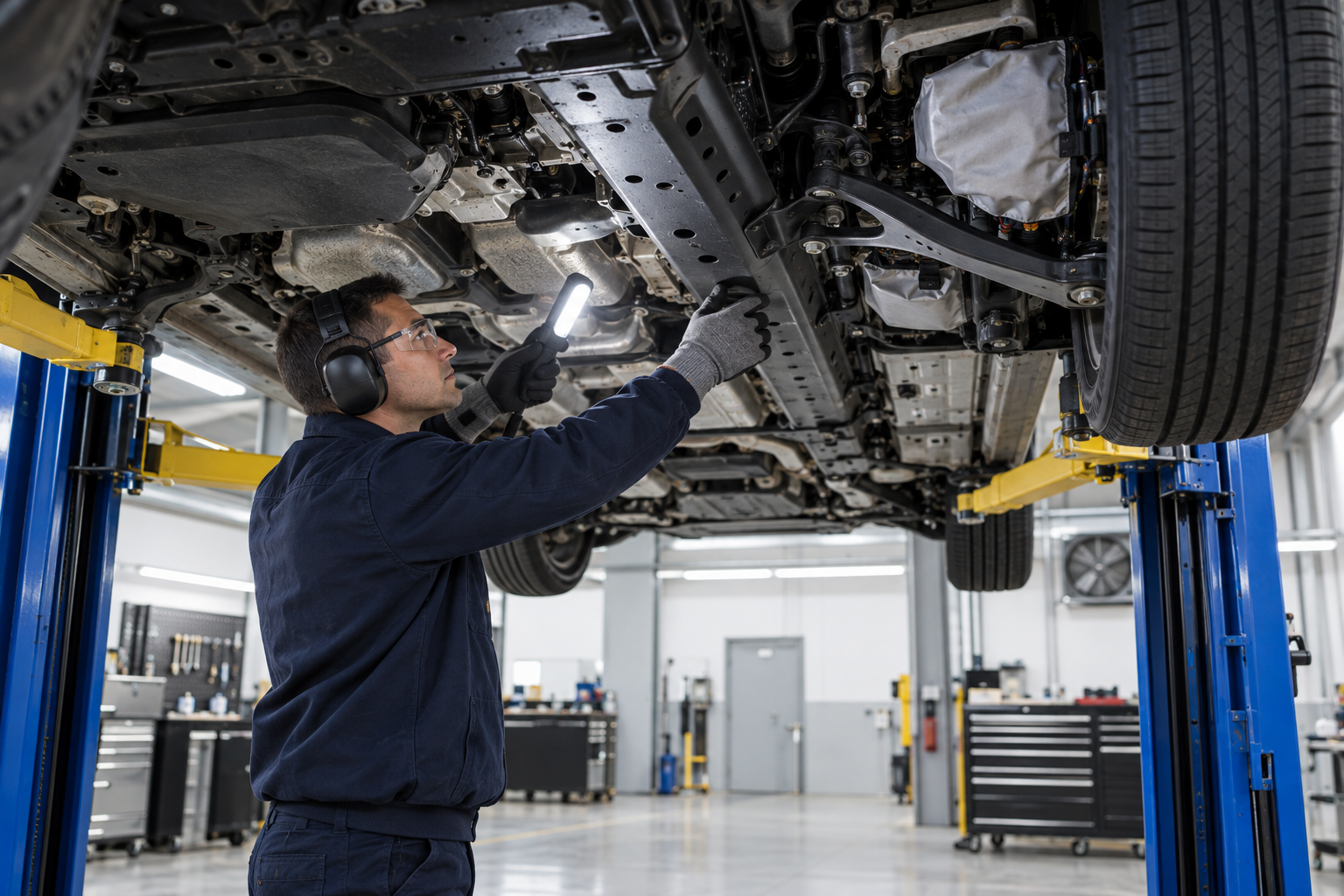
This surface-first approach also follows the broader rule in our guide to whether dry ice cleaning can damage surfaces: substrate, coating, contamination, and blast setup must be evaluated together.
Why Dry Ice Blasting Can Fit Underbody Cleaning
A named LandCruiser underbody demonstration documents grease, dirt, and grime, the cleaning setup, the cleaning pass, inspection, and a later protective-coating step. Separately, a manufacturer automotive restoration page identifies oil, grease, road grime, and cosmoline on undercarriages as application targets. These sources establish a real use; they do not establish one universal recipe or a transferable cleaning time.
The mechanism explains both the fit and the limit. Compressed air accelerates dry ice particles. Impact and local thermal effects help release adhered contamination, then the carbon dioxide sublimates. The peer-reviewed process paper treats cleaning performance as an optimization problem, not a fixed property of the medium. That is why nozzle, delivered air, media rate, distance, angle, and dwell belong in the job record.
Sublimation removes persistent blast-medium cleanup. It does not make the removed grease, oil, dirt, or coating fragments disappear. Those materials still need containment, identification, and disposition. US shops should compare the actual residue with EPA used-oil guidance; other jurisdictions may classify it differently.
For a fuller explanation of particle impact and sublimation, see the dry ice cleaning machine working-principle guide.
Preserve and Remove Are Different Jobs
“Non-abrasive” is not a promise that every coating will remain. Public automotive material shows the contradiction clearly: underbody cleaning may be used to preserve sound surfaces, while a separate 1970 Plymouth demonstration intentionally uses dry ice for undercoating removal.
The correct conclusion is not that one demonstration cancels the other. It is that coating adhesion, age, condition, temperature, and blast setup matter. A preservation job must identify paint, wax, seam sealer, markings, and underseal that must remain. A stripping job needs a separate removal specification, capture plan, and substrate acceptance criterion.
Rust is another boundary. A named 4Runner detailing demonstration assigns dry ice to wheel-well contamination and a separate process to rust. Dry ice can expose corrosion hidden by grime, but exposure is not removal or neutralization. The endpoint distinction is covered in more detail in can dry ice blasting remove rust.
Pass the Pre-Trigger Shop Gate
The vehicle, lift, atmosphere, operator, and waste route must all be ready before blasting.
- Support the vehicle under the lift and vehicle manufacturers’ procedures. Treat lift operation as its own trained task; the Automotive Lift Institute’s lift-user guidance is a useful US industry reference.
- Stop and cool the vehicle. Apply the shop’s applicable energy-control procedure. Do not work around a fuel leak, refrigerant leak, hot exhaust, rotating component, or unisolated high-voltage system.
- Inspect the proposed surfaces. Reject unknown coatings, loose corrosion, damaged underseal, and any surface whose preservation cannot be verified.
- Protect brake friction surfaces, bearings, seals, boots, wiring, connectors, labels, sensors, fuel-system parts, and high-voltage components. Protection does not authorize blasting them.
- Provide ventilation and assess carbon-dioxide exposure. The NIOSH carbon-dioxide entry identifies inhalation, asphyxiation, and cold-contact hazards associated with carbon dioxide and dry ice.
- Assess actual task noise and use the site hearing program. Wear eye and face protection, hearing protection, insulated gloves, protective clothing, and safety footwear suited to the risk assessment.
- Route the blast hose so it cannot pull across the lift, vehicle, access path, or technician. Establish an exclusion zone and a contained collection surface beneath the work.
These controls supplement, not replace, the broader dry ice cleaning machine safety checklist.
Qualify One Representative Test Zone
Do not start with the most visible panel or the most fragile coating. Choose a representative, durable area that contains the real contaminant and is outside every exclusion zone.
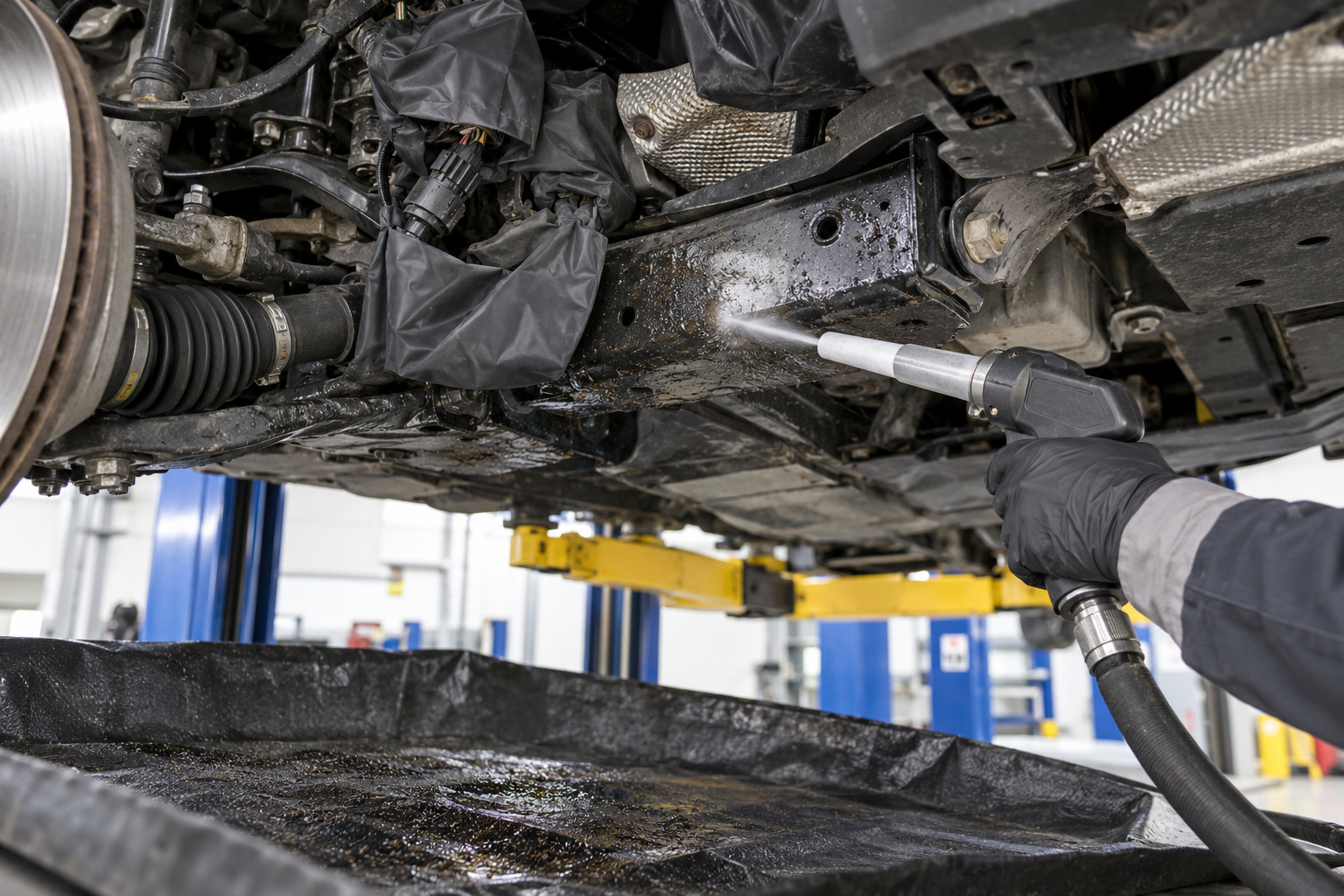
- Photograph and describe the starting condition. Record the surface, coating, contamination, temperature, and nearby exclusions.
- Define acceptance before cleaning. State what must be removed, what must remain, how residue will be collected, and who releases the surface.
- Record the complete setup: machine, nozzle, delivered air, media size and rate, distance, angle, dwell, ventilation, and protection method.
- Begin with the least aggressive compatible setting allowed by the equipment and task plan. Change one variable at a time.
- Stop immediately for coating lift, texture change, marking loss, seal disturbance, moved lubricant, connector exposure, unexpected debris, leak evidence, or uncontrolled residue migration.
- Inspect under production lighting after the surface returns to a stable temperature. Compare the result with the written acceptance criteria, not a marketing photograph.
- Expand only after the vehicle owner and shop authority accept the test. Preserve the recipe and excluded-zone map with the job record.
If water tolerance, drainage, and drying are the primary decision variables, compare this protocol with dry ice blasting versus pressure washing.
Turn the Trial into a Buyer Specification
A useful equipment request describes the task, not just machine pressure. Give suppliers the representative contaminant, surface list, coating-preservation requirement, exclusion map, access geometry, available compressed-air delivery, ventilation, expected duty cycle, waste-capture method, and acceptance test.
Ask the supplier to demonstrate the proposed machine, applicator, and nozzle on the representative zone. Record delivered pressure and flow at the machine, not only compressor nameplate values. Compare controllability at the accepted setting, hose reach, operator ergonomics, media consumption during trigger-on time, service support, and the complete system needed to reproduce the result.
Reject a proposal that replaces a controlled trial with a universal “safe for all surfaces” claim. The useful purchase is the system that can repeatedly meet the accepted underbody condition without crossing the exclusion boundary.
FAQ
Can dry ice blasting remove underbody grease and road grime?
Yes, documented automotive examples support grease, oil, dirt, and road-grime cleaning on selected underbody surfaces. The shop still needs a surface-specific trial and capture plan.
Will it remove rust?
Do not specify dry ice cleaning as corrosion removal. It may reveal rust beneath contamination, but rust treatment and the required surface-preparation endpoint are separate decisions.
Will factory undercoating remain?
Not automatically. Automotive demonstrations include both preservation-oriented cleaning and intentional undercoating removal. Test the actual coating and state whether it must remain.
Is there no waste because the dry ice sublimates?
The dry ice does not remain as blast media. Removed oil, grease, dirt, corrosion particles, and coating fragments do remain and require collection and appropriate disposition.
Can a technician blast the whole underside once a test passes?
No. A passed test applies to the documented surface, contaminant, coating condition, and setup. Brake parts, seals, bearings, wiring, fuel-system parts, high-voltage components, labels, and other exclusions remain outside the authorization.
Sources
- Aussie Arvos: LandCruiser underbody dry ice blasting demonstration
- Cold Jet: automotive detailing and restoration application page
- DRY ICE AUTOS: undercoating-removal demonstration
- I AM Detailing: dry ice wheel-well cleaning and separate rust-removal process
- Wear / Elsevier: dry-ice blasting process, optimization, and application
- Automotive Lift Institute: safe vehicle-lift use
- NIOSH: carbon dioxide hazard information
- US EPA: used-oil management questions for businesses