
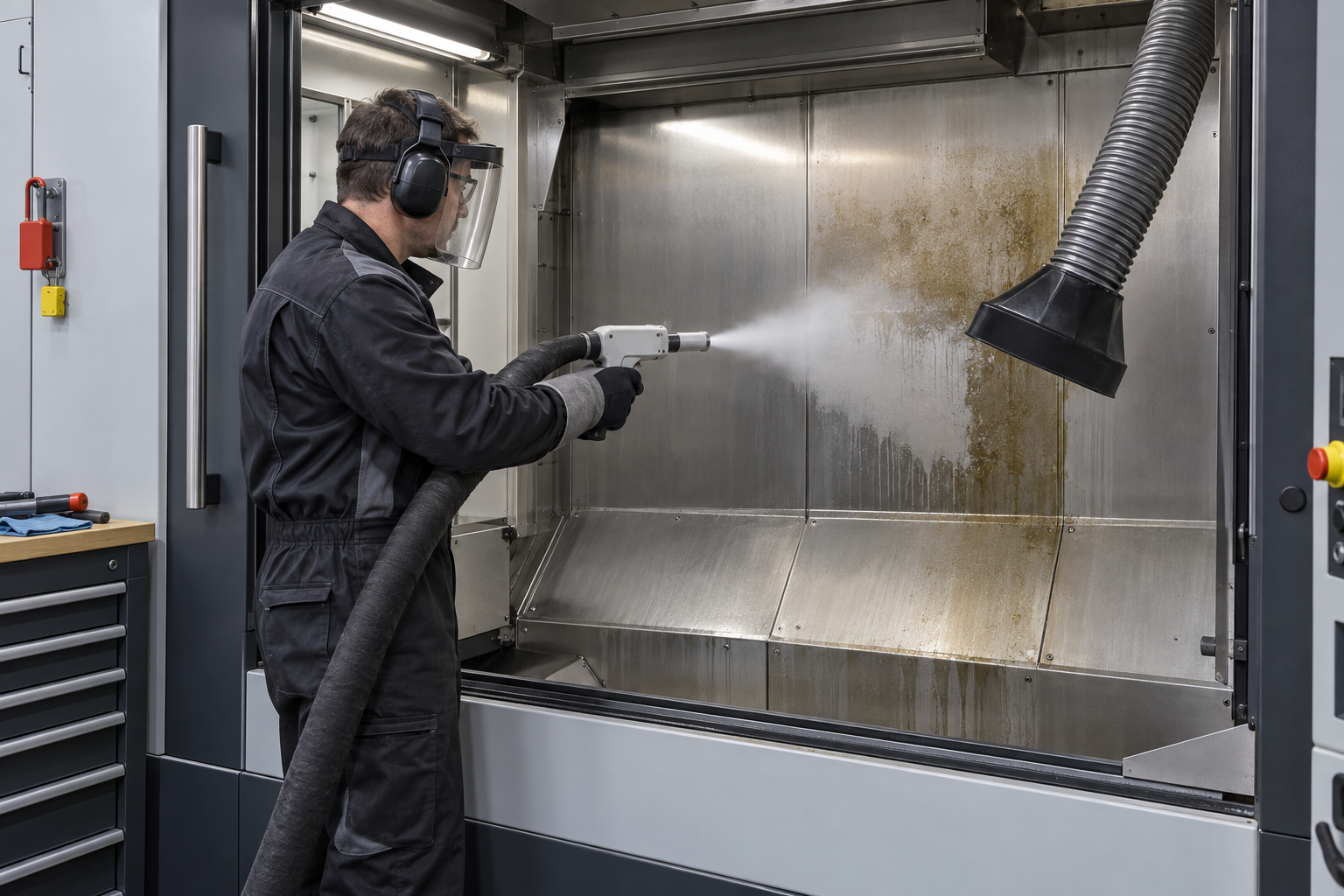
Dry ice blasting can remove approved coolant, oil, and grime from mapped CNC enclosure surfaces after loose chips are removed, but it should not be used on precision, lubricated, sealed, sensing, or electrical components unless the machine OEM explicitly approves the procedure.
That boundary is the buying decision. A dry process can be useful for adhered residue on broad enclosure panels and guards. The same compressed-air stream can also move chips into a rotary interface, strip wanted lubricant, or carry contaminated fluid residue toward a protected component. The machine’s documented condition is the invariant; the blast setup is only one controlled cleaning method.
Define the CNC Cleaning Boundary
A named contractor CNC case describes hardened coolant-and-oil slurry on machine surfaces. A separate machine-shop demonstration from Cold Jet shows dry ice cleaning oils, grease, and carbon buildup. These sources establish a real application, but they do not make every surface inside a CNC machine blast-safe.
Start with a surface map approved against the actual machine manual.
| Condition | Dry ice blasting role | Separate maintenance route |
|---|---|---|
| Adhered coolant film, oil, or grime on an approved painted or stainless enclosure panel | Candidate for a controlled trial | Define finish and residue acceptance first |
| Loose chips or stringy swarf | Remove before blasting | Use the OEM-approved brush, chip conveyor, vacuum, or other method |
| Spindle taper, linear way, bearing, rotary platter interface, seal, encoder, sensor, or lubrication point | Exclude unless the OEM approves a written procedure | Follow component-specific maintenance instructions |
| Electrical cabinet or energized wiring | Outside this application | Qualified electrical service under the site’s energy-control process |
| Coolant-tank odor, microbial growth, concentration drift, or blocked circulation | Cleaning the enclosure does not resolve it | Service the coolant system and fluid-management program |
| Alignment, backlash, accuracy, damaged window, failed seal, or machine fault | Cleaning may expose the condition but cannot correct it | Inspect, repair, and verify through the OEM service route |
This is narrower than a generic claim that dry ice can clean a whole CNC machine. It also differs from routine dry ice cleaning machine maintenance: one maintains the blaster, while the other qualifies a cleaning process for the CNC asset.
Remove Loose Chips Before Blasting
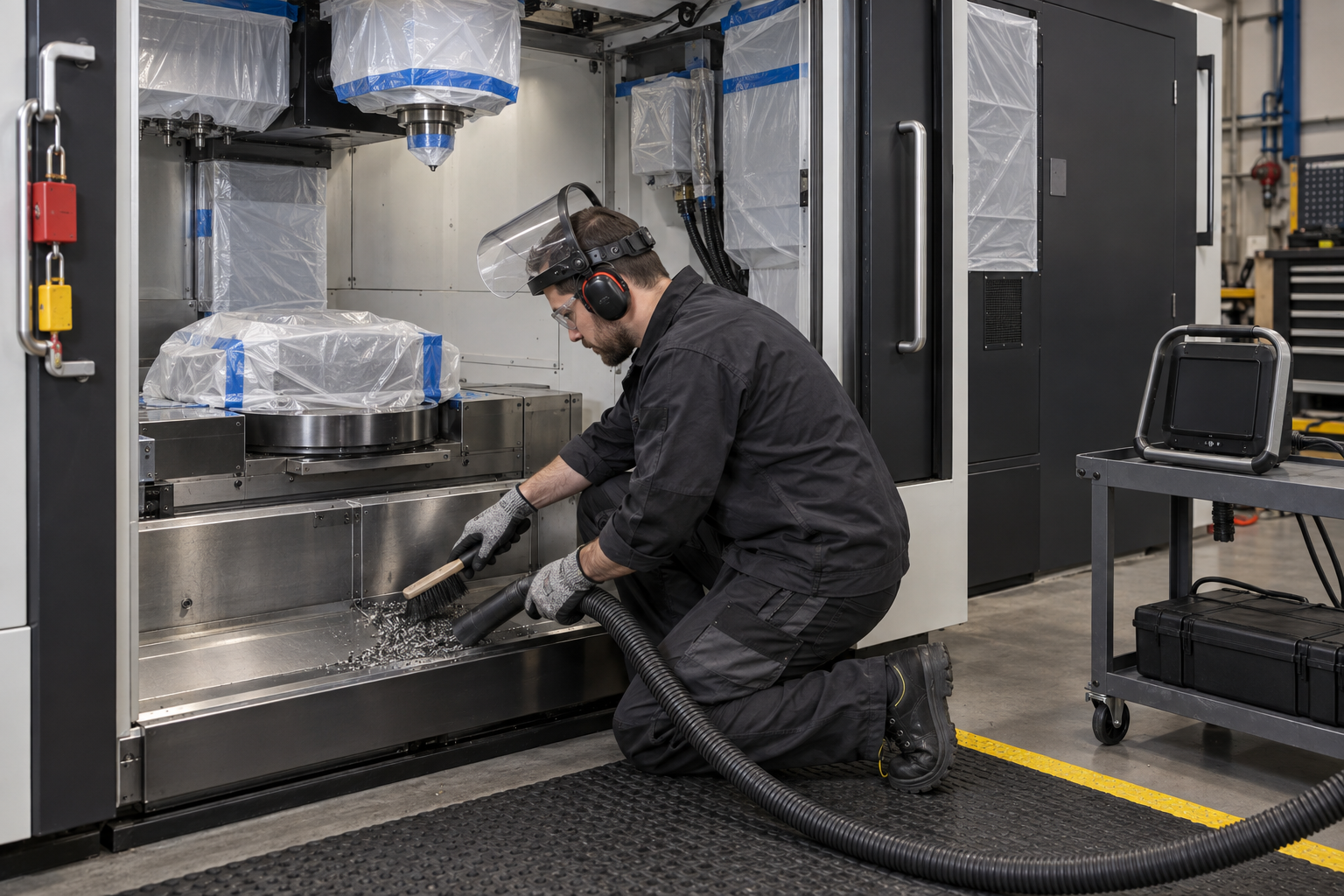
Loose swarf is not just another contaminant. It can become a moving projectile or be driven into an interface that the machine depends on.
Haas rotary troubleshooting guidance states that compressed air can push metal chips under a brake plate and platter. Haas instructs users to brush chips away around that component before later cleanup. The instruction is component-specific, but the decision rule is general: an air-driven cleaning method must not start until loose chips are removed and every no-air zone is identified.
Do not infer permission from an open door or an accessible surface. Protect spindle openings, guideways, seals, sensors, cable penetrations, lubrication points, rotary interfaces, and any component the OEM excludes. If the blast path or rebound can reach one of those areas, revise the setup or reject the method.
Understand the Residue and Waste Boundary
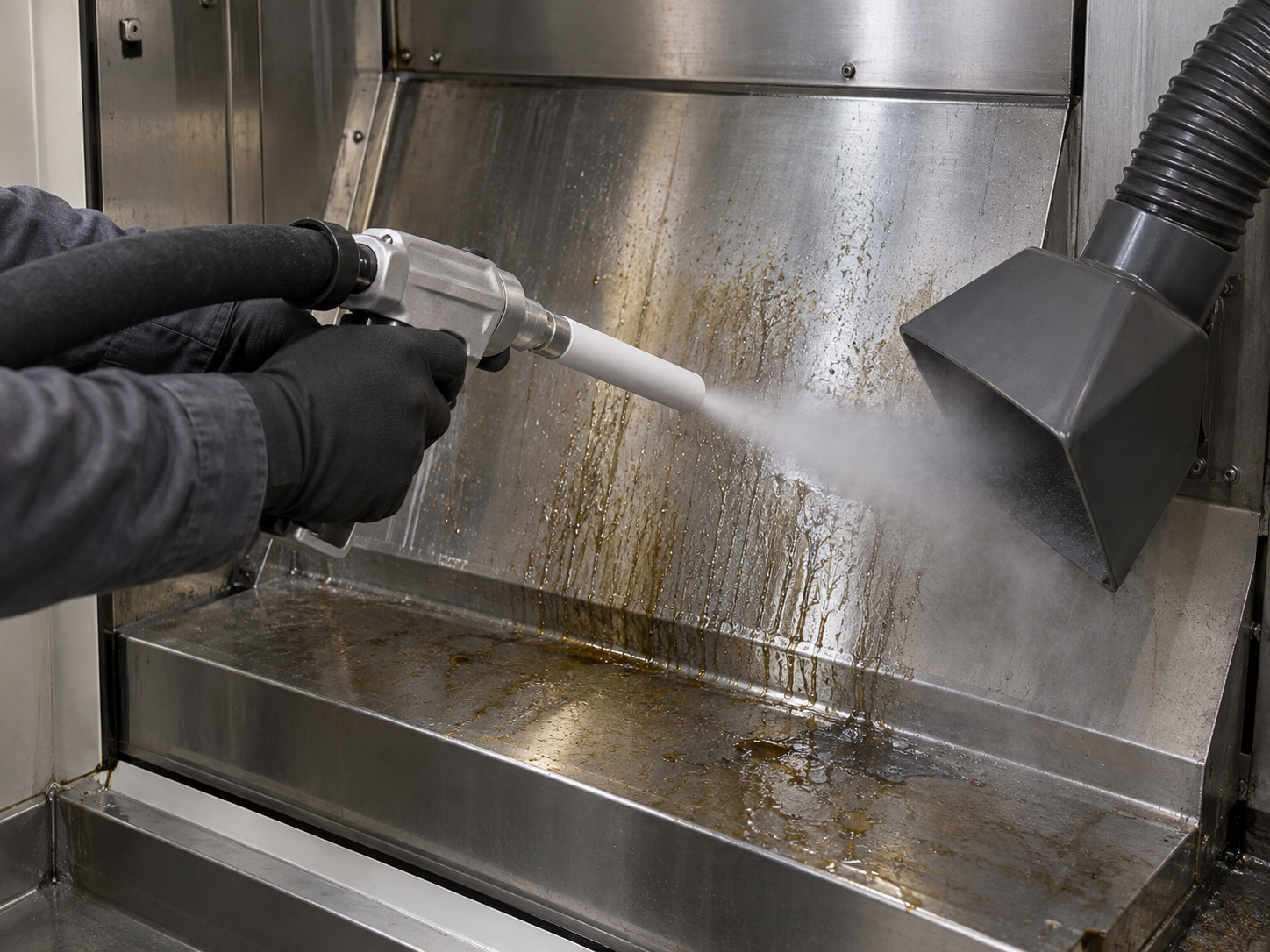
Peer-reviewed dry ice cleaning research treats the process as an application-specific combination of equipment and settings. Compressed air accelerates solid carbon-dioxide particles. Impact and local thermal effects help release contamination, and the dry ice sublimates after contact.
Sublimation eliminates a persistent blasting medium. It does not eliminate the removed coolant, oil, grime, or fine debris. Capture still matters.
OSHA’s metalworking-fluid guidance notes that these fluids can contain additives and contaminants and that poorly managed exposure can affect the skin, eyes, nose, throat, and respiratory system. The cleaning plan therefore needs to identify the fluid from its safety data sheet, control contact and aerosolized residue, and collect the released material for the site’s disposal route. Calling the process dry does not make the contaminant inert.
Authorize the Machine State Before the Trigger
The CNC machine and the blaster create separate hazards. Both control sets must pass.
Haas CNC safety guidance separates operation, maintenance, and service. It describes chip cleaning with machine operation stopped and requires trained personnel, appropriate protective equipment, and a defined cleaner-entry state. That is an OEM example, not a universal procedure; the manual for the actual machine controls.
Where unexpected startup, movement, or stored electrical, pneumatic, hydraulic, gravity, or spindle energy can expose a worker, apply the site’s hazardous-energy procedure. OSHA’s lockout/tagout standard is the US reference; local requirements may differ. An emergency stop, program stop, open door, or control-power command is not a substitute when the energy-control procedure requires isolation and verification.
The blast process also needs:
- ventilation and carbon-dioxide assessment;
- eye and face protection, hearing protection, insulated gloves, protective clothing, and safety footwear;
- a controlled hose route and exclusion zone;
- debris extraction or capture that cannot contact precision components;
- confirmation that no combustible-metal-dust atmosphere or other prohibited condition exists.
NIOSH identifies dry ice as solid carbon dioxide and lists inhalation, asphyxiation, and frostbite hazards. A visible vapor cloud is not an exposure measurement. Use the site’s assessment and monitoring plan.
For a broader pre-start framework, see the dry ice cleaning machine safety checklist. The CNC authorization adds the machine-specific energy, access, chip, fluid, and protected-component boundaries.
Run a Mapped-Surface Trial
Use a representative machine and residue. A flat coupon cannot approve a coated enclosure corner beside a seal or sensor.
- Record the machine model, manual revision, fluid, residue, surface, coating, and pre-cleaning condition.
- Mark approved zones and explicit exclusions. Remove loose chips by the OEM method and verify the work area again.
- Authorize the machine state, ventilation, carbon-dioxide controls, personal protection, extraction, and hose route.
- Record the blaster, delivered air, particle feed, nozzle, distance, angle, dwell, and surface temperature. The facility must meet the selected machine’s airflow, pressure, and air-quality requirement.
- Start on a bounded approved panel. Inspect frequently for coating change, residue movement, lubricant loss, moisture, or rebound toward an exclusion zone.
- Collect the released residue. Inspect the cleaned surface, guards, seals, sensors, lubrication points, and adjacent interfaces before expanding the zone.
- Complete the OEM return-to-service checks and verify the defined machine condition before production.
Stop if residue is being driven into a joint, cleaning is not progressing, the finish changes, a protective cover moves, the nozzle cannot be controlled, carbon-dioxide or noise controls fail, or the machine state leaves the approved boundary. A conservative setup that fails acceptance is a rejection, not permission to keep increasing aggression.
The same trial logic is explained in the surface-damage test guide. For CNC equipment, the acceptance record must include protected precision and lubrication functions, not only appearance.
Specify the System Around the Accepted Zone
After the trial passes, convert it into a purchase or service specification:
- approved machine models, surfaces, residues, and access states;
- explicit no-blast components and loose-chip prerequisites;
- the accepted nozzle, particle delivery, air condition, standoff, angle, and dwell;
- ventilation, extraction, carbon-dioxide assessment, noise control, and personal protection;
- setup records, operator training, inspection, maintenance, and stop authority;
- responsibility for fluid identification, waste collection, OEM approval, and return to service.
Compare ownership, rental, and contract cleaning on the accepted-work boundary, not on machine price alone. The complete dry ice cleaning machine cost guide explains why air supply, media logistics, controls, labor, and validation belong in the same budget.
FAQ
Can dry ice blasting remove loose CNC chips?
Do not make loose-chip removal the blast objective. An OEM explicitly warns that compressed air can drive chips into a rotary interface. Remove swarf first by the machine-approved method, then consider dry ice only for mapped adhered residue.
Can the process clean spindle tapers, ways, bearings, or rotary tables?
Not under a general enclosure-cleaning approval. These are precision, lubricated, sealed, or component-specific areas. Use the OEM maintenance procedure unless the OEM approves a written dry ice method for that exact component.
Does sublimation mean there is no cleanup?
No. The dry ice does not remain as blast medium, but the released coolant, oil, grime, and debris remain. Capture and disposal are part of the process.
Can the CNC stay powered during cleaning?
Only the machine owner can define the authorized state from the actual manual, risk assessment, and energy-control procedure. When unexpected startup or stored energy can expose a worker, use the required isolation and verification process.
The final decision is narrow: dry ice blasting can be qualified for adhered residue on approved CNC enclosure surfaces after loose chips are removed. Precision interfaces, lubrication, coolant management, electrical work, repair, and accuracy verification remain separate OEM-controlled work.
Sources
- Premium Plant Services: Dry Ice Blasting for CNC Machines
- Cold Jet: Cleaning Machine Shop Tools, Motors & Equipment
- Haas Automation: Lathe Operator’s Manual – Safety
- Haas Automation: Rotary Troubleshooting Guide
- Wear: Dry-Ice Blasting for Cleaning
- OSHA: The Control of Hazardous Energy
- OSHA: Metalworking Fluids – Health Effects
- NIOSH: Carbon Dioxide