
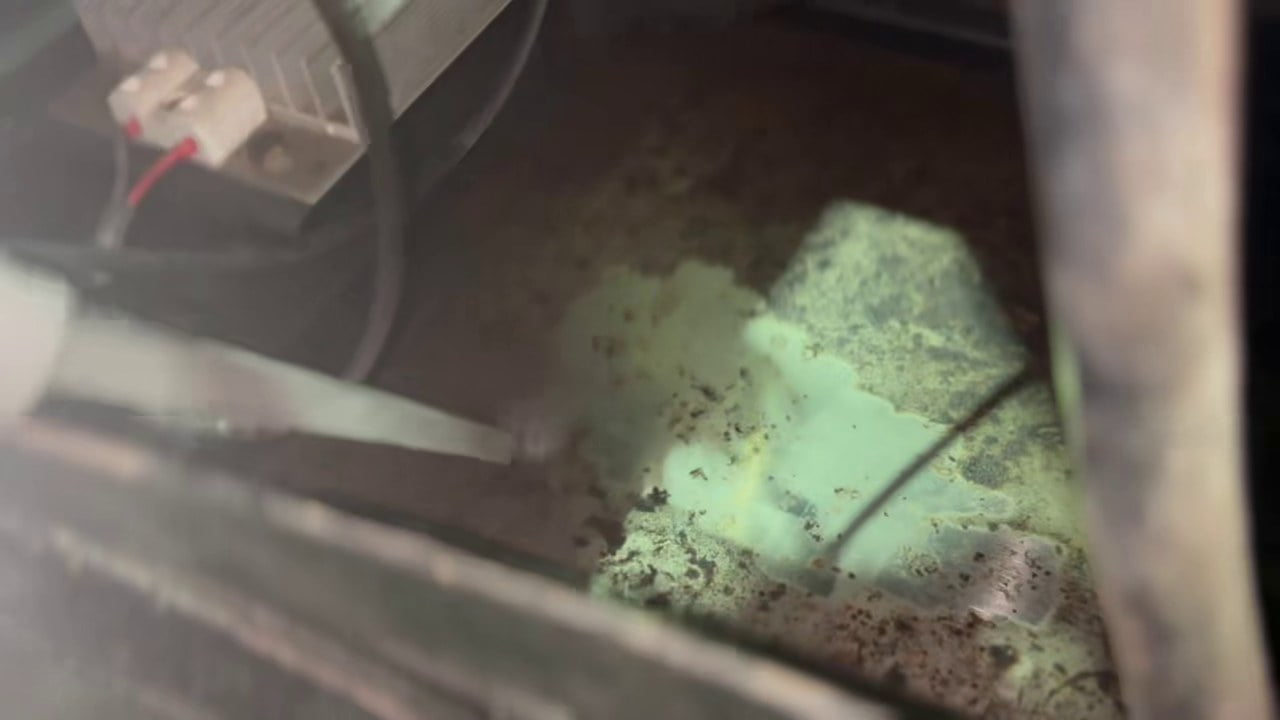
Dry ice cleaning is often described as non-abrasive, but that does not make every surface immune to change. A stable metal substrate may remain intact while weak paint lifts, an aged seal moves or a cosmetic finish loses gloss. The correct answer is conditional: dry ice cleaning can preserve many substrates, but suitability must be proved for the complete substrate, coating, contaminant and blasting setup.
The practical buying question is therefore not, “Will a dry ice cleaning machine damage surfaces?” It is, “What must this exact trial preserve, what must it remove, and which result will stop the test?”
Non-abrasive is a process property, not an acceptance result
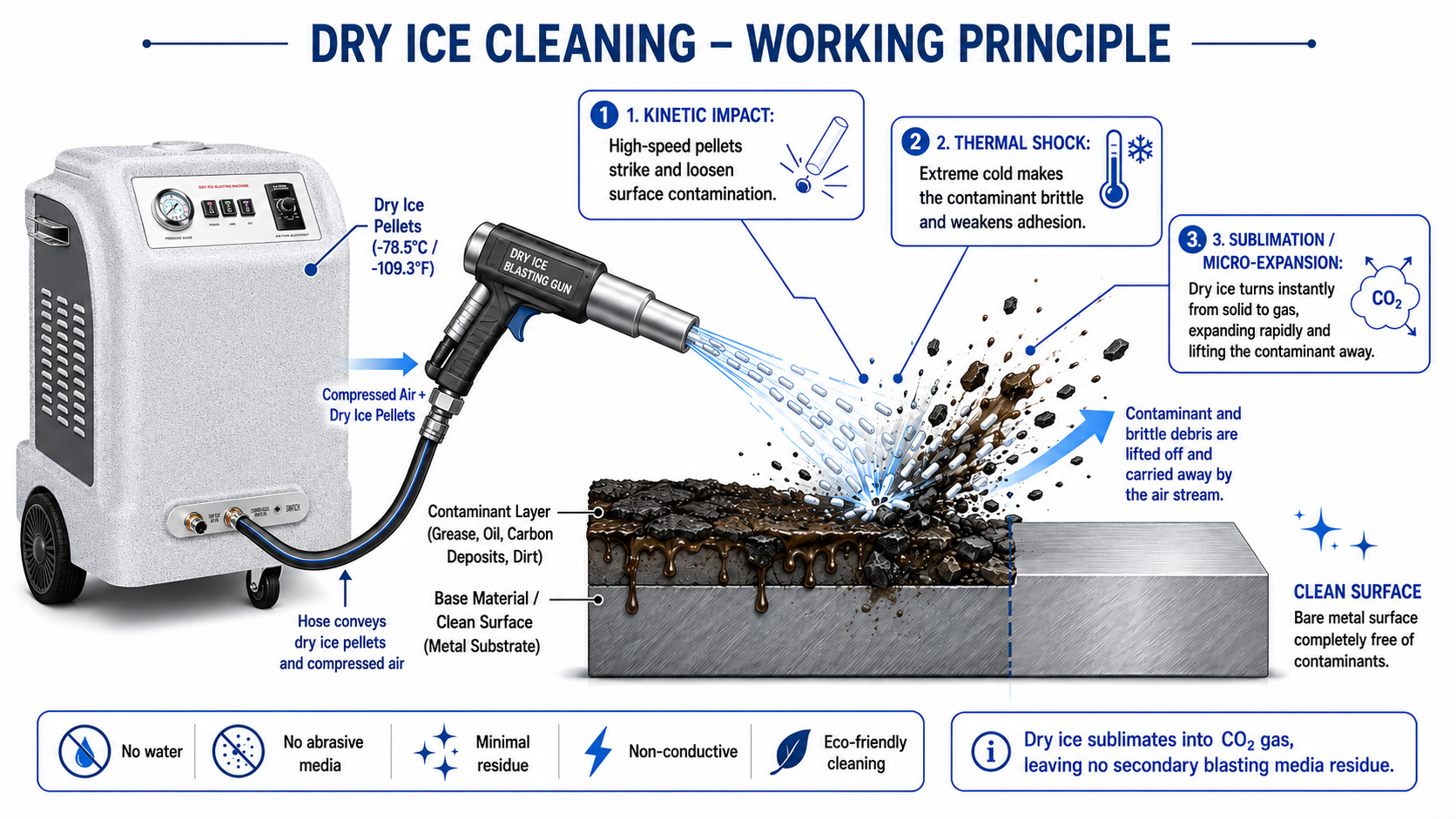
Dry ice blasting uses compressed air to accelerate solid carbon dioxide particles through a nozzle. The particles strike the contamination, cool that layer and then sublimate. These effects help break the bond between the contamination and the underlying surface. The dry ice does not remain as spent blast media.
Calling the medium non-abrasive is useful when comparing it with sand, grit or another hard media. It is not a universal no-change guarantee. The cleaning stream still transfers energy. It is also acting on a system that may include a substrate, primer, paint, plating, adhesive, gasket and pre-existing corrosion. Each layer can have a different bond strength and acceptance requirement.
This distinction resolves an apparent contradiction in supplier literature. Dry ice cleaning is presented as a way to protect substrates, yet it is also used to remove failing paint, surface rust and other bonded material. Both statements can be true. “Substrate” and “everything visible on the substrate” are not the same fact.
The substrate, coating and contaminant are three decisions
Start by naming the layers instead of writing “surface” on a test sheet.
Substrate
Record the base material, grade where relevant, thickness, geometry and existing defects. Thin sections, edges, soft materials, precision features and aged components deserve separate acceptance criteria. A hidden area may be useful for an initial screen, but it is not representative if its material, coating or exposure history differs from the production area.
Coating, finish and seals
Identify paint, primer, plating, labels, adhesive joints, gaskets and seals that must remain. Cold Jet’s technical FAQ says dry ice can remove failing or weakly bonded paint and that paint-removal performance depends on adhesion, paint and primer. A Porsche Club of America practitioner report likewise notes that paint may flake where corrosion exists underneath it. Those observations do not prove that every coating will lift. They show why coating condition belongs in the test definition.
Define preservation in observable terms. Depending on the part, that may mean no lift at an edge, no change in gloss, no visible whitening, no seal movement, no loss of label legibility or no dimensional change at a measured feature.
Contaminant
State what must be removed and what may remain. Oil film, carbon deposit, release agent, adhesive, loose paint and corrosion are different targets. Dry ice blasting alone can remove loosely adhered or surface rust, but manufacturer and practitioner guidance both set a boundary at deeply pitted corrosion. The same process also does not create the abrasive surface profile that some coating specifications require.
Do not merge a hybrid dry ice-plus-abrasive process into this decision. Adding an abrasive changes the process generator and its surface effect. Results from that equipment do not establish what standard dry ice cleaning will do.
Record the whole blasting setup
The trial record must make the result reproducible. Identify the machine and delivery configuration, dry ice form, particle size and condition, nozzle type, and delivered air pressure under flow. Then record the work geometry: standoff distance, blast angle, traverse pattern, pass count and time over the area. Complete the baseline with the starting part condition, contaminant condition and any ambient or part conditions that matter to the application.
These are not fields for administrative completeness. They define the applied process. In a Japan Society of Mechanical Engineers electrode-cleaning study, residual contamination changed when blasting pressure and dry ice pellet diameter changed. That result is scoped to the reported electrode experiment, not a universal setting table. Its useful lesson is structural: if two trials change several inputs at once, the cleaning result cannot be assigned to one cause.
Begin with the least aggressive practical setup recommended for the machine and application. Hold the other variables constant and change one selected variable at a time. A setting copied from another material, nozzle or contaminant is a starting hypothesis, not an approved production recipe.
A surface trial must have a rejection rule
A demonstration that looks clean is not yet a validation. Use a staged protocol.
- Define the test unit. Select a coupon, rejected part or representative area with the same substrate, coating, condition and contamination as production. Record why it is representative.
- Write acceptance criteria first. Specify the cleanliness required and the substrate, finish, seal or function that must remain unchanged. Choose an inspection method appropriate to the consequence: visual comparison, gloss reading, microscopy, dimensional check, adhesion check, electrical test or another controlled method.
- Document the baseline. Use consistent lighting, scale and camera position for photographs. Record existing scratches, coating lift, corrosion and contamination distribution so pre-existing defects are not assigned to the cleaning step.
- Run a bounded first pass. Use the recorded setup on a small area. Keep people and adjacent equipment outside the controlled work zone. Collect the removed contamination; the dry ice sublimates, but paint, oil, dust and corrosion products do not disappear.
- Inspect before increasing energy or coverage. Stop when coating lifts, gloss or texture changes, a seal moves, a precision feature changes, contamination spreads into a protected area or any predefined rejection condition appears. Do not increase pressure simply because the first pass did not remove the target.
- Confirm repeatability. Repeat the accepted setup on more than one representative location or part. Production approval should state the allowed setup window, inspection frequency and response when incoming condition differs from the trial.
The removal criterion and preservation criterion must both pass. A clean part with a damaged finish fails. An unchanged finish with unacceptable residue also fails.
Approval is conditional and bounded
A passed trial authorizes only the material condition, process window and acceptance criteria that were actually tested. It does not prove every part with the same material name, every aged coating or every operator technique. Re-test when the substrate, coating supplier, contamination, machine, nozzle, dry ice form or work method changes materially.
Surface validation also does not close the safety case. Dry ice is solid carbon dioxide, and blasting uses compressed air. Ventilation, carbon dioxide assessment, cold-contact protection, eye and hearing protection, hose and coupling inspection, contaminant controls and hazardous-energy isolation remain separate requirements. Use the dedicated dry ice cleaning machine safety checklist for that decision.
The defensible conclusion is measured: dry ice cleaning can preserve many underlying surfaces because the medium is softer than conventional abrasive media, but the complete surface system decides the outcome. Approve the application only when a representative, recorded and repeatable trial meets both cleanliness and preservation criteria. DryIceSys can help define a machine, nozzle and application trial through the project enquiry form.
Sources and further reading
- Cold Jet: Dry Ice Blasting Solutions
- Cold Jet: Dry Ice Blasting Frequently Asked Questions
- Japan Society of Mechanical Engineers: The Effect of Blasting Conditions on Dry-Ice Blast Cleaning
- Porsche Club of America: I Cleaned My Porsche’s Underbody with Dry Ice
- Laserax: Disadvantages of Dry Ice Blasting
- NIOSH Pocket Guide: Carbon Dioxide