
A dry ice cleaning machine uses compressed air to accelerate solid carbon-dioxide pellets or smaller particles toward a contaminated surface. The equipment is important, but it is only one part of the process. Cleaning performance also depends on the air supply, media quality, hose and nozzle, contaminant, substrate and operator settings.
That distinction matters. Dry ice cleaning is often described as a process in which the cleaning media “disappears.” The dry ice does sublimate, but the contamination removed from the surface does not. A sound application plan must address both the cleaning mechanism and what remains afterward.
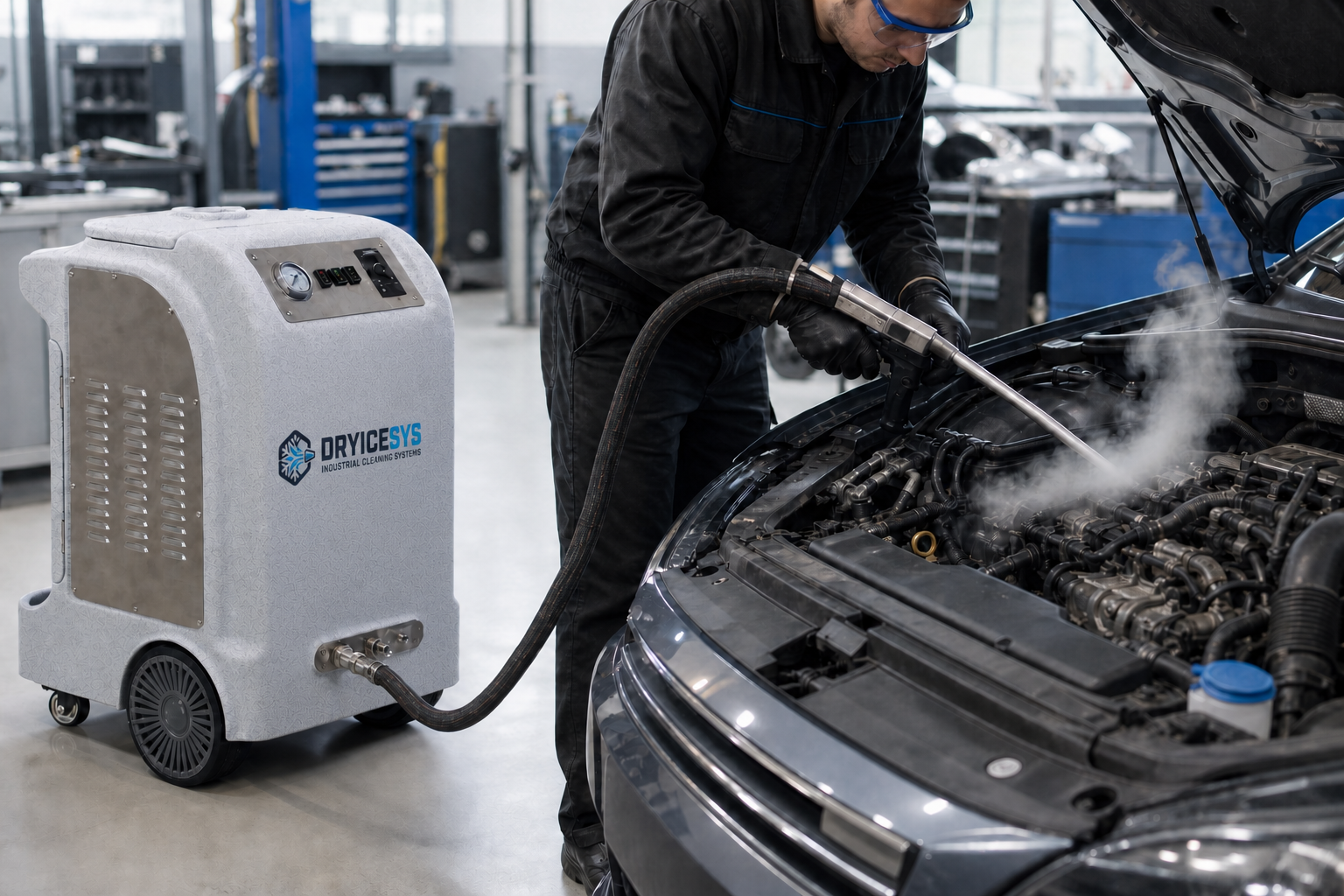
What is inside a dry ice cleaning system?
The machine receives compressed air and meters dry ice into the airflow. The resulting air-and-media stream travels through an insulated blasting hose to a hand-held or automated nozzle. At the surface, the process removes contamination without adding water or conventional abrasive grit.
A practical system normally includes:
- a dry ice hopper and controlled feed mechanism;
- an air-management and pressure-control section;
- a blasting hose, gun and application-specific nozzle;
- a reliable compressed-air source with suitable pressure, flow and quality;
- dry ice with the particle size and condition required by the machine;
- ventilation, personal protective equipment and residue-control measures.
The compressed-air requirement deserves early attention. A machine selected without checking available airflow may operate below its intended cleaning range. Long air lines, undersized pipework, moisture and pressure loss can also change the result at the nozzle.
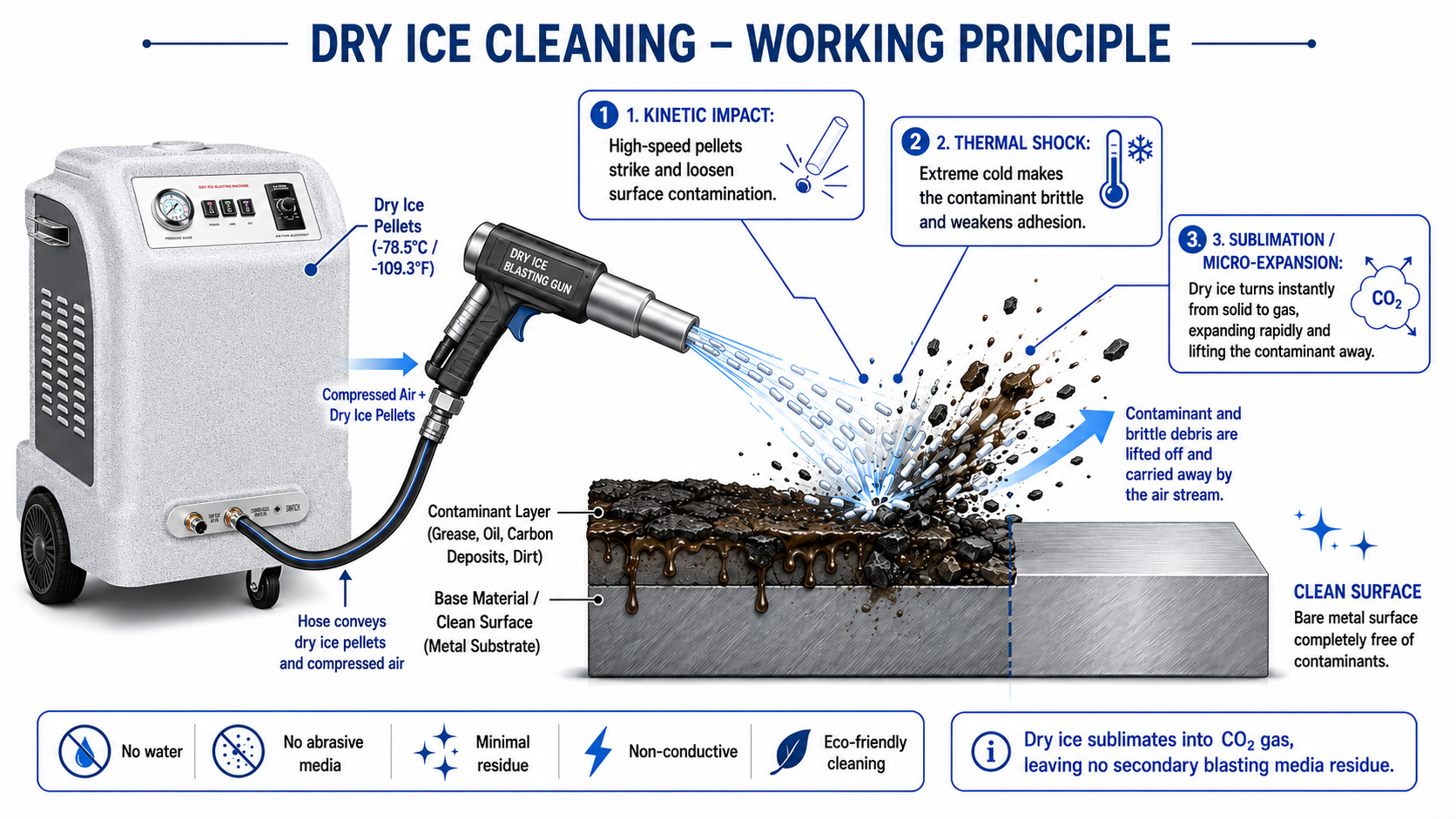
The working principle: three effects at the surface
Dry ice cleaning is commonly explained through three interacting effects. Their relative contribution changes with the contaminant and the selected operating parameters.
1. Kinetic impact
Compressed air accelerates dry ice particles through the nozzle. When they strike the contamination, their momentum helps fracture, loosen or shear the unwanted layer. Nozzle geometry, stand-off distance, impact angle, air pressure and media feed all influence this action.
More impact is not automatically better. A delicate coating, soft substrate or precision surface may require lower settings and a different nozzle. The target is controlled removal, not maximum aggression.
2. Localized thermal effect
Dry ice is extremely cold. Contact can create a rapid local temperature difference between the contamination and the underlying substrate. Because materials respond differently to temperature change, this can weaken the bond at the interface and make the contamination easier to dislodge.
This effect is application-specific. The substrate, coating thickness, dwell time and temperature sensitivity must be considered. Parts with uncertain thermal response should be tested on a representative sample before production use.
3. Sublimation and expansion
After impact, solid carbon dioxide changes directly into gas. This phase change helps disturb loosened contamination at the interface, while the dry ice itself does not remain as spent blasting media.
The boundary is important: grease, paint, carbon, adhesive, production residue and other removed material still remain in the work area. They may fall, become airborne or require extraction. Collection and disposal should be based on the contaminant, not on the dry ice.
What the process does—and does not—eliminate
Dry ice cleaning can reduce the need for water, solvents and disposable abrasive media in suitable applications. It can also reduce disassembly when the equipment and safety assessment allow cleaning in place.
It does not eliminate every supporting task. The process still needs compressed air and dry ice. Operators must manage noise, flying debris, cold surfaces and carbon-dioxide exposure. Sensitive components may need masking, and removed contamination may require vacuum extraction or physical collection.
Carbon dioxide is heavier than air and can accumulate in low or enclosed areas. High concentrations can displace oxygen. Work planning should therefore include adequate ventilation, site-specific exposure assessment, appropriate monitoring where needed and trained operators using suitable PPE.
A first-pass application checklist
Before selecting a machine, define the cleaning problem in engineering terms:
- Contaminant: What must be removed—grease, carbon, adhesive, coating, release agent or process residue?
- Substrate: What material and finish must remain unchanged?
- Geometry: Are there deep cavities, sharp edges, sensitive seals or hidden surfaces?
- Acceptance criterion: Is the goal visual cleanliness, coating preparation, restored heat transfer or a measured production standard?
- Air supply: What pressure and flow are available at the machine during operation?
- Work environment: Is the area enclosed, low-lying, occupied or difficult to ventilate?
- Residue control: Where will the removed contamination go, and how will it be collected?
- Production constraint: How much access time is available, and can the equipment be cleaned online or must it be isolated?
The final decision should follow an application test using a representative part and realistic site conditions. A useful trial records cleaning time, dry ice consumption, air conditions, surface result and residue behavior. Those measurements are more valuable than a generic claim about cleaning speed.
DryIceSys can use this information to recommend a machine, hose, nozzle and operating configuration. Share the contaminant, substrate, compressed-air conditions and expected quantity through the project enquiry form.