
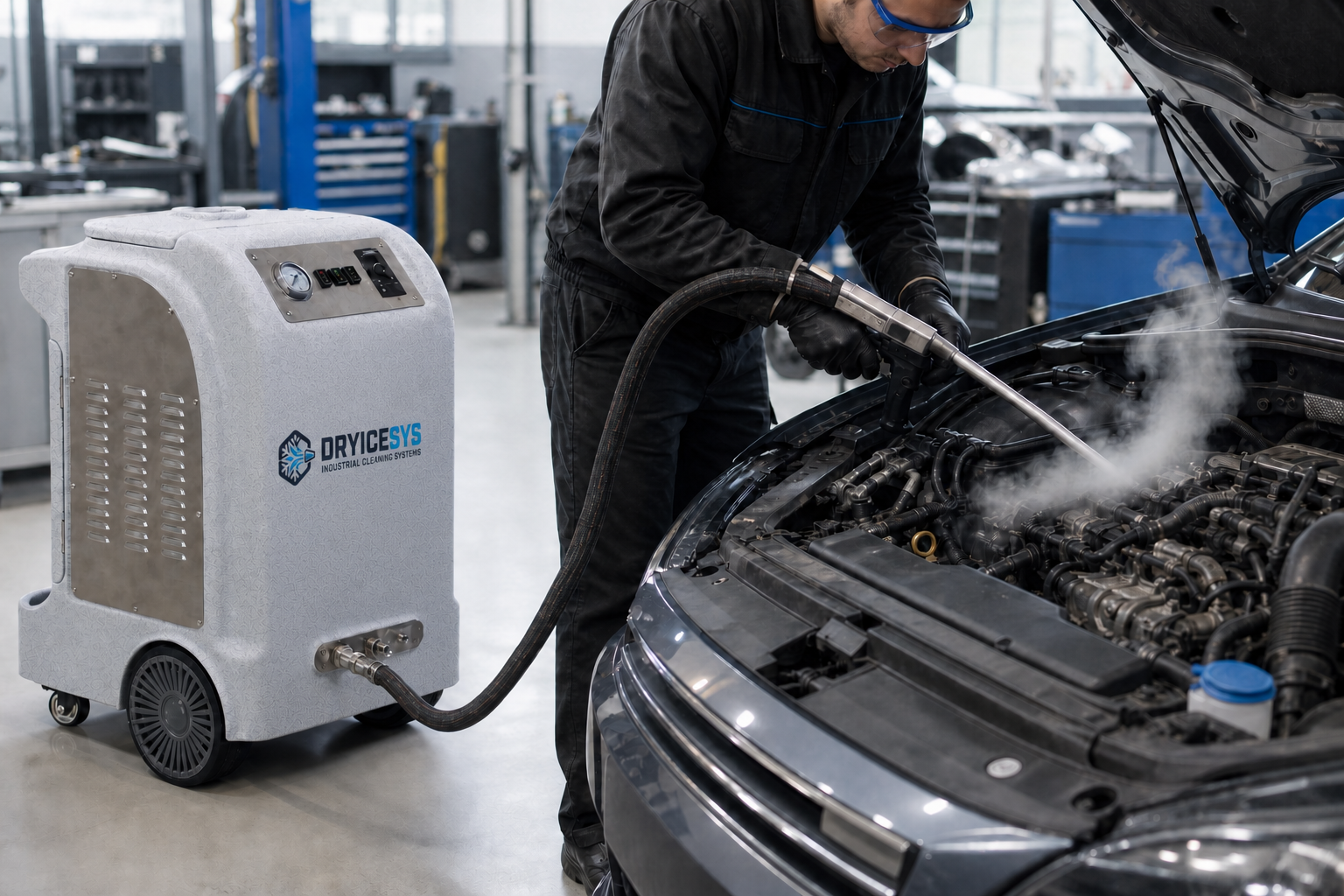
A dry ice cleaning machine needs a model-specific maintenance plan, not a generic daily, weekly and monthly table. Start with the current manual for the exact machine and revision. Separate work the operator may perform from work reserved for trained or authorized service personnel. Then record operating hours, condition and recurring symptoms against that schedule.
The shared outcome is simple: the machine should be empty of residual dry ice before a long stop, isolated from hazardous energy before hands-on work, inspected for damage and documented before it returns to service. The steps and intervals that produce that outcome are the change axis. They depend on the feeder, air system, controls and manufacturer.
The maintenance schedule belongs to the model
Current search results illustrate the problem. Google’s live US-English results for this topic showed a generic maintenance summary, but the same summary ended by asking for a brand and model before giving a schedule. Primary manuals explain why.
The Commando 40 manual specifies a pneumatic lubricator check and fill every 4 to 6 operating hours and a used-lubricant drain every 16 operating hours. The PHX-150 manual instead calls for a daily or shift-start inspection of separator moisture or contamination, lubricator level and hose condition, followed by separate filter, chain and airlock procedures when required. The Dry Ice Energy Champ manual limits user maintenance to hose and pressure-regulator inspection before and after use, assigns other work to service and specifies annual service for that model.
These are examples of different ownership rules, not a combined checklist. A web instruction such as “lubricate moving parts” is unsafe when it does not identify the component, lubricant, interval or permission boundary. If the manual does not assign a task to the operator, route it to the OEM or an authorized service provider.
Close every shift without leaving pellets in the feed path
The compared manuals share one practical outcome: residual dry ice should not remain in the machine during a long stop. Pellets can clump as they warm, and moisture can remain in the feed path. The correct clearing sequence is still model-specific.
For example, the Commando 40 manual says to empty the hopper and briefly blast air through the system for a stop longer than 15 minutes. The PHX-150 guide uses a separate overnight procedure: remove unused ice, expel remaining pellets, then complete its defined shutdown and venting steps. The Champ instructions say to run the container empty, continue blasting for about 10 seconds after pellets stop, relieve pressure in the stated order and leave the lid open so condensate can dry. Dry Ice Energy’s current support page also tells its users to use the machine’s back-blast function before opening the lid.
Follow only the sequence for the installed model. Do not borrow another machine’s purge time, back-blast control or valve order.
Separate operator inspections from service work
An ownership matrix prevents routine care from becoming unauthorized repair.
Before use
Confirm the machine model, serial number and current manual. Complete every pre-start item the manual assigns: this may include hose condition, secure fittings, the nozzle, grounding provisions, guards, filter or separator condition, lubricator level, control response and the specified air supply. A cut hose, damaged coupling, missing guard or defeated safety device is a stop condition, not an item to monitor until the next scheduled service.
Use a baseline rather than memory. Record normal inlet pressure under load, pellet flow and control behavior for the validated setup. A change from that baseline can justify inspection, but it does not identify the failed part by itself.
After use
Apply the model’s shutdown sequence. Remove or expel remaining dry ice, stop the air source, depressurize the system and isolate other energy sources before hands-on work. Manage separator drainage, filters, wiping or drying only as the manual directs. Inspect the hose, gun, nozzle and accessible connections after the machine has warmed enough for safe handling.
Do not pressure-wash a machine unless its documentation explicitly permits it. The Commando manual, for example, instructs users to clean with low-pressure compressed air or a moistened wiper and says not to pressure-wash that model.
Send service work across the boundary
Stop and request model-specific support for damaged pressure components, persistent leaks, repeated moisture, unexplained pressure loss, irregular feed after approved clearing, control or safety-device faults, recurring filter contamination or an unknown service history. Internal feeder, airlock, motor, chain, electrical and pressure-system work belongs only to personnel authorized by the manufacturer and the site’s procedures.
This is also an energy-control boundary. OSHA identifies pneumatic, electrical, mechanical, hydraulic, chemical and thermal energy as hazards during servicing. In the United States, the employer’s applicable energy-control procedure governs lockout or tagout, training and verification. Other markets must apply their local requirements. Closing the compressor valve is not proof that trapped pressure or another energy source is absent.
Use condition and operating hours, not the calendar alone
A calendar reminder is useful only when it points to the correct requirement. Some tasks are due by operating hours. Others are due before each shift, after use, annually or when condition changes. Record both time and condition so the OEM schedule can be applied without guesswork.
The maintenance log should identify the machine model, serial number and manual revision. Record the date, operating hours, shifts since service, completed pre-start and shutdown checks, and the person who performed the work with their authorization level. Add moisture, icing, pellet-bridging or contamination events; pressure and feed symptoms under the recorded setup; approved parts or materials used; and every open defect, stop condition or service case number.
Do not create a second spreadsheet that silently becomes the schedule. The OEM manual remains the source of task ownership and interval. The log is evidence that the requirement was completed and that recurring conditions can be reviewed.
Build the spare and service plan before downtime
Ask the supplier for a maintenance ownership matrix before purchase or deployment. It should identify operator consumables, service-only components, inspection and replacement triggers, approved lubricants, filter and hose part numbers, required tools, warranty boundaries, training and the nearest authorized repair path.
Also ask what evidence service needs when a fault appears. A useful package may include the serial number, operating hours, air condition at the inlet, pellet specification, fault code, photos of accessible components and a description of when the symptom occurs. Do not open a guarded area simply to collect evidence.
Cold Jet’s current preventive-maintenance page illustrates the OEM side of this boundary: its service offering includes multipoint inspection, critical-component replacement, adjustments, diagnostics, repairs, upgrades and training. Those tasks describe Cold Jet’s service scope; they do not define a universal package for every manufacturer.
Maintenance acceptance checklist
Before returning the machine to work, confirm:
- the exact model manual and applicable procedure were used;
- residual dry ice was removed by the approved shutdown sequence;
- energy sources were isolated and pressure was relieved before maintenance;
- hoses, nozzle, fittings, guards and grounding provisions meet the manual’s condition criteria;
- filters, separators, drains and lubricators are within their model-specific requirements;
- no unexplained leak, pressure change, feed fault or safety-device fault remains;
- the maintenance record is complete and every service-only item is closed.
The limitation is deliberate: no article can authorize a repair or interval that the current machine documentation reserves for trained service personnel. DryIceSys can help distributors and equipment owners define the model, spare-parts list and service boundary through the project enquiry form.
Sources and further reading
- Cold Jet: Dry Ice Machine Preventative Maintenance
- Dry Ice Energy: Support and Help Center
- Nu-Ice Age: Commando 40 and 40 Pro Operation Manual
- Phoenix Unlimited: PHX-150 User’s Guide
- Dry Ice Energy: Champ Operating Instructions
- OSHA: Control of Hazardous Energy
- Dustless Blasting: The Machine Behind the Clean