
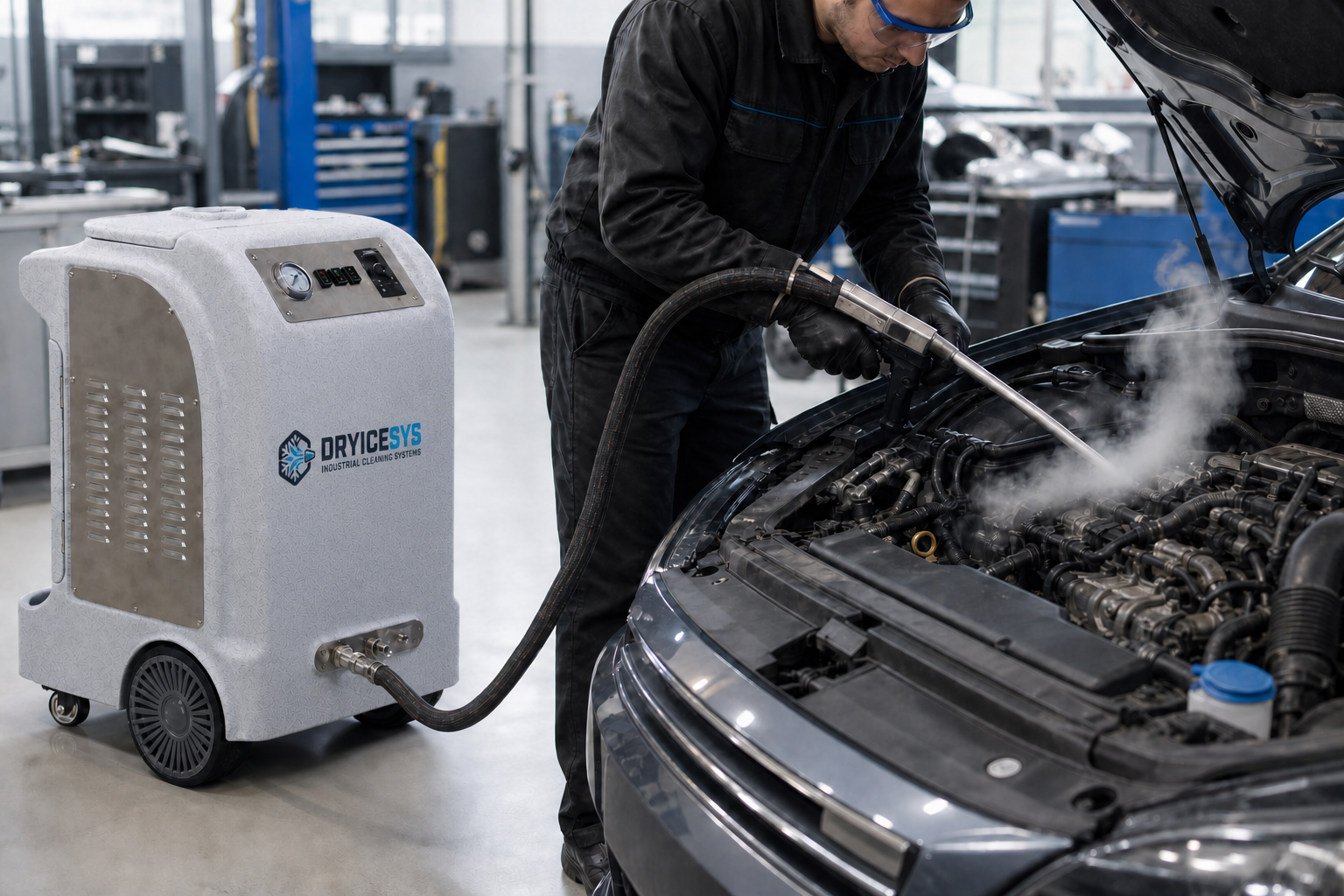
A dry ice cleaning machine does not have one meaningful universal cost. The purchase price is only one line in a working system. A buyer may also need compressed-air capacity, air treatment, dry ice or liquid carbon dioxide, storage, hoses, nozzles, safety controls, operator time, training, transport, maintenance and service support.
The useful comparison is not machine price. It is total cost per accepted cleaning output for a defined workload. Hold the required result constant, then compare complete systems.
The search result price is not the system price
The current Google US-English result page for “dry ice cleaning machine cost” is dominated by price ranges, shopping cards and individual product listings. Its People also ask section mixes machine cost with dry ice price, dry ice production equipment and detailing-service cost. Those are four different purchases.
A low machine price may exclude the compressor, dryer, compatible hose set, application nozzle, commissioning, spares or local service. A higher quote may include some of them. Neither quote is comparable until the boundary is normalized.
Write the workload first: the part or asset, contaminant, substrate, access conditions, required finish, available cleaning window and acceptance test. The accepted result is the invariant. Equipment architecture, local utilities and utilization are the change axes.
Build the complete cost boundary
Use one boundary for every option. At minimum, test whether each cost is included, excluded or not applicable.
| Cost group | What to verify |
|---|---|
| Blasting equipment | Machine, gun, control cable, blast hose, air hose, standard nozzles and adapters |
| Compressed air | Existing plant capacity or compressor purchase or rental, delivered flow and pressure, fuel or electricity, distribution losses and mobilization |
| Air treatment | Aftercooling, separation, drying, filtration, drains and service parts required for the specified inlet condition |
| Carbon dioxide supply | Pellet price and delivery, insulated storage and loss, or liquid-carbon-dioxide vessel and handling for an on-demand system |
| Application tooling | Extra nozzles, longer hoses, access equipment, lighting, containment and debris collection |
| People and support | Preparation, blasting, inspection, cleanup, training, maintenance, spares, warranty response and travel |
| Safety | Ventilation, carbon-dioxide monitoring, hearing and eye protection, barriers and site-specific emergency controls |
| Production consequence | Planned outage, restart, rejected output, rework and the approved value of displaced downtime |
Compressed air deserves its own system review. The US Department of Energy sourcebook treats compressed air as generation, treatment, distribution, controls and end use. For a dry ice cleaner, “air available” is not the same as verified flow and pressure at the machine while other users are operating. Cost the energy and maintenance of the supply that can actually hold the validated operating point.
Calculate cost per accepted output
Choose an output that operations already understands: accepted parts, square metres, mould cavities, machine-hours restored or another verified unit. Then use the same time boundary for every option.
Cost per accepted unit = (annualized fixed cost + variable operating cost + production consequence) / accepted units
Annualized fixed cost can include the machine, compressor or air-system modification, air treatment, initial tooling, training and planned capital recovery. Variable cost can include carbon dioxide, compressor energy or fuel, labor, maintenance, replacement nozzles, transport and rental days. Production consequence belongs in the equation only when the plant approves the baseline and valuation method.
Do not divide by scheduled hours if the process produces rejected work. Record accepted output. Likewise, do not use the machine’s maximum media-feed setting as actual consumption. Measure trigger-on time, delivered media, preparation, cleanup and inspection during the representative job.
An ROI claim needs two measured totals:
Annual benefit = validated cost of the current method − validated cost of the proposed method
Simple payback = installed capital / annual benefit
If annual benefit is zero or uncertain, payback is not established. Do not fill the gap with a vendor’s customer example, an unapproved downtime rate or a best-case utilization assumption.
Do not force every machine into one media model
Most dry ice blasters consume delivered pellets. Their usable media cost depends on the selected machine, feed setting, trigger time, delivery quantity, storage quality and time before use. Cold Jet’s FAQ notes that both equipment consumption and storage loss vary with the application and conditions. That is why a local supplier quote and a measured trial are stronger than a generic per-hour allowance.
Other architectures change the equation. Kärcher describes the IB 10/8 L2P as producing pellets from liquid carbon dioxide when needed. That can remove the delivered-pellet storage assumption, but it introduces a different supply, vessel, connection and service boundary. Compare architectures as complete systems; do not subtract pellet loss from one option while ignoring liquid-carbon-dioxide infrastructure in another.
Own, rent or contract the same outcome
Ownership is strongest when the workload is repeatable, utilization is credible, trained operators are available and response time matters. Rental can fit a defined project or an uncertain duty cycle, but rental days, compressor availability, media delivery, transport and training still belong in the job cost. Contracted service can transfer equipment and operating complexity, yet the scope must still define preparation, acceptance, access, cleanup and schedule responsibility.
The sourcing decision can be written without a guessed market price:
- own when annualized fixed cost plus measured internal variable cost is lower than the qualified alternative at credible utilization;
- rent when the project cost is lower than ownership and the required equipment, air and media can arrive within the operating window;
- contract when the qualified service price and schedule are better than building internal capability for the same accepted endpoint.
Safety is not an optional surcharge. Dry ice becomes carbon dioxide gas, and NIOSH publishes occupational exposure and emergency-response limits for carbon dioxide. The site risk assessment determines ventilation, monitoring, work-area control and emergency measures. Local rules govern outside the United States.
Require a measured trial before approving ROI
Run the trial on a representative asset with the acceptance test agreed in advance. Record the machine and nozzle, media architecture, delivered air under load, settings, trigger time, media used, preparation, labor, inspection, cleanup, rejected output and every safety control. Repeat enough work to expose setup and replenishment time rather than timing only the best pass.
Reject the quote comparison if suppliers use different workloads, acceptance criteria or system boundaries. Also stop if the required air cannot be delivered, the surface does not meet acceptance, contamination is redistributed, safety controls are undefined or service support cannot meet the required response.
Ask each supplier for the same completed cost sheet and the same trial evidence. That turns dry ice cleaning machine cost from a volatile shopping result into a controlled operating decision.
Sources and further reading
- Google: dry ice cleaning machine cost
- US Department of Energy: Improving Compressed Air System Performance
- AIOLITH: Dry Ice Blasting Setup Cost
- Cold Jet: Dry Ice Blasting Startup Guide
- Cold Jet: Dry Ice Blasting FAQ
- Kärcher: IB 10/8 L2P
- NIOSH: Carbon Dioxide
- SubZero Dry Ice: Dry Ice Blasting Guide and Costs