
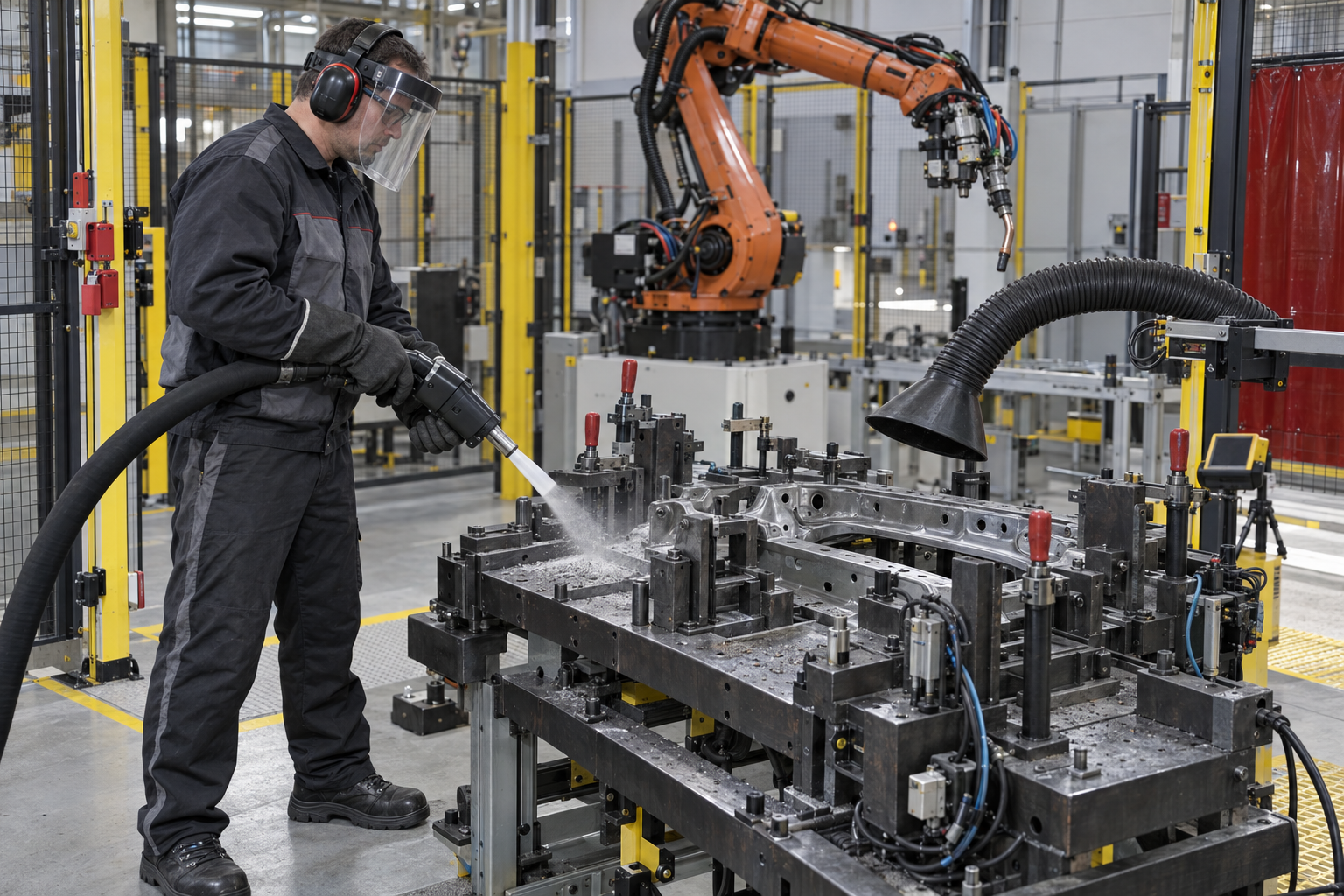
Dry ice blasting can clean documented weld spatter, slag, soot, and production residue from accessible weld-cell fixtures, but only in a stopped and isolated cell; it does not replace fixture repair, calibration, weld inspection, or mechanical removal when the trial fails.
That boundary matters. A weld cell is not one surface and it is not one energy source. Steel locating fixtures, clamps, guards, sensors, cables, a robot, a positioner, a welder, pneumatics, and extraction may share the same enclosure. The cleaning method is useful only when it restores the approved fixture condition without changing geometry, damaging protected components, or creating a new exposure.
Define the Weld-Cell Cleaning Boundary
Current application pages from Cold Jet, welding-equipment specialist Red-D-Arc, and an Enviro-Blast fixture case independently document dry ice cleaning on weld-line fixtures and tooling. Their evidence supports a bounded application, not a promise that every deposit or component can be blasted.
| Decision item | Inside a controlled trial | Outside the cleaning boundary |
|---|---|---|
| Cleaning object | Accessible steel fixture plates, clamps, tables, positioners, guards, and approved external surfaces | Internal torch passages, gearboxes, robot joints, electrical cabinets, and closed pneumatic or hydraulic components |
| Contamination | Documented weld spatter, slag, soot, dirt, and selected carbonized production residue | Cracked tooling, worn locating pins, damaged coatings, failed sensors, and dimensional errors |
| Acceptance | Target residue removed while fixture geometry, coating, sensor function, and surface condition remain within the site specification | A visual “looks clean” judgment used as proof of calibration or weld quality |
| Stop condition | Coating lift, surface change, sensor or cable exposure, incomplete removal at the approved limit, or unstable debris control | Increasing pressure or dwell indefinitely to force a result |
The stable axis is the documented fixture geometry and accepted locating and sensing condition. Deposit type, pellet delivery, compressed-air supply, nozzle, angle, distance, and dwell are change axes. This is the same principle used in a broader surface-damage validation guide: a method name cannot replace a representative test.
How Deposit Release Works
Dry ice particles travel in compressed air and strike the deposit. Impact and local thermal effects contribute to release, while the solid carbon dioxide changes to gas after impact. Process research treats mechanism, application-specific optimization, and equipment development as separate problems; that is why the technical process literature supports a controlled recipe rather than a universal setting.
Sublimation removes the persistent blasting medium from the solid waste stream. It does not make contamination disappear. Released spatter, slag, soot, and dirt remain in the cell and need collection. A vacuum nozzle or local extraction can keep debris away from sensor recesses, cable trays, bearings, and nearby production areas.
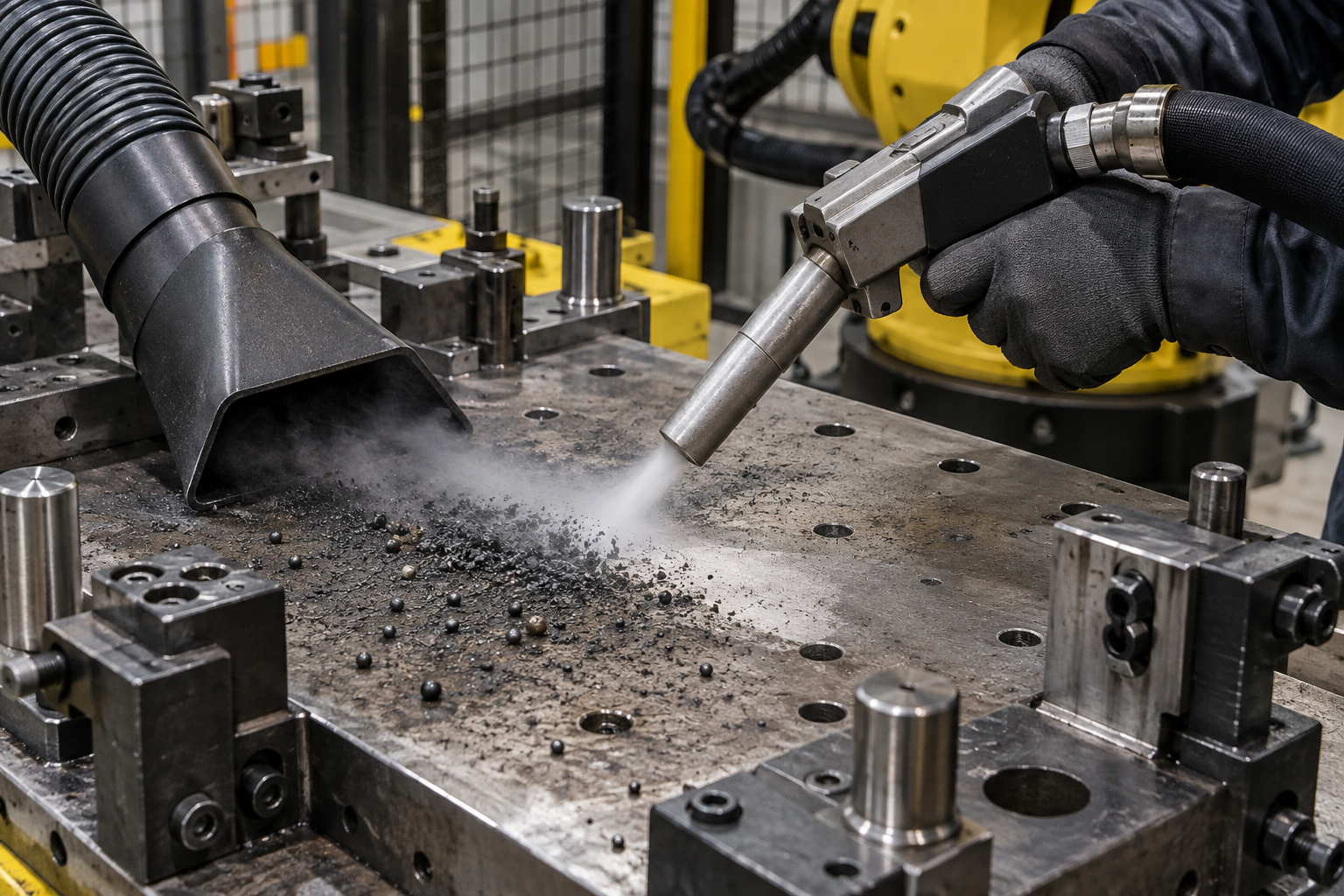
This distinction also controls purchasing language. “No secondary blasting media” is precise. “No cleanup” is not. The buyer should specify how loose material will be captured, where filters discharge, and how the cleaned cell will be inspected before release.
Isolate the Complete Cell Before Blasting
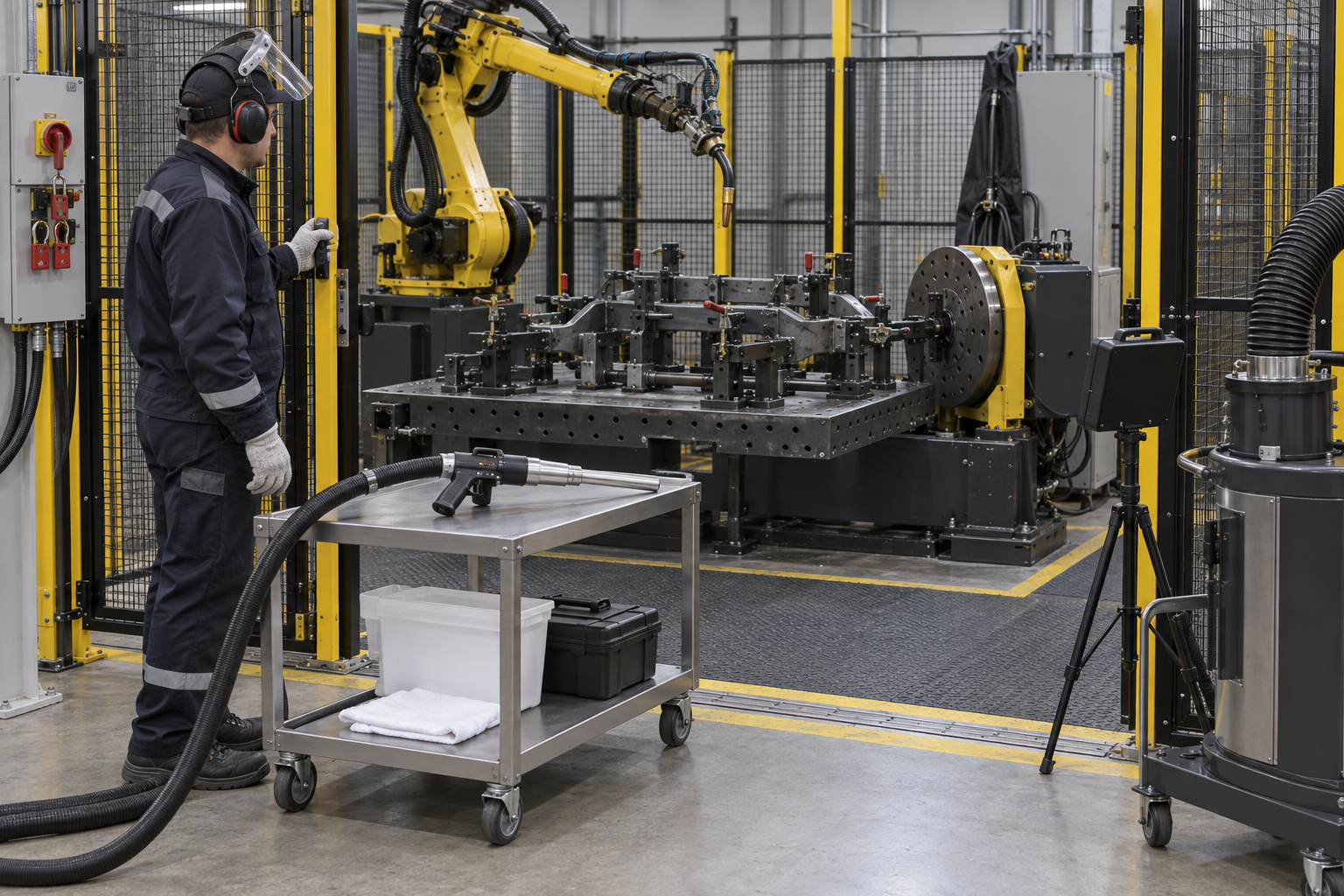
Pressing a stop button is not a maintenance authorization. The OSHA hazardous-energy standard addresses unexpected startup and stored energy, while the OSHA robot-systems manual treats robot applications as systems requiring risk assessment and risk reduction. A site procedure must cover the robot, welder, positioner, conveyors, pneumatics, hydraulics, gravity, and any retained electrical or mechanical energy that can expose the worker.
Before the trigger is enabled, confirm all of the following:
- The welding cycle and hot work have ended, the torch and target surfaces are at an approved temperature, and the cell is released for maintenance.
- Every hazardous energy source is isolated, stored energy is relieved or restrained, and the isolation is verified under the site procedure.
- Robot motion cannot occur while a technician is inside the safeguarded space. Teach mode is not a substitute for the approved maintenance state.
- Sensors, cable jackets, precision pins, seals, bearings, robot joints, torch components, and unknown coatings are masked, excluded, or explicitly approved for the trial.
- The work zone has a defined debris path, ventilation, carbon-dioxide monitoring strategy, exclusion zone, and emergency response.
- Eye and face protection, insulated gloves, protective clothing, safety footwear, and hearing protection match the site risk assessment.
The NIOSH carbon-dioxide entry identifies asphyxiation and cold-contact hazards and adds an important exclusion: suspended dusts of certain metals can be ignitable or explosive in carbon dioxide. Do not take this article as approval for combustible-metal-dust or explosive-atmosphere work. That case requires its own authoritative engineering review and authorization.
Noise is another measured condition. The OSHA occupational-noise standard requires representative monitoring when exposure may reach the action level. Hearing protection does not replace exposure assessment, engineering controls, or a hearing-conservation program where required.
For a wider pre-start framework, use the dry ice cleaning machine safety checklist together with the cell-specific robot and welding procedures.
Build a Representative Fixture Trial
A useful trial reproduces the difficult production condition without sacrificing a critical fixture. Select a representative coupon, sacrificial plate, or approved low-consequence area with the actual substrate, coating, deposit age, thickness, access angle, and nearby protected components.
Record the starting condition with photographs and an acceptance sheet. Then begin at the supplier’s conservative setup and change one variable at a time: pellet delivery, air pressure and volume, nozzle, distance, angle, traverse speed, and dwell. The available compressed-air system and nozzle choice must be treated as one recipe; a quoted pressure without airflow at the operating nozzle is incomplete.
The trial should answer five questions:
- Does it remove the target residue to a defined visual or measured limit?
- Does the fixture retain its dimensions, finish, coating, pin condition, and clamp action?
- Do protected sensors, cables, and adjacent components remain functional and undamaged?
- Are released solids captured without redistributing contamination into recesses or adjacent equipment?
- Can the result be repeated within the planned maintenance window and exposure controls?
Stop when the approved limit cannot remove the deposit, a protected boundary is approached, the surface changes, debris escapes containment, carbon-dioxide control is lost, or noise and visibility leave the validated condition. A failed dry ice trial is a routing decision. It may send the part to controlled scraping, another cleaning method, repair, replacement, calibration, or OEM service.
Specify the System Around the Accepted Recipe
The RFQ should reproduce the accepted process, not ask for a generic “weld-cell blaster.” Include:
- fixture photographs, materials, coatings, deposit types, access distances, and excluded components;
- the accepted pellet format, media rate range, air pressure and airflow at the nozzle, nozzle geometry, distance, angle, and traverse method;
- hose length, grounding or bonding requirements defined by the site, extraction interface, filtration, and waste collection;
- carbon-dioxide monitoring, ventilation, noise data, PPE, and exclusion-zone requirements;
- operator training, maintenance ownership, spare parts, test support, and acceptance documentation;
- a rule that cleaning does not release the fixture for production until the site’s functional, dimensional, and weld-quality checks are complete.
An automated option should be evaluated only after the manual application is valid. The automated dry ice blasting guide explains why part presentation, robot path, recovery, safeguarding, and inspection belong to the complete cell—not to the nozzle alone.
FAQ
Can dry ice blasting remove every type of weld spatter?
No. The cited application sources document weld spatter and slag removal, but deposit bond and fixture condition vary. The approved trial defines what is removable without exceeding the surface and component limits. Deposits that fail the trial need another maintenance route.
Can a robot cell be cleaned while it is stopped but still energized?
Not on the strength of a stop command alone. Entry and maintenance must follow the site’s hazardous-energy and robot-system procedures, including verification of the approved safe state.
Does sublimation mean there is no waste?
No. The dry ice leaves no persistent blasting medium, but removed spatter, slag, soot, dirt, and damaged masking remain. The plan still needs extraction, collection, inspection, and disposal.
Does a clean fixture guarantee good welds?
No. Cleaning may restore access to locating and sensing surfaces, but calibration, sensor checks, process qualification, and weld inspection remain separate release steps.
What should determine machine size?
Use the accepted nozzle recipe, airflow and pressure at the nozzle, hose length, duty cycle, pellet consumption, and extraction needs. A machine should be sized around the validated process and available utilities, not a single headline pressure.