
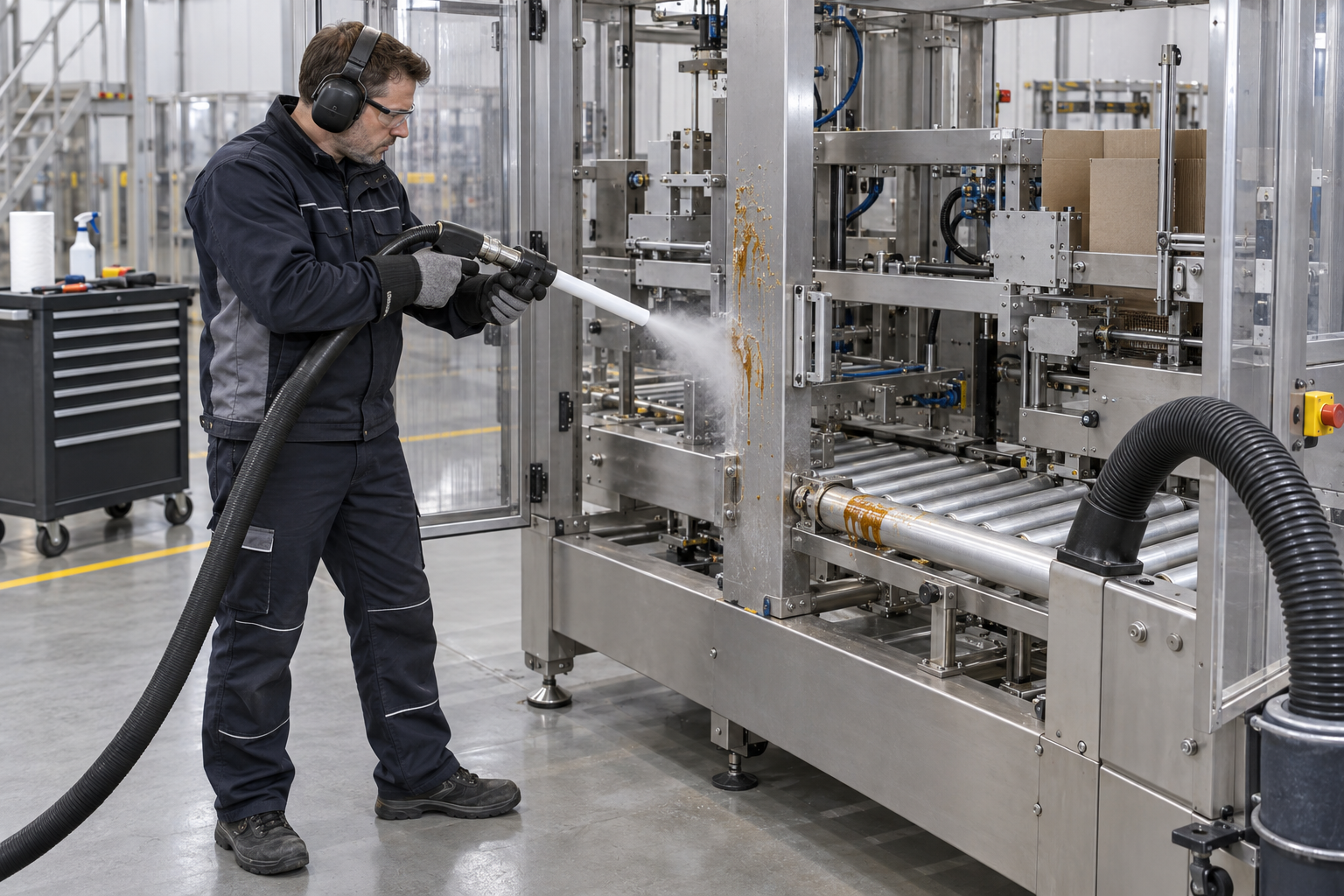
Hot-melt glue on a packaging line creates two different maintenance jobs. Adhesive deposited on an accessible guard, frame or roller is a surface-cleaning problem. Char or debris inside the melter, hose, gun or nozzle is an adhesive-system service problem. Treating them as one job creates the wrong process boundary.
Dry ice blasting can remove cured hot-melt adhesive from accessible external packaging-machine surfaces, but it does not replace flushing or OEM service for the internal melter, hoses, guns, or nozzles.
That distinction should drive the trial, the risk assessment and the equipment specification. The accepted machine condition is the invariant. Adhesive type, deposit thickness and blast recipe can change; bearings, seals, sensors, coatings, geometry and the closed adhesive path must remain protected.
First Separate External Cleaning from Internal Service
Current supplier evidence supports dry ice blasting for exposed adhesive and label residue on selected production surfaces. Cold Jet documents hot-melt glue on packaging equipment, while a separate Cryoblaster application shows a production machine covered with hot-melt adhesive and names packers and labellers as targets. CRYONOMIC also documents label and glue residue removal.
Those sources establish a useful application class. They do not make every adhesive-covered component a valid target.
| Maintenance target | Correct process boundary | Acceptance condition |
|---|---|---|
| External stainless-steel guard or frame | Candidate for a controlled dry ice trial | Adhesive removed; finish, geometry and fasteners unchanged |
| Accessible roller surface | Trial only after bearings, seals and sensors are protected | Surface clean; roller finish, runout and adjacent components acceptable |
| Box former, labeller or conveyor structure | Candidate where residue and substrate are documented | No coating lift, marking, debris migration or functional change |
| Melter tank, adhesive hose, gun or nozzle passage | Follow the adhesive-equipment OEM service procedure | Internal flow path restored and released under the OEM specification |
| Product-contact surface | Cleaning trial is not a sanitation release | Separate hygiene validation and site authorization completed |
The counterexample is explicit. Nordson’s melter guidance identifies system flushing for char and debris that can clog melters, hoses, guns and nozzles. Blasting the outside of a glue applicator does not clean its internal passage.
How Dry Ice Releases Adhesive—and What Remains
A dry ice cleaning machine meters solid carbon-dioxide particles into compressed air. At the target, particle impact and the local temperature gradient can embrittle the adhesive or weaken its bond to the surface. The dry ice then changes directly from solid to gas. The working-principle guide explains the three effects in more detail.
Sublimation removes the blasting medium from the solid cleanup stream. It does not remove the glue. Released flakes, labels, dust and any unintentionally lifted coating remain physical waste. Local extraction should therefore follow the blast direction closely enough to capture debris before it reaches a bearing, sensor, open product zone or adjacent line.
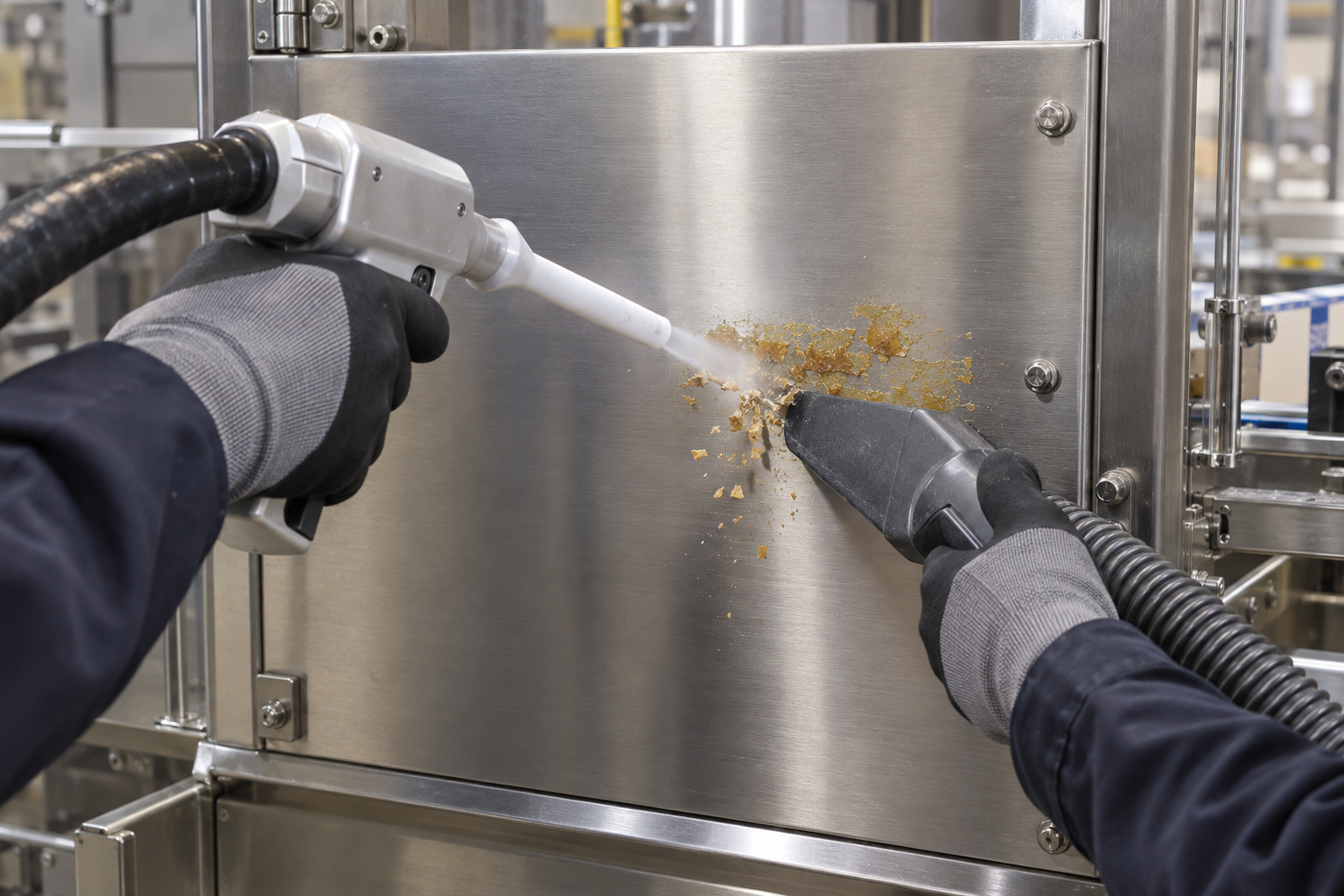
The phrase “non-abrasive” is not a substitute for a compatibility test. A coating, soft polymer, brittle sensor cover or already-damaged surface can fail under a setup that leaves stainless steel unchanged. The surface-damage test framework is the correct model: substrate, coating, contaminant and blast settings form one test system.
Safety Gate Before the Trigger
Packaging machinery combines motion, electrical energy, pneumatics and stored adhesive pressure. Hot-melt equipment can also retain heat after production stops. The conservative baseline is a stopped, authorized and verified maintenance state—not a claim that the line can be cleaned safely while running.
For US workplaces, OSHA’s hazardous-energy standard supplies the governing boundary when unexpected startup or stored energy could injure a worker. The site’s procedure and the adhesive-system manual must define how to stop the line, isolate every relevant energy source, relieve adhesive and pneumatic pressure, verify the zero-energy state and control the cool-down interval. Local requirements may differ outside the United States.
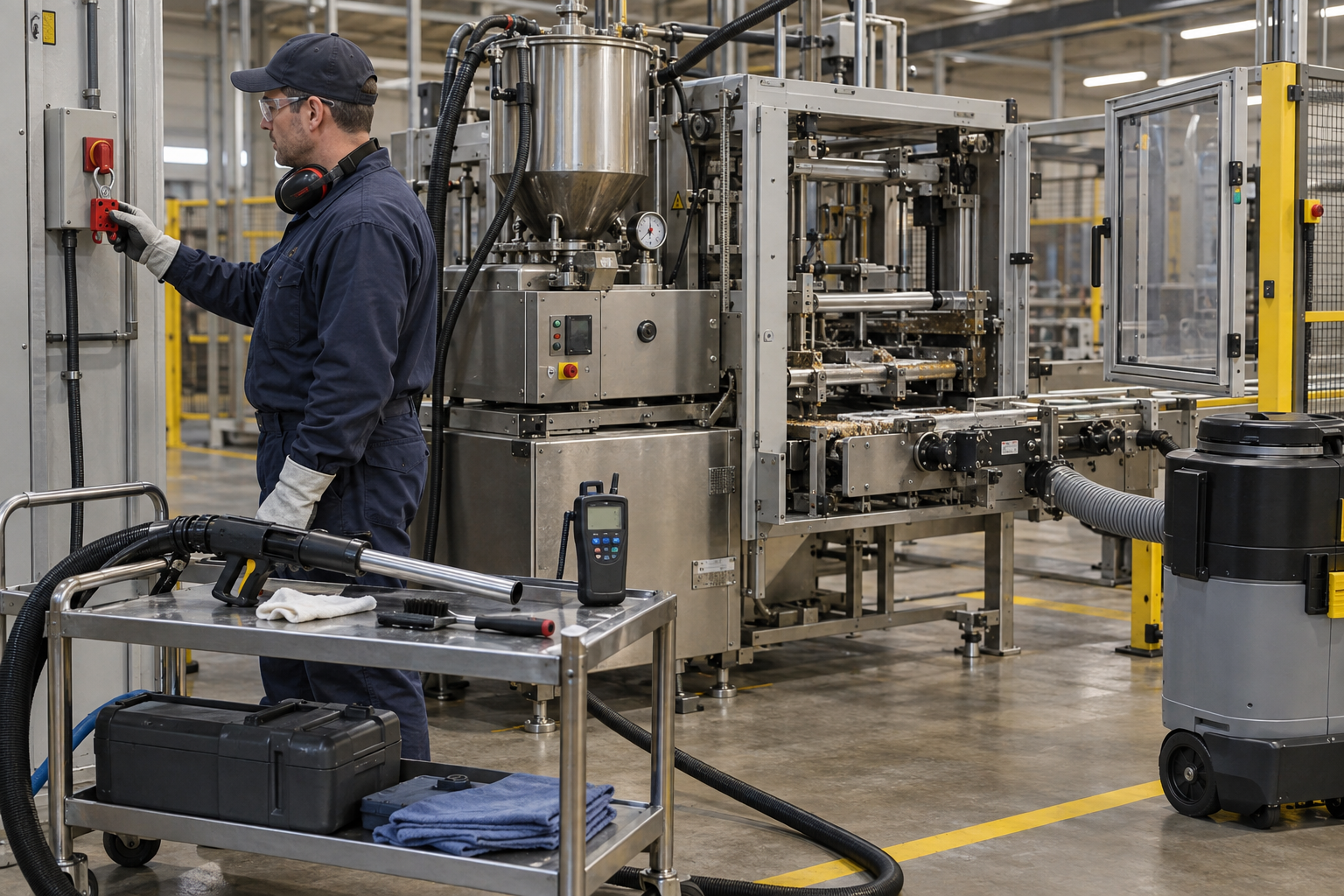
The pre-trigger gate should confirm:
- The packaging machine is stopped, isolated and verified under the site’s hazardous-energy procedure.
- The adhesive circuit is in the OEM-approved pressure and temperature state; internal passages remain closed to the blast.
- Bearings, seals, sensors, wiring, coated parts and open product zones are outside the blast and debris paths.
- Ventilation and carbon-dioxide monitoring match the work-zone volume and release rate. NIOSH identifies dry ice as solid carbon dioxide and lists inhalation, asphyxia and cold-contact hazards.
- Eye protection, insulated gloves and task-specific protective clothing are defined; the noise assessment determines hearing controls. OSHA’s occupational-noise standard provides the US program boundary.
- Extraction, barriers, hose routing, visibility and stop signals prevent debris escape and bystander entry.
The broader dry ice cleaning safety checklist can be incorporated into the job plan, but the packaging line and adhesive-system procedures still control the work.
Build a Representative Trial
One recipe cannot be inferred from the words “hot-melt glue.” Adhesive formulation, curing history, deposit thickness, substrate, coating, surface temperature, particle size, air delivery, nozzle, stand-off distance and dwell time interact. The trial must preserve that algebra instead of hiding it behind a pressure setting.
Use this sequence:
- Define the endpoint. Photograph and map the external residue. State how much adhesive must be removed and which finish, geometry and functions must remain unchanged.
- Record exclusions. Mark bearings, seals, sensors, labels needed for operation, coated areas, electrical openings, product-contact zones and the complete internal adhesive circuit.
- Choose the worst representative coupon or location. Include the thickest realistic deposit on the most sensitive in-scope substrate, not an easy demonstration spot.
- Start at the least aggressive documented setup. Record particle size, delivered air condition, nozzle, distance, angle, media rate and dwell. The compressed-air requirements guide explains why compressor nameplate values are not delivered conditions.
- Capture the released adhesive. Position extraction for the actual plume and inspect adjacent components for migration.
- Inspect under the acceptance method. Check residue removal, surface marking, coating lift, fasteners, roller finish and protected components. Stop on the first unacceptable change.
- Release the machine separately. Remove controls only under the site procedure, then verify machine and adhesive-system function before production.
The accepted window becomes the maintenance specification. Anything outside it returns to engineering review.
Specify the Machine Around the Accepted Window
The buying question is not simply whether a blaster can remove glue. It is whether the complete system can reproduce the approved result at the line.
Ask suppliers to demonstrate:
- stable control of the tested particle size, air delivery and media rate;
- a nozzle that reaches the approved surfaces without exposing excluded components;
- hose length and routing that do not create a trip, pinch or access hazard;
- compatibility with the facility’s filtered compressed-air supply;
- a debris-extraction arrangement that remains separate from the blast circuit;
- operator controls and training appropriate to the site’s isolation and carbon-dioxide plan; and
- repeatable documentation of the accepted recipe.
The nozzle-selection guide helps connect access, footprint and air demand. The maintenance guide provides a separate framework for keeping the blaster itself reliable.
When Dry Ice Is the Wrong Next Step
Reject or pause the application when the residue is inside the adhesive circuit, the line cannot be isolated, stored pressure is unresolved, ventilation is inadequate, or a sensitive substrate has no representative test. Do the same when the task actually requires sanitation release, coating removal, bearing service, sensor repair or correction of the adhesive process that caused the buildup.
Dry ice blasting can be a useful external-cleaning process. It is not a substitute for diagnosis. Recurring glue deposits should still trigger a review of adhesive temperature, delivery, alignment, application and preventive maintenance.
Frequently Asked Questions
Can dry ice blasting remove burnt-on hot-melt glue?
It can remove selected cured or burnt-on deposits from tested external machine surfaces. Approval still depends on the adhesive, substrate, temperature state, blast recipe and acceptance inspection.
Can I blast inside a hot-melt glue nozzle?
No general recommendation supports that use. Internal melters, hoses, guns and nozzle passages belong to the OEM flushing, disassembly or service procedure.
Does the glue disappear with the dry ice?
No. The carbon dioxide sublimates, but the released adhesive remains. Plan local extraction, collection and disposal for the actual residue.
Can the packaging line remain in production during cleaning?
Do not assume so. If unexpected startup, motion, heat or stored pressure can injure a worker, the site’s hazardous-energy and adhesive-system procedures control the maintenance state.
Sources
- Cold Jet: adhesive-removal application and packaging-equipment targets
- Cryoblaster: hot-melt glue on production and packaging equipment
- CRYONOMIC: label and glue residue removal
- Nordson: flushing boundary for internal adhesive-system contamination
- OSHA: control of hazardous energy
- NIOSH: carbon dioxide hazards
- OSHA: occupational noise exposure