
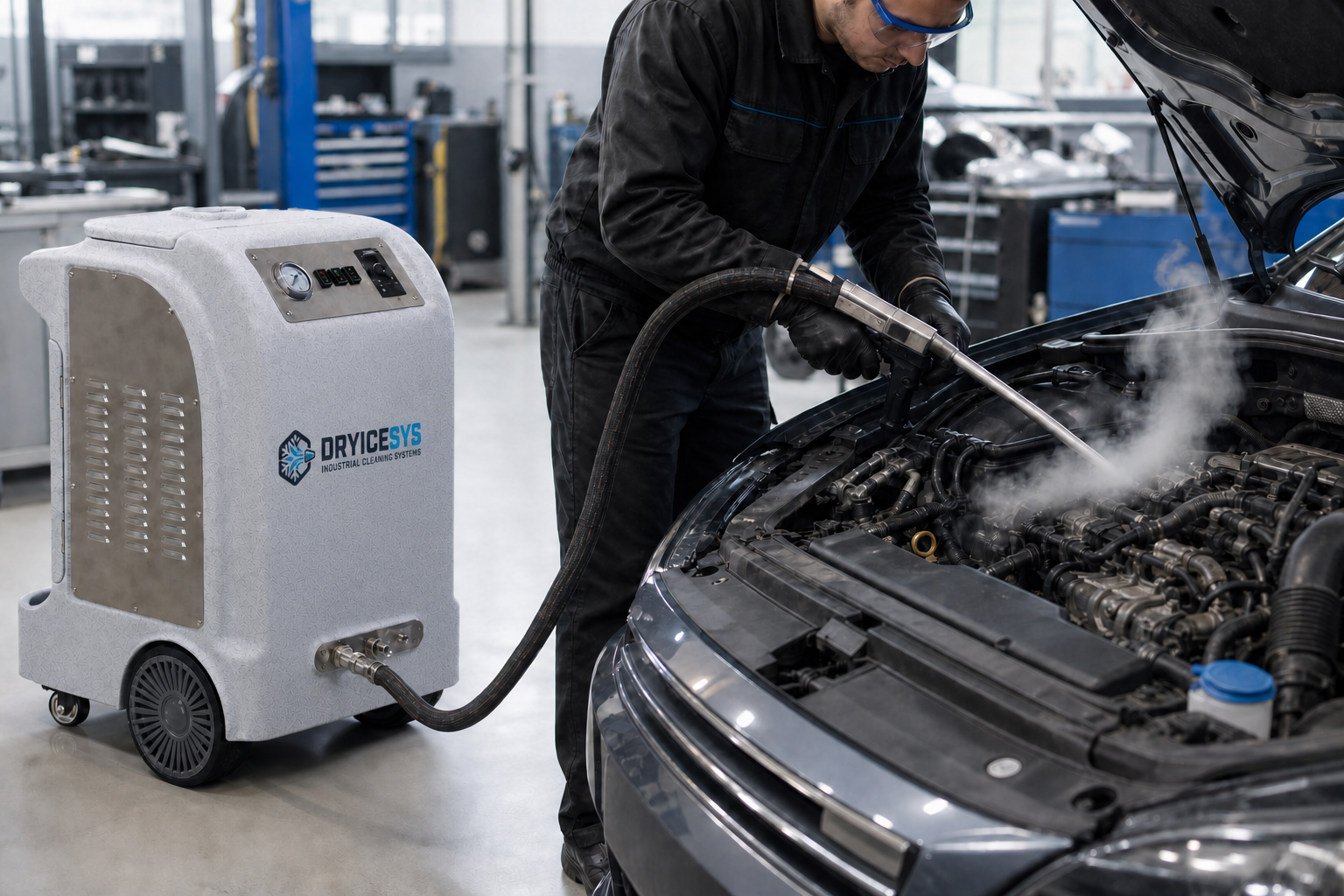
Automated dry ice blasting makes sense when a stable, repeatable cleaning task has already been proven. It is not simply a robot holding a nozzle. A production cell must present the part consistently, reproduce the accepted blast recipe, supply air and media, control carbon dioxide and debris, safeguard people, recover from faults and verify the cleaned part.
The source of truth is the accepted part condition at cell exit. Robot path, blast settings and cell hardware are controlled means of reaching it.
Automate a Stable Cleaning Process, Not a Nozzle
Automation is strongest when parts arrive in a known orientation, contamination falls within a defined range, the target surfaces are reachable and the same acceptance test applies repeatedly. Manual blasting remains the better baseline when the operator must continually interpret unknown residue, changing geometry or hidden damage.
| Production condition | Automation fit | Reason |
|---|---|---|
| Repeating part family, fixed fixture and measurable clean endpoint | Strong candidate after a process trial | Motion and blast inputs can be reused and checked |
| High mix with frequent nozzle, fixture or acceptance changes | Conditional | Changeover and revalidation may own the cycle |
| Uncertain contaminant or damage mixed with residue | Weak candidate | Inspection and diagnosis come before cleaning |
| Occasional maintenance task with irregular access | Compare with manual work | A dedicated cell may add more handling than it removes |
No public source establishes one production volume or payback threshold for every plant. Use observed labor, rejected output, downtime, utilities, consumables, maintenance and integration cost from the same validated task. Do not build the business case from robot speed alone.
Define the Complete Cell Boundary
A defensible specification connects six subsystems.
Part presentation and robot path
The fixture must locate the relevant surface within the validated tolerance. The robot program must control nozzle orientation, standoff, speed and dwell without collisions or hose interference. A vision system is useful only if it resolves a defined presentation error and feeds a controlled response.
Blast recipe and utilities
Cold Jet’s automation-ready equipment page documents programmable recipes that include blast pressure, particle size and feed rate. Those variables remain separate from robot motion. Specify delivered air at the machine during the cycle, required air quality, media condition, nozzle, hose and permitted recipe range. A command to start blasting is not proof that the surface received the accepted process.
Media supply and fault handling
Define how dry ice is stored or produced, loaded, monitored and replenished. Then define what the cell does when media flow becomes unstable, air falls outside range, a nozzle blocks, a part is missing or the process stops mid-cycle. A safe stop needs a documented recovery state; an automatic retry is not always an equivalent clean.
Exhaust, debris and inspection
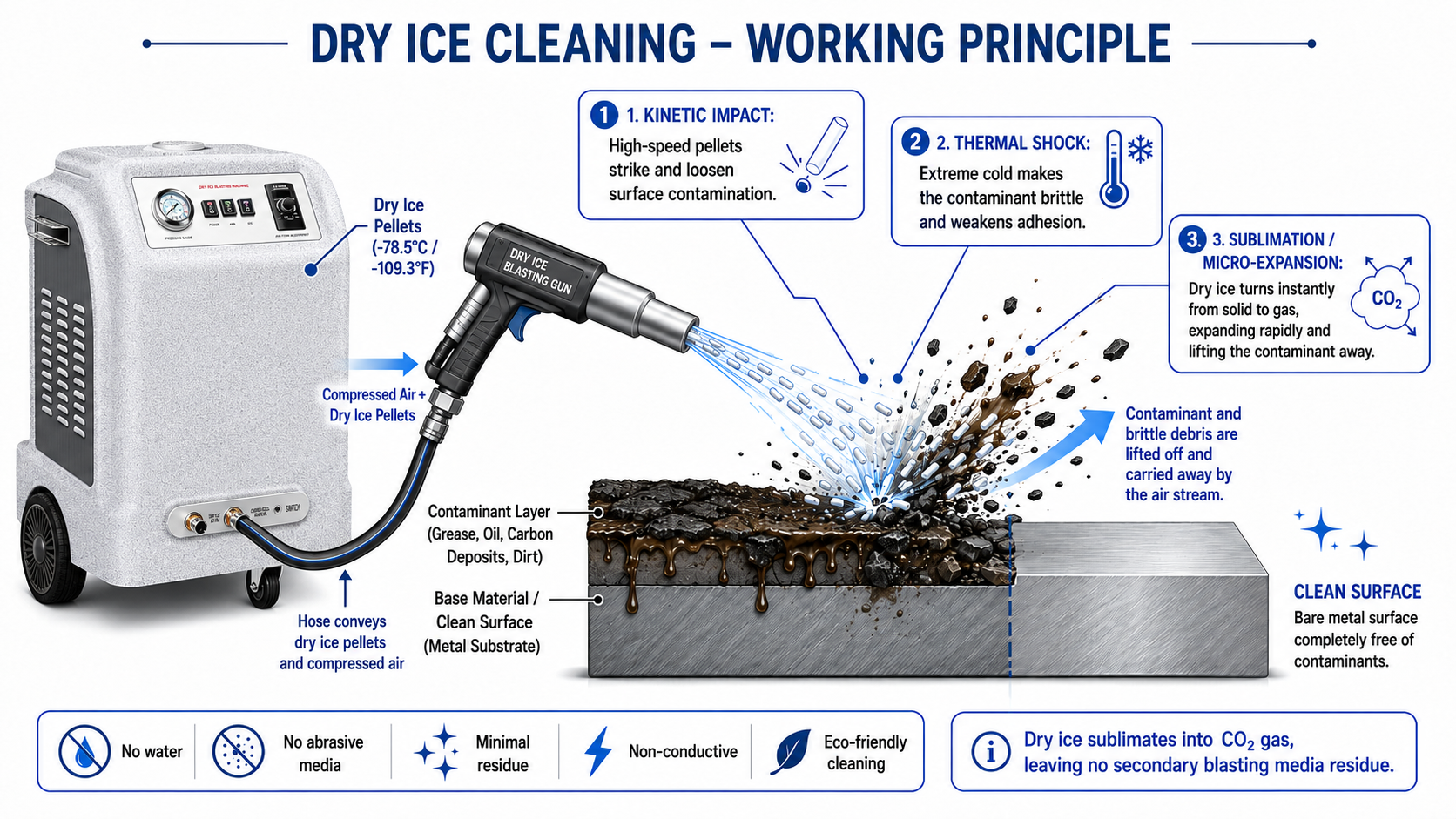
Dry ice media sublimates, but removed contamination remains. The cell needs a controlled destination for loosened material and any airborne hazard. Inspection must distinguish a completed cycle from an accepted part.
Choose Semi-Automated or Fully Automated Scope
Cold Jet’s integrated-system page separates two useful boundaries. A semi-automated system integrates a blaster into an existing manufacturing process. A fully automated system may combine dry ice production and blasting for continuous operation.
That distinction is about ownership, not marketing language. A semi-automated cell may still use robotic motion while an operator loads parts, replenishes dry ice and performs inspection. A fully automated line must also control part transfer, media availability, recipe selection, faults and downstream disposition.
CRYONOMIC’s automated-blaster page describes variants for conveyor use, robot I/O and remote control, plus a robot gun. This shows why interfaces must be named in the request for quotation. Confirm signals, states, recipe authority, reaction forces, hose routing, end-of-arm mass and recovery behavior for the selected equipment. Do not infer them from an “automation ready” label.
Safeguard the Application, Including Recovery Work
The robot arm is one component of the hazard analysis. OSHA’s robotics standards page describes consensus guidance for robot-system integration that includes end-effectors and related equipment. A practitioner explanation from Universal Robots assigns the integrated application and cell, including safeguarding, to the company that designs and integrates it. An end user that performs that work can hold the integrator role.
Analyze normal cycling and the work that breaks the cycle: teaching, nozzle adjustment, media refill, jam clearing, inspection, maintenance and restart after a partial clean. OSHA notes that many robot accidents occur during non-routine programming, maintenance, testing, setup or adjustment, when a worker may enter the working envelope.
Dry ice adds a separate exposure case. NIOSH identifies dry ice as solid carbon dioxide and lists inhalation, asphyxia and frostbite hazards. Design ventilation and monitoring from a site exposure assessment. Also control noise, compressed-air energy, flying debris, cold contact and the hazards of the removed contaminant. Robot guarding does not close those cases.
Validate the Process Before and After Automation
Use one evidence chain from manual proof to cell release.
- Define the contaminant, surfaces to clean, surfaces to protect and measurable acceptance condition.
- Prove a manual process window on representative parts. Record machine, air, media, nozzle, distance, angle, dwell and inspection method.
- Design the fixture and robot path to reproduce that window without hose strain, collision or inaccessible shadow areas.
- Challenge expected variation: part position, contaminant load, media condition, start-stop events and the least favorable reachable geometry.
- Test guards, interlocks, exhaust, alarms and safe responses to low air, low media, blockage, missing part and interrupted cycle.
- Verify that the inspection method can separate a completed program from an accepted part. Route failures to a defined disposition.
- Release the cell only after production representatives approve the part result, safety functions, recovery instructions, maintenance plan and change-control limits.
A later change in nozzle, air delivery, particle range, fixture, robot speed, dwell or acceptance method is a process change. Evaluate it against the validated window rather than treating it as an equivalent recipe.
Put These Requirements in the RFQ
Ask each supplier or integrator to identify:
- the part range, contaminant range and accepted clean endpoint;
- semi-automated or fully automated scope, with every manual task named;
- machine interfaces, recipe control, feedback signals and fault states;
- air, power, media, exhaust and environmental requirements at the cell boundary;
- robot gun, nozzle, hose management, fixture and part-detection responsibility;
- guarding, safety functions, carbon-dioxide assessment and validation ownership;
- inspection, rejected-part routing and partial-cycle recovery;
- operator training, maintenance access, spare parts, documentation and change control;
- the site acceptance test and evidence required for production release.
Do not accept duplicated responsibility. If the blaster supplier, robot integrator and plant each assume another party owns exhaust, fault recovery or validation, the architecture has a gap.
Keep Manual Blasting When Variability Owns the Job
Automation should preserve a proven cleaning decision, not hide an unstable one. Keep manual work, a portable machine or a flexible semi-automated station when changing geometry, uncertain contamination or low repetition makes human inspection the controlling step.
Move toward a fully automated cell when the complete process can be bounded, supplied, safeguarded and verified repeatedly. The robot is not the invariant. The accepted part is.