
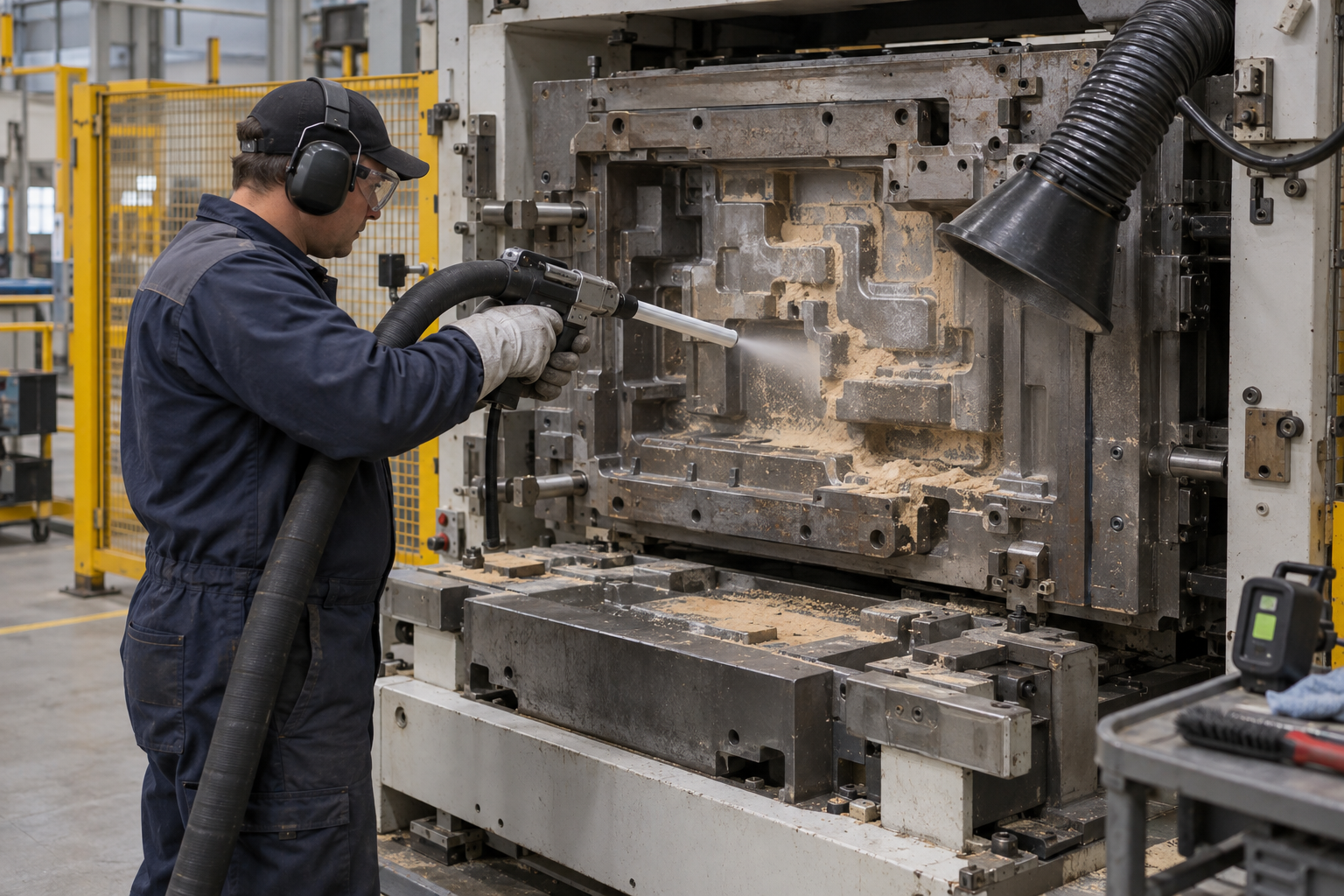
Dry ice blasting can remove binder, resin, release-agent and residual-sand buildup from exposed core-box surfaces, but it should be approved only after a stopped, isolated trial proves that vents, screens, parting lines, coatings and dimensions remain within specification.
That qualification matters. The carrier medium disappears as carbon dioxide gas, yet the foundry residue does not. A useful process therefore has two jobs: release the contaminant without changing the tool, then capture what was released. The decision is not whether dry ice is universally “non-abrasive.” It is whether one controlled setup can meet a written core-box acceptance standard.
Where Dry Ice Blasting Fits Core-Box Cleaning
Current foundry evidence supports a narrow, useful application: cleaning exposed tooling surfaces where residue interferes with vents, parting lines or repeatable core production. A named Progress Casting case published by Foundry Management & Technology describes sand and binder residue on core boxes, plus release-agent and resin buildup on related mold faces. Separate technical pages from Cold Jet and ICEsonic identify core boxes as an established foundry application.
| Cleaning target | Evidence-backed residue | Why dry ice may fit | Boundary to verify |
|---|---|---|---|
| Exposed core-box cavity | Sand, binder and resin residue | Compressed-air particles can reach complex geometry without adding spent grit | Coating, insert and cavity dimensions must remain acceptable |
| Vent slots and screens | Binder and sand accumulation | A focused nozzle can access small exposed features | No deformation, plugging or enlarged openings |
| Parting lines and sharp edges | Release agent and bonded residue | No added abrasive media to recover | No rounding, peening or change in sealing condition |
| Adjacent tooling surfaces | Refractory coating carryover and process residue | Dry process avoids added water | A functional coating must not be stripped by mistake |
This is not a repair process. Worn edges, damaged vents, failed coatings, blocked internal passages and dimensional drift still require the appropriate tooling or process intervention.
What Must Stay Unchanged
The stable axis is the core box’s accepted production condition. Residue type, temperature, nozzle, air delivery, media rate, stand-off distance and dwell time can change. Vents, screens, parting lines, inserts, coatings and dimensional surfaces cannot change outside the drawing, maintenance standard or approved sample.
Before a trial, record the condition of the tool rather than relying on “looks clean.” Useful acceptance checks include:
- photographs of representative cavity, vent and parting-line locations;
- vent or screen condition against the maintenance specification;
- confirmation that a functional coating remains intact;
- dimensional or fit checks on the features most exposed to the blast;
- a sample core or production check defined by the process owner; and
- a stop rule for coating lift, edge change, surface marking or airborne-debris loss of control.
The named foundry case reported cleaning delicate vents successfully, but that is evidence for running a trial, not permission to copy its setup. The surface-damage test framework explains why substrate, coating, contamination and blast settings must be treated as one test system.
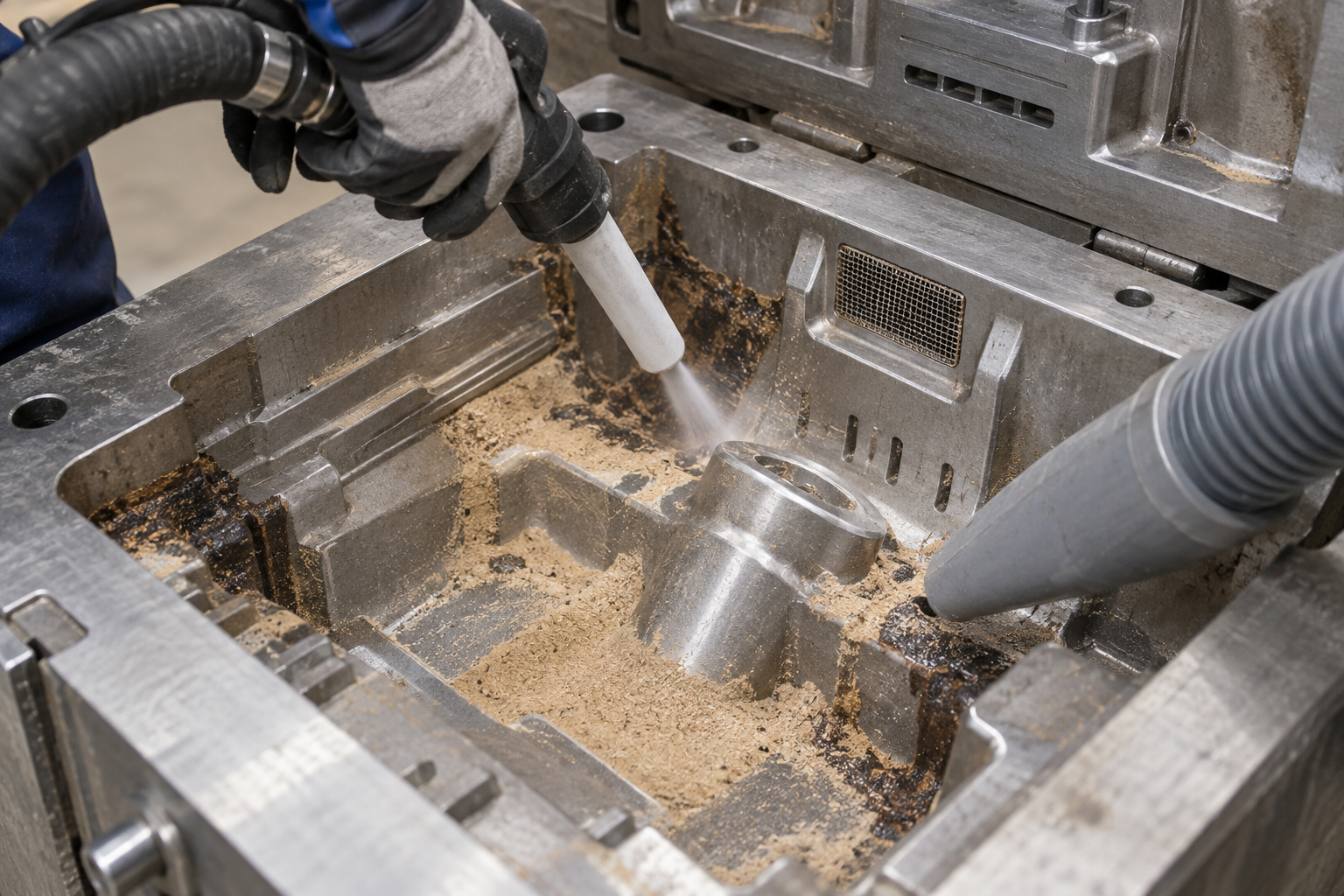
How the Process Removes Residue – and What Remains
A dry ice cleaning machine meters solid carbon-dioxide particles into compressed air. At the surface, particle impact and the local thermal gradient help break the bond between residue and tooling. The carbon dioxide then sublimates from solid to gas. For a fuller mechanism explanation, see the dry ice cleaning machine working-principle guide.
Sublimation changes the waste calculation; it does not cancel it. Sand, binder, resin, release agent and any coating unintentionally removed from the tool remain physical contaminants. They can settle on the machine, enter a vent, or become airborne. The process design therefore needs a separate extraction and collection plan positioned for the actual blast direction.
Compressed-air capacity also has to be verified at the machine inlet while the system is flowing. A nameplate compressor rating alone does not establish delivered pressure, flow or air quality. The compressed-air requirements guide provides the correct boundary for that check, while the nozzle-selection guide explains why access and blast footprint must be matched to the task.
Safety Gate Before the Trigger
The conservative baseline is a stopped, authorized and energy-isolated core-making machine. Supplier pages often promote hot or in-place cleaning, and the named case describes a hot, online process. Those observations do not override the site’s energy-control procedure. OSHA’s lockout/tagout standard expressly includes cleaning when unexpected startup, energization or stored energy could injure a worker.
The pre-trial gate should confirm all of the following:
- The machine is stopped, isolated and verified under the site’s hazardous-energy procedure.
- Guards are opened only within the authorized maintenance boundary, and the operator stays outside the point of operation.
- The work area has ventilation and carbon-dioxide monitoring appropriate to the release rate and enclosure.
- Eye protection, hearing protection, insulated gloves and any task-specific PPE are defined by the risk assessment.
- Local extraction captures dislodged residue close to the blast zone.
- Bystander access, hose routing, visibility and emergency stop criteria are controlled.
The dust assessment is not optional. Core-box residue may contain sand. Under OSHA’s respirable crystalline-silica standard, compressed air cannot be used to clean surfaces where it may contribute to silica exposure unless it is used with an effective ventilation system that captures the dust cloud, or no alternative method is feasible. The standard also requires exposure assessment and applicable engineering, work-practice and respiratory controls.
NIOSH identifies dry ice as solid carbon dioxide and lists inhalation, asphyxia and frostbite hazards. The same guide notes that suspended dusts of certain metals can be ignitable or explosive in carbon dioxide. This article does not authorize blasting where combustible-metal dust or an explosive atmosphere may be present; that condition requires a separate engineered hazard review.
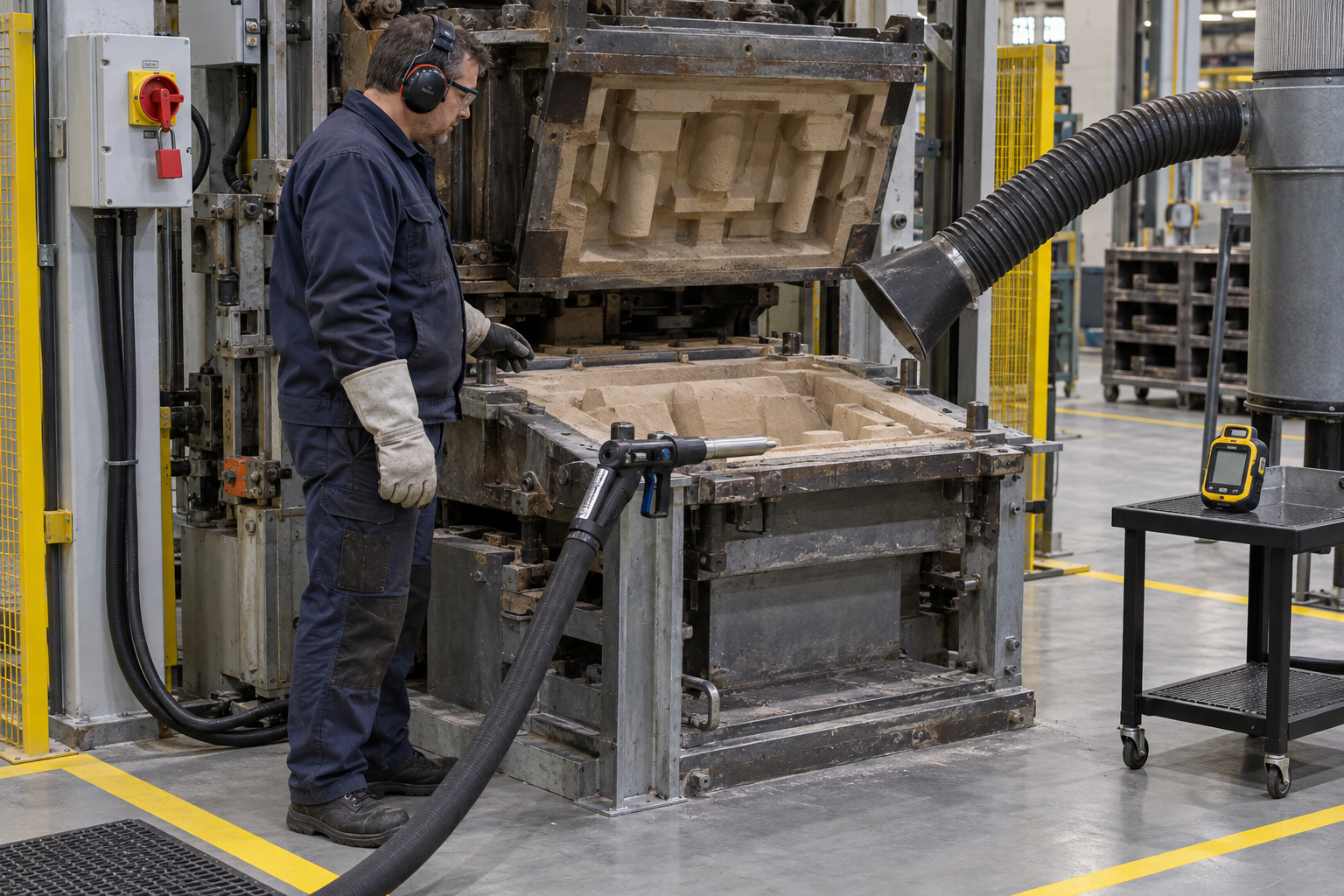
The broader dry ice cleaning machine safety checklist can support the pre-start review, but site rules and local law remain controlling.
Turn One Trial into a Cleaning Specification
Use a representative dirty tool, not an easy demonstration coupon. Mark test zones that include a cavity surface, a parting-line segment and the most delicate vent or screen that can be inspected. Then change one variable at a time.
- Document the starting residue and accepted tool condition.
- Begin at the least aggressive practical combination of air, media rate, nozzle, distance and dwell.
- Position extraction before pulling the trigger.
- Clean a small marked zone and stop for inspection.
- Compare residue removal with coating, edge, vent and dimensional criteria.
- Repeat only within the authorized test plan, recording every changed variable.
- Run the process owner’s required core or production check before release.
| Trial result | Decision |
|---|---|
| Residue remains but tooling is unchanged | Adjust one variable and retest within the approved range |
| Residue is removed and all acceptance checks pass | Record the operating window and repeatability check |
| Coating lifts, an edge changes, a vent marks or debris escapes capture | Stop; the setup fails |
| A defect remains after the surface is clean | Route to tooling or process diagnosis, not more blasting |
Case-study time and cost figures should stay in the case. Your purchase case should use measured trigger time, dry ice use, compressed-air demand, setup and cleanup labor, inspection time and accepted output on your own tool.
What to Put in the RFQ
A supplier can size the system only if the workload is concrete. Provide:
- core-box type, dimensions, material, coating and replaceable inserts;
- residue identity, thickness pattern and cleaning frequency;
- vent, screen and parting-line access photographs;
- available compressed air measured at the proposed connection;
- required hose reach and operator access limits;
- ventilation, extraction and carbon-dioxide-monitoring provisions;
- written acceptance and stop criteria;
- the representative trial protocol; and
- training, maintenance, spares and service requirements.
Ask the supplier to demonstrate the complete machine, hose, gun and nozzle combination. Do not accept a result produced with a different air supply or a different particle-preparation system unless the change is documented and retested.
Core Box Cleaning FAQ
Can dry ice blasting clean core-box vents?
Yes, exposed vents and screens are documented applications, including in the named foundry case. Approval still depends on a representative trial showing that openings, edges and any coating remain within specification.
Does the process leave no waste?
It leaves no spent dry ice as solid blast media. The removed sand, binder, resin, release agent and any other dislodged material remain and require capture, housekeeping and disposal.
Can the core box stay hot or in the machine?
Some supplier and case sources describe hot, in-place cleaning. Treat that as a site-specific operating state, not a general recommendation. Energy control, stored energy, surface compatibility, access and guarding must be resolved before any alternative to a stopped, isolated trial is considered.
Will the process repair a damaged vent or worn parting line?
No. Cleaning can expose the true condition of the tool. It does not restore geometry, replace a screen, reopen an inaccessible internal passage or rebuild a failed coating.
What proves the machine is suitable?
A repeatable trial on representative tooling. The pass condition is accepted residue removal with unchanged critical geometry, controlled exposure and a documented operating window.