
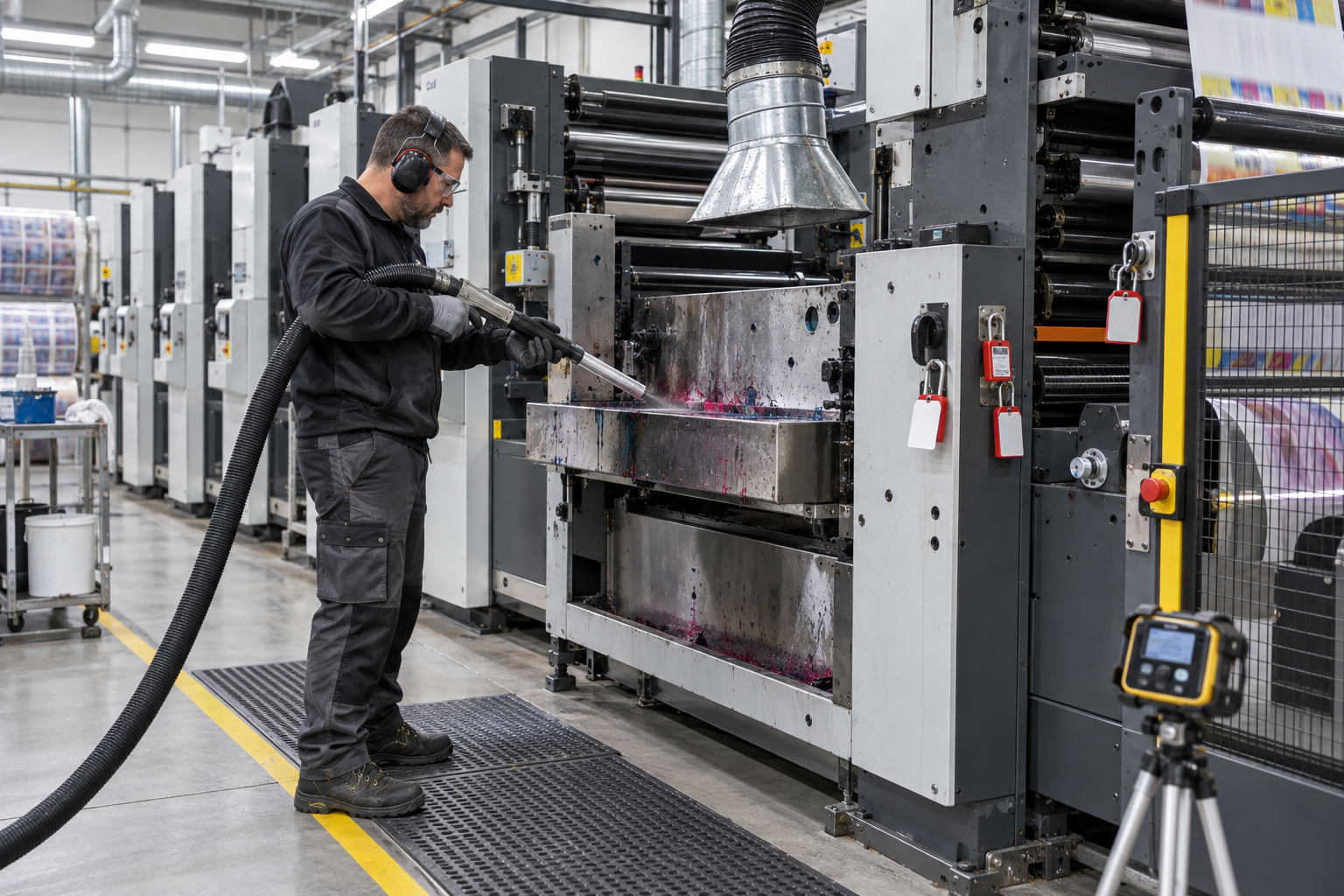
Dry Ice Blasting for Printing Press Cleaning
Dry ice blasting can remove dried ink, adhesive, grease and paper dust from selected printing press surfaces, but only on a stopped, energy-isolated machine after component compatibility, ventilation and debris controls have been validated.
That boundary matters. A printing press combines robust metal frames and trays with precision rollers, coatings, seals, bearings, sensors, wiring and hazardous moving parts. The same blast setting is not appropriate for every component. The useful question is not whether dry ice can clean a press in general. It is which contaminant can be removed from which surface, under a controlled maintenance procedure.
Where Dry Ice Blasting Fits on a Printing Press
Current printing-industry sources consistently describe dry ice blasting for accumulated ink, adhesive, grease, grime and paper residue. Cold Jet’s printing application page names ink trays, frames, grippers, feed and delivery areas, rollers and accessible mechanical assemblies. CRYONOMIC separately documents ink and oil removal from printing equipment. A Printing News case article reports use on ink, grease, glue and paper grime in a folding-carton operation.
These sources establish a real application, but they do not establish one universal recipe. Treat each part as a separate qualification task.
| Candidate area | Typical contamination | Validation question |
|---|---|---|
| Stainless ink trays and metal side frames | Dried ink, grease and adhesive | Does the selected setting remove residue without changing paint, finish or dimensions? |
| Grippers, guides and accessible metal mechanisms | Ink mist, paper dust and oily grime | Can debris be captured without driving it into bearings or protected gaps? |
| Selected drums and rollers | Ink or coating residue | Has the OEM-approved surface, coating and cell geometry passed a low-intensity trial? |
| Sensors, seals, wiring and bearings | Mixed contamination | Can they be isolated or shielded, and has the component supplier approved the method? |
| Anilox cells and precision coated surfaces | Dried ink | Is there an application-specific nozzle, particle size and inspection method? Do not assume compatibility. |
The safest starting point is usually a robust, accessible metal surface with a clearly defined contaminant. Sensitive coatings and precision cells belong later in the trial plan, if they belong at all.
Why Sublimating Media Can Reduce Secondary Cleanup
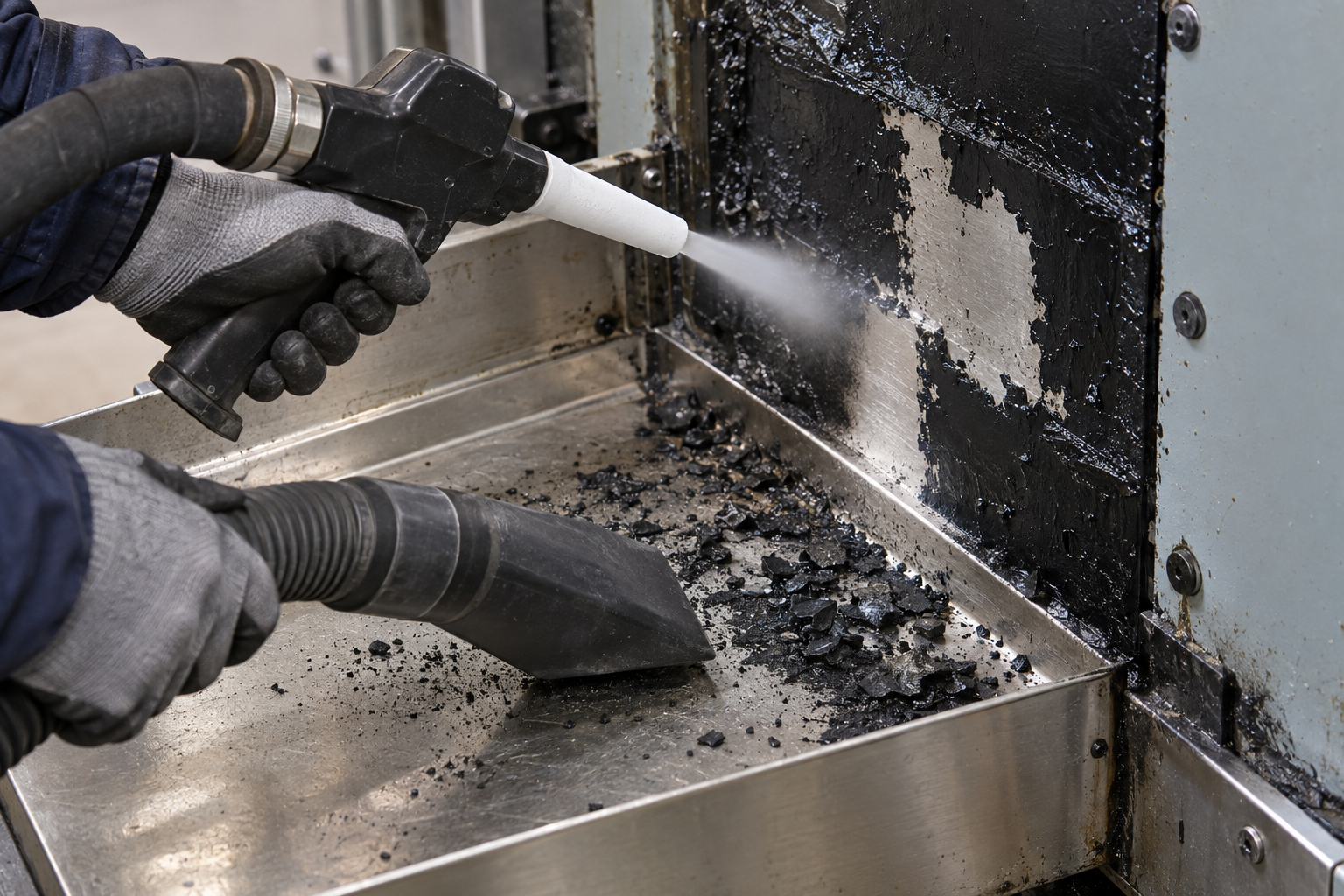
A dry ice cleaning machine accelerates solid carbon dioxide particles with compressed air. Impact, rapid cooling and gas expansion can weaken the bond between contamination and the substrate. The dry ice then changes to gas instead of remaining as spent grit or water.
This does not mean there is no waste. Removed ink, adhesive flakes, grease and paper dust remain in the work area. A vacuum, extraction hood, drop sheet or other containment method must collect them according to the ink chemistry and plant waste procedure. Sublimation removes the cleaning medium from the solid waste stream; it does not remove the contaminant.
Air delivery also controls the result. Pressure shown at the compressor is not necessarily pressure delivered at the nozzle. Hose size, length, fittings, air quality and simultaneous plant demand matter. Review the site’s compressed-air requirements before scheduling a press trial, and match the nozzle to the access and surface rather than choosing only for maximum aggression. Our nozzle selection guide explains that boundary.
Stop, Isolate and Protect the Press
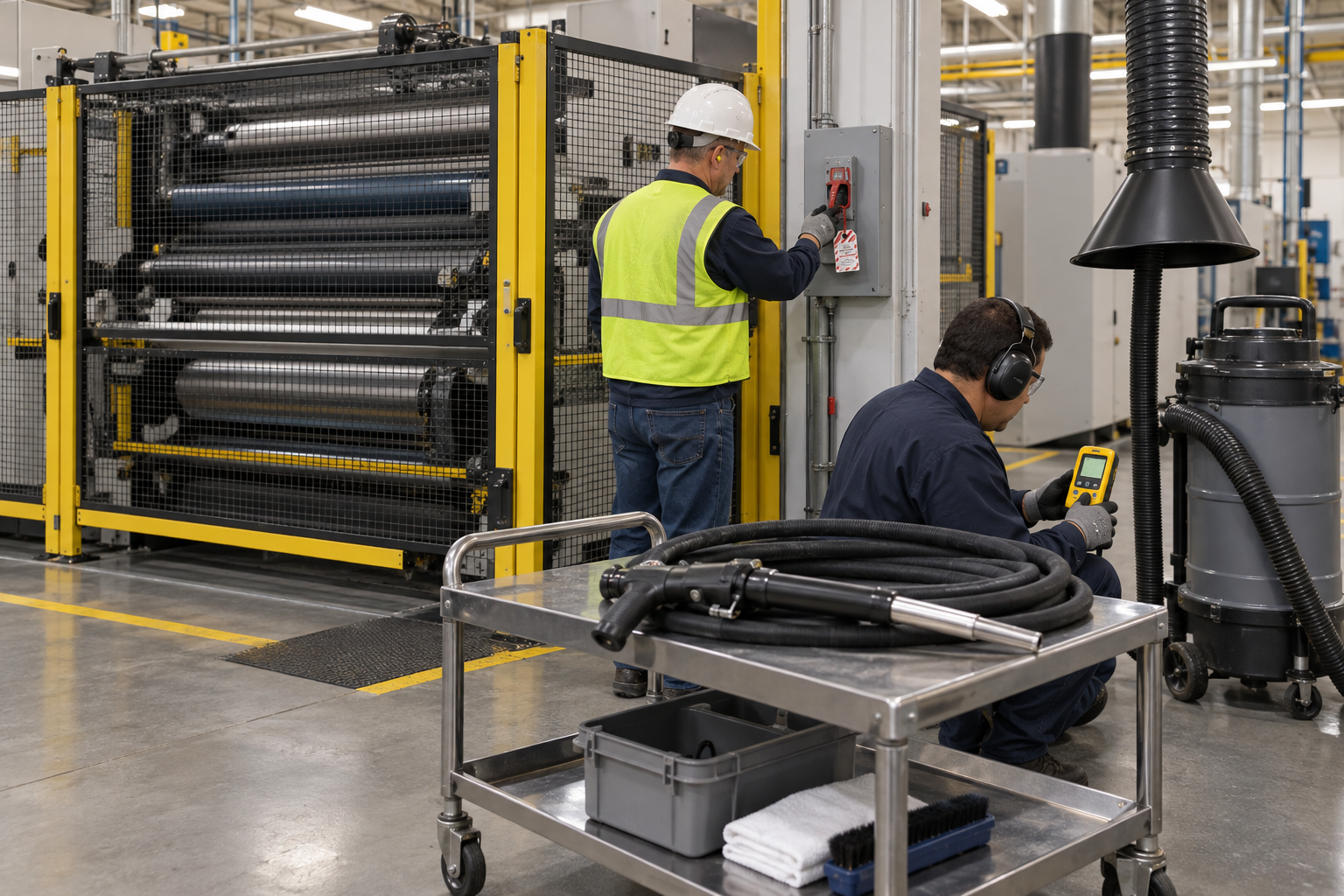
Dry ice cleaning is maintenance work, not a reason to bypass press safeguards. OSHA’s hazardous-energy standard requires control of hazardous energy during covered servicing and maintenance. OSHA has also published printing-industry guidance on lockout/tagout and machine guarding. Local law and the press manufacturer’s procedure may impose additional requirements.
Before blasting:
- Stop the press and apply the site’s approved energy-isolation procedure.
- Verify the zero-energy state rather than relying on a stop button.
- Identify nip points, movable guards, stored pneumatic or hydraulic energy and automatic restart functions.
- Shield or remove components that have not passed compatibility review.
- Establish local exhaust and a collection path for dislodged contamination.
- Define a restricted work zone and inspection method before removing isolation.
Carbon dioxide is a separate hazard. NIOSH identifies dry ice as solid carbon dioxide and lists inhalation, asphyxia and frostbite risks. Ventilation and CO2 monitoring should follow a site exposure assessment. A visible white plume is not an exposure measurement. Operators also need eye, hearing and hand protection suited to noise, flying debris, compressed air and cold contact. See the broader dry ice cleaning safety guide for planning points.
Validate a Component-Specific Cleaning Recipe
A useful trial produces a repeatable maintenance specification, not just a convincing clean patch.
1. Define the endpoint
Name the contaminant and the accepted condition. “Looks clean” is weak. Depending on the component, the endpoint may be no visible ink under defined lighting, an approved surface image, a measured cell volume or a functional inspection after reassembly.
2. Record surfaces to clean and protect
List the substrate, coating, seals, edges, bearings, sensors and adjacent openings. Obtain the press or component manufacturer’s guidance where available. Masking and shielding must be part of the procedure.
3. Start with the least aggressive practical setting
Record machine, air delivery, dry ice condition, particle size, nozzle, distance, angle, traverse speed and dwell. Increase energy only when the surface inspection permits it. One successful setting on a steel tray does not authorize use on a coated roller.
4. Control debris direction
Position extraction so loosened material moves away from bearings, electrical enclosures and product-contact zones. Inspect hidden ledges and gaps after cleaning.
5. Inspect the substrate and function
Check paint, coating, finish, dimensions and component function. If the acceptance method cannot detect the damage being avoided, the trial is incomplete.
6. Release a written procedure
Define approved components, protected zones, settings, PPE, isolation, ventilation, monitoring, debris collection and stop conditions. Changes to ink chemistry, coating, nozzle, air delivery or component design require review.
When Another Cleaning Method Is Better
Dry ice blasting is not the default for every press task. Use the OEM-approved manual or chemical method when contamination is inside a sealed bearing, when a coating cannot tolerate thermal or mechanical stress, when debris cannot be contained, or when the press cannot be safely isolated and ventilated. Precision anilox cleaning may require a specialized validated process rather than a general-purpose blast setting.
The purchase decision should follow a representative site trial. Bring sample contamination, identify the most difficult access points, measure available compressed air and agree on the inspection standard before selecting equipment. The broader printing equipment application overview can help frame that discussion.
Frequently Asked Questions
Can a printing press be cleaned while it is running?
Do not assume so. Cleaning can expose workers to nip points, unexpected motion and stored energy. Follow the machine manufacturer’s instructions and the site’s hazardous-energy and guarding procedure. A normal production stop is not automatically an energy-isolated maintenance state.
Does dry ice blasting leave no waste?
The dry ice media sublimates, but removed ink, adhesive, grease and paper dust remain. They must be captured and disposed of according to the contaminant and site procedure.
Will it damage printing rollers?
Compatibility depends on the roller material, coating, cell geometry, contaminant and blast recipe. Use an OEM-reviewed, low-intensity trial and an inspection method capable of detecting surface change. Do not apply a metal-frame recipe to a precision roller.
What should a buyer test before ordering a machine?
Test representative ink and adhesive on actual or sacrificial components. Record delivered air, dry ice condition, nozzle, settings, distance, angle, dwell, cleaning time, debris behavior and post-cleaning inspection. Confirm ventilation, CO2 monitoring and energy-isolation requirements at the same time.