
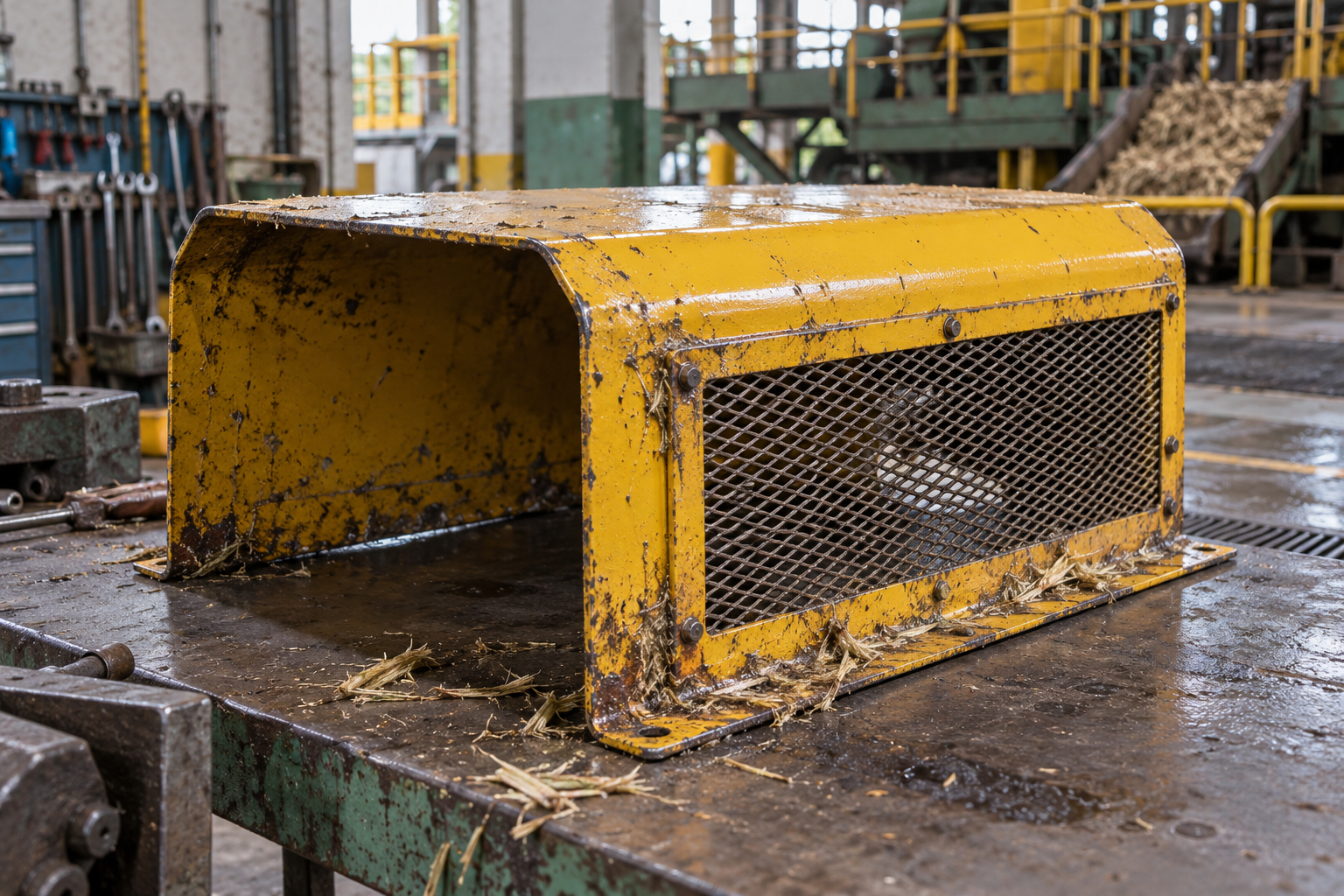
Brazil Sugar Mills: Dry Ice Cleaning Gearbox Guards
A Brazilian sugar mill can trial dry ice cleaning on a removed gearbox guard after identifying the oil-and-fibre deposit, controlling dust disturbance and defining coating acceptance; this does not qualify cleaning of an operating drive or sugar-contact surfaces.
This article is a proposed evaluation guide, not a report of a completed customer installation.
Focus on the oil-bound deposit
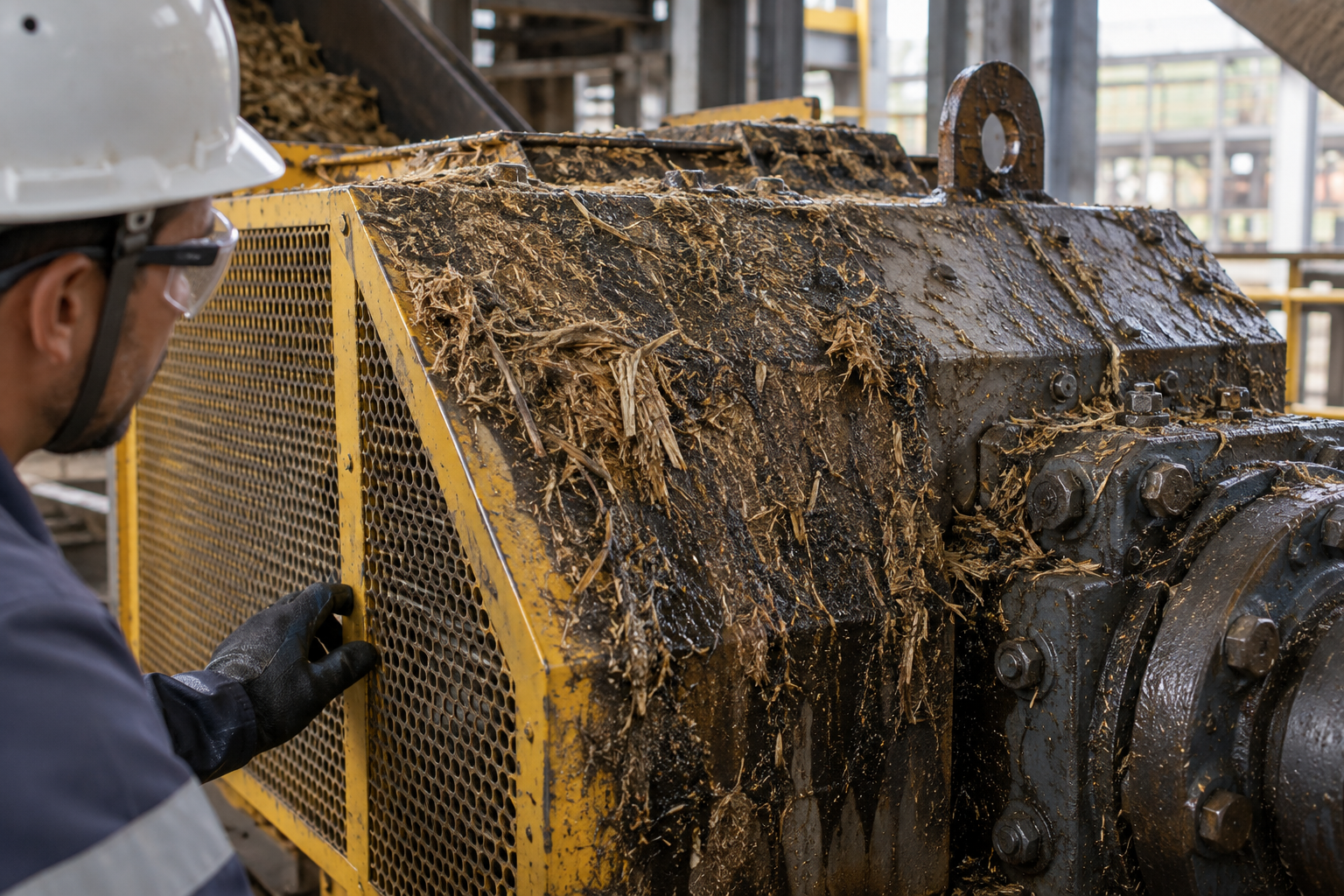
A gearbox guard can carry layers of oily soil mixed with sugarcane fibres. Loose dry material and an oil-bound layer present different collection problems. Map the actual deposit and identify the oil before planning a trial. A cleaning method chosen for a steel guard should not automatically be used on a motor winding, bearing seal or product-contact conveyor. Explain what the maintenance team needs to see afterwards: a coating defect, a loose fastener, a leak path or the guard’s general condition.
Use guard removal as a planned maintenance step
Removing the guard can expose a coupling or shaft. The mill must isolate the relevant drive and prevent unauthorised restart under its own procedure. The detached guard then needs a stable stand with access to both the test patch and the collection side. Do not clean over an open gearbox, uncovered product or an unprotected bearing. Keep the stand and work zone outside normal traffic. Establish who is responsible for refitting the guard and checking that its fasteners and clearances remain correct.
Do not turn settled material into a wider housekeeping job
Review where dislodged oil and fibres will land. The OSHA dust resource is useful background about combustible dust, but it does not decide Brazilian requirements or classify this particular deposit. The mill’s assessment must cover the deposit, the collection equipment and other activities nearby. Remove only what the authorised preparation method permits. If suitable capture cannot be provided, the trial is not ready. Dry ice disappearing does not mean the original soil has disappeared.
Accept the coating and the seams
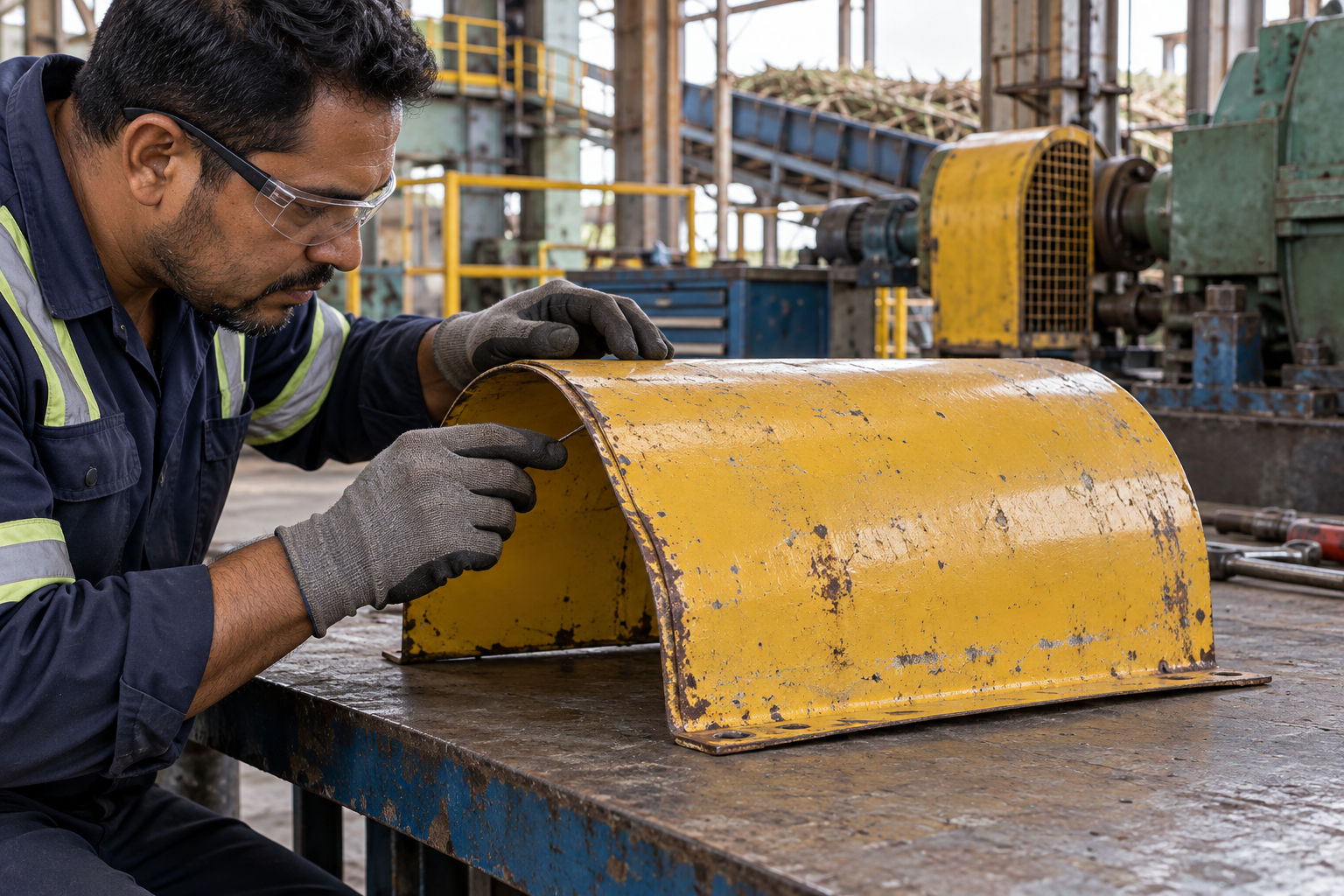
Choose a representative patch spanning a flat area and, where approved, a seam or flange. Inspect after the surface stabilises. Look for paint lifting, exposed corrosion and trapped debris at folded edges. Agree whether old loose paint is an exclusion or an intended removal target; the trial cannot use both definitions after the event. Record any remaining deposit and the work needed at corners. An apparently clean outer face should not hide dirty pockets that will shed material during guard installation.
Count the whole maintenance cycle
For an off-season or scheduled shutdown job, compare the time from authorised removal to completed reassembly. Include handling, setup, containment, inspection and waste collection rather than quoting only nozzle-on time. Ask how the method affects leak inspection: cleaning can expose a path, but it cannot repair a leaking seal. Record the accepted guard family and finish. Keep sugar-contact cleaning and any sanitation work within their existing programmes. A sound decision may be to reserve dry ice for a small subset of difficult exterior guards.
Trial scope and acceptance
| Surface or task | Proposed action | Acceptance boundary |
|---|---|---|
| Detached painted guard | Controlled patch including an approved seam | Deposit removed to the agreed coating limit |
| Exposed coupling or running gearbox | Outside the trial | Isolation before guard handling |
| Sugar-contact equipment | Separate programme | No sanitation claim from guard cleaning |
Local reference and work planning
Brazil’s Ministry of Labour publishes NR-12 on machinery and equipment safety. The mill should review the applicable current text and its own maintenance controls before removing a guard; a cleaning supplier does not authorise changes to machine protection. See Brazil Ministry of Labour NR-12 publication.
The NIOSH carbon dioxide reference identifies inhalation and cold-contact hazards. Have the competent site team establish ventilation, CO2 monitoring where required, handling, noise and eye protection, and emergency arrangements for the actual task. Do not rely on an oxygen reading alone to assess CO2 exposure. Removed contamination still needs collection and an appropriate waste route.
For maintenance-isolation background, the US OSHA hazardous-energy standard addresses control of hazardous energy. It is a US reference, not a statement of local law for this application. Use the facility’s approved isolation and restart procedure.
Questions before a supplier trial
Will dry ice repair an oil leak?
No. It may help expose a surface for inspection; diagnosis and repair remain separate.
Should every guard be stripped to bare metal?
Only if that is the approved maintenance objective. Coating preservation and coating removal require different acceptance criteria.
Prepare the supplier discussion
Send DryIceSys the substrate and coating details, photographs of the actual deposit, approved trial zone, available utilities and written acceptance criteria. Request an application review before selecting equipment or estimating production capacity. For practical preparation, use the site-readiness checklist, machine-safety guide and nozzle-selection guide. These guides support planning; the component owner still defines the permitted scope.