
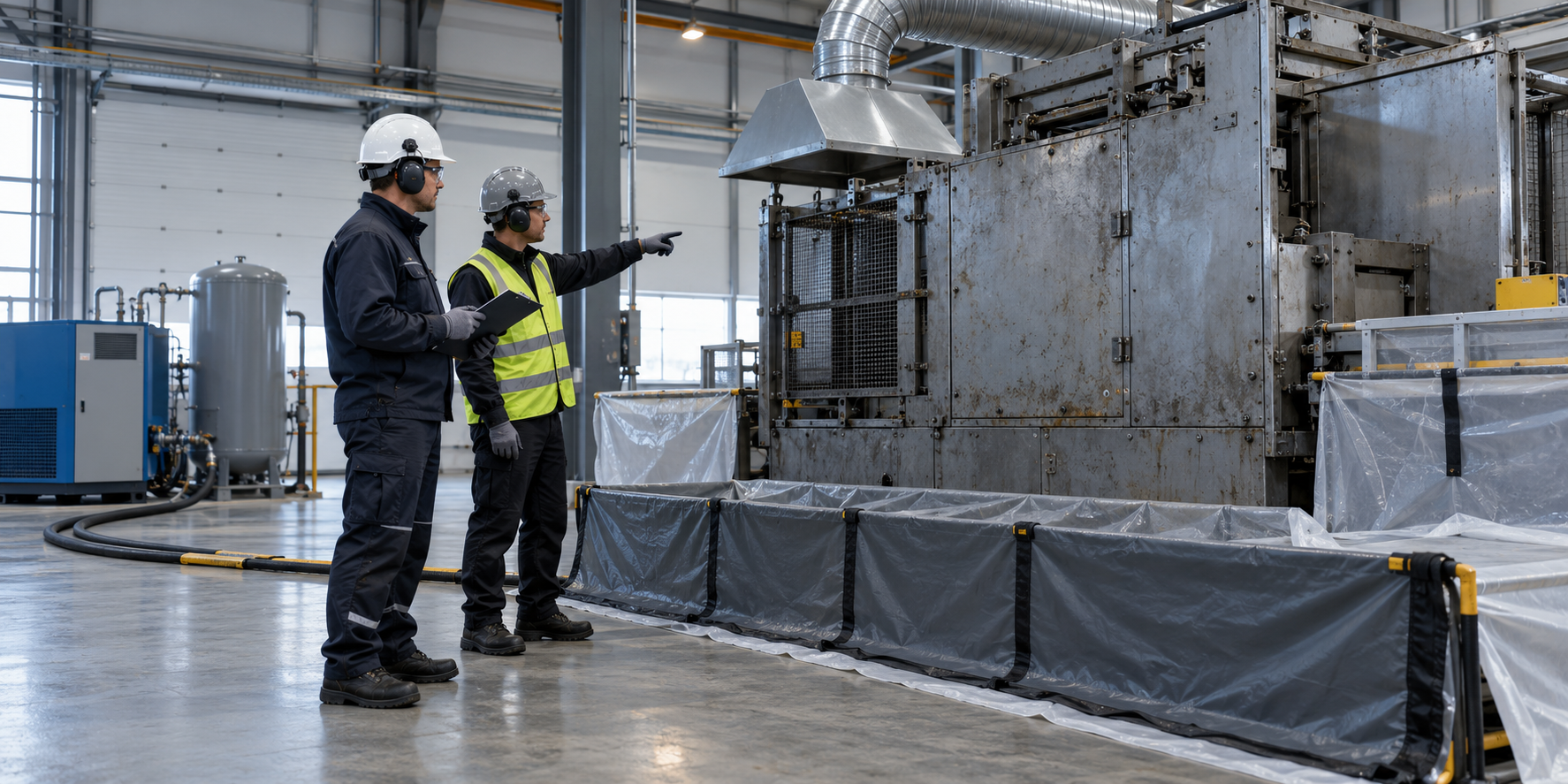
Dry ice blasting should start only after the work area, energy isolation, air supply, carbon-dioxide controls, and residue route are checked against the actual cleaning task. A machine specification alone cannot establish that a particular site is ready. This checklist helps a maintenance planner turn those requirements into a documented go/no-go decision before pellets are loaded.
The sequence applies to industrial maintenance with a portable dry ice blasting system. It is a planning framework, not an authorization for work on live electrical equipment, confined spaces, unknown coatings, or uncontrolled contamination. Local rules and the site’s qualified personnel govern those cases.
1. Define the work before arranging utilities
“Clean the machine” is not a usable work scope. Identify the exact component, substrate, coating, contaminant, area, and accepted condition. A cleaning trial on a robust external steel panel does not authorize blasting nearby seals, labels, electrical connectors, bearings, or fragile finishes. Photograph the starting condition and mark both the target and the exclusions.
The project owner should also decide who will isolate equipment, who may operate the blaster, who approves the test patch, and who handles the removed material. If the contamination is unknown, stop and identify it before choosing a cleaning method or disposal route.
| Gate | Evidence to record before work | Stop or redesign when |
|---|---|---|
| Surface | Material, coating condition, contaminant, target finish, protected parts | The coating or residue is unknown, or the accepted finish is undefined |
| Isolation | Site procedure, isolated energy sources, verification, release authority | Unexpected motion, pressure, heat, or electrical energy remains possible |
| Utilities | Delivered air pressure and flow, power compatibility, hose route | The supply drops below the machine requirement during a trial |
| Atmosphere | Ventilation arrangement and carbon-dioxide exposure assessment | The space or airflow cannot be assessed and controlled |
| Residue | Collection method and waste identification | Removed material can migrate or its handling is undecided |
2. Confirm isolation and access
Where servicing exposes workers to unexpected startup or stored energy, a maintenance team needs the applicable energy-control procedure. In US general industry, OSHA’s hazardous-energy standard explicitly includes cleaning within servicing and maintenance when such exposure is possible. The standard has scope exceptions, so use the rules that actually apply to the site and equipment. Dry ice blasting does not replace isolation, guarding, or verification.
For electrical equipment, a separate assessment is essential. OSHA’s electrical work-practice standard describes de-energizing and verification by a qualified person for covered work. A photograph of a switch in the “off” position is not verification. Our guide to dry ice blasting electrical equipment explains why component compatibility and electrical state must be decided before cleaning.
Check access as a physical route, not only as a floor-space estimate. Keep the blast hose clear of sharp edges, vehicle paths, stairs, and moving machinery. Confirm safe footing, lighting, a protected pellet staging point, and an exclusion zone that prevents other workers entering the blast path.
3. Test the air and power at the machine
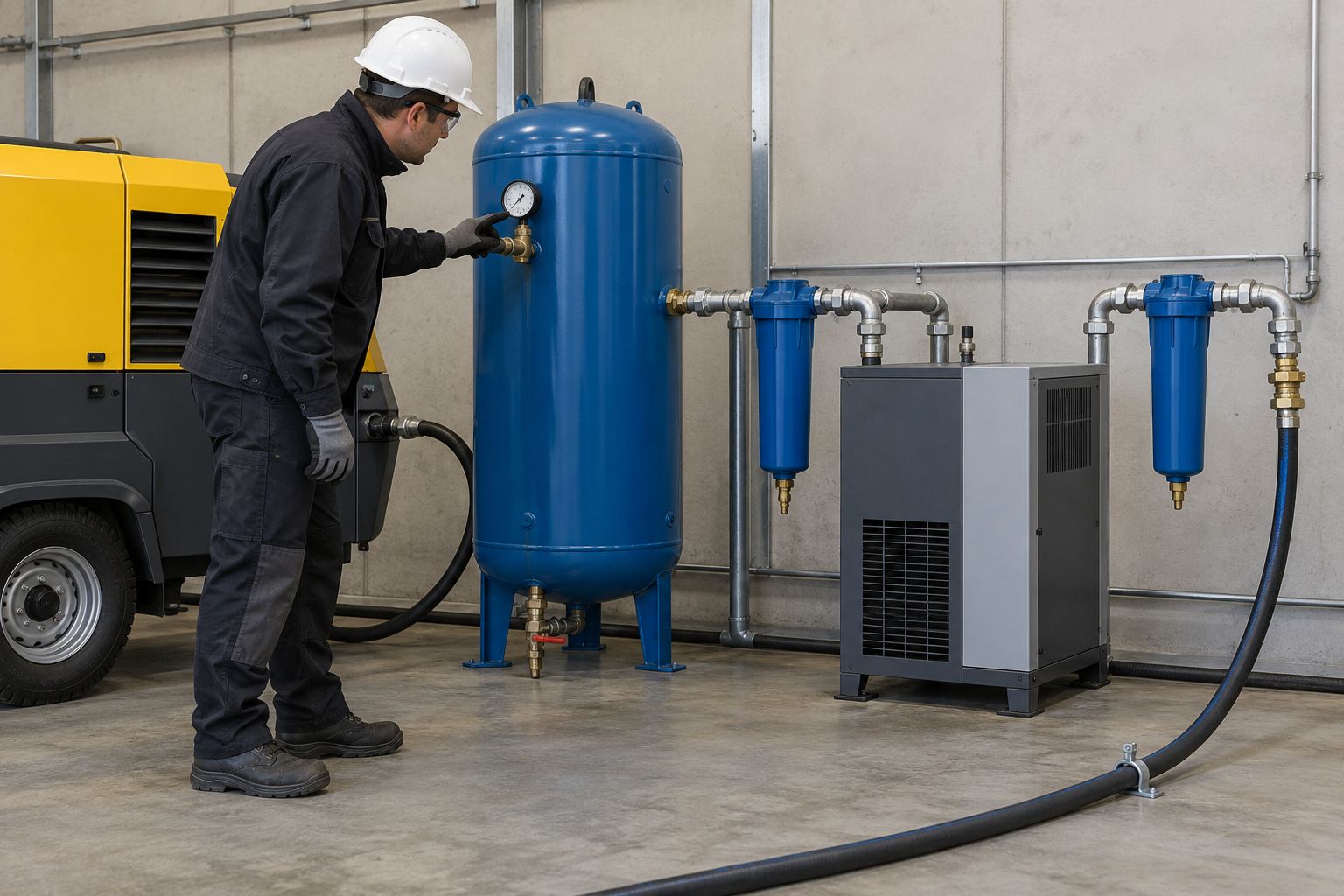
The available compressor must meet the chosen machine’s pressure and flow at the inlet during operation. For example, the DryIceSys 20 L machine specification states 0.6–0.8 MPa and 2–4 m³/min at the air inlet, with more than 0.4 MPa maintained during continuous operation. Those values describe this model, not every dry ice blaster. Check the site’s voltage and frequency against the selected configuration as well.
A compressor nameplate or a static gauge reading cannot show what reaches the blaster after a long hose, filters, fittings, and simultaneous plant demand. Record pressure while the proposed nozzle and dry ice feed run. Check for condensate, oil carryover, leaks, and pressure fluctuation; then confirm that the air preparation and hose arrangement match the equipment requirements. An air receiver may buffer demand, but it is not a substitute for adequate compressor output. In US workplaces, OSHA’s air-receiver rule addresses receiver equipment and drainage. For more on this calculation, see our compressed-air requirements guide.
4. Plan for carbon dioxide, noise, and people
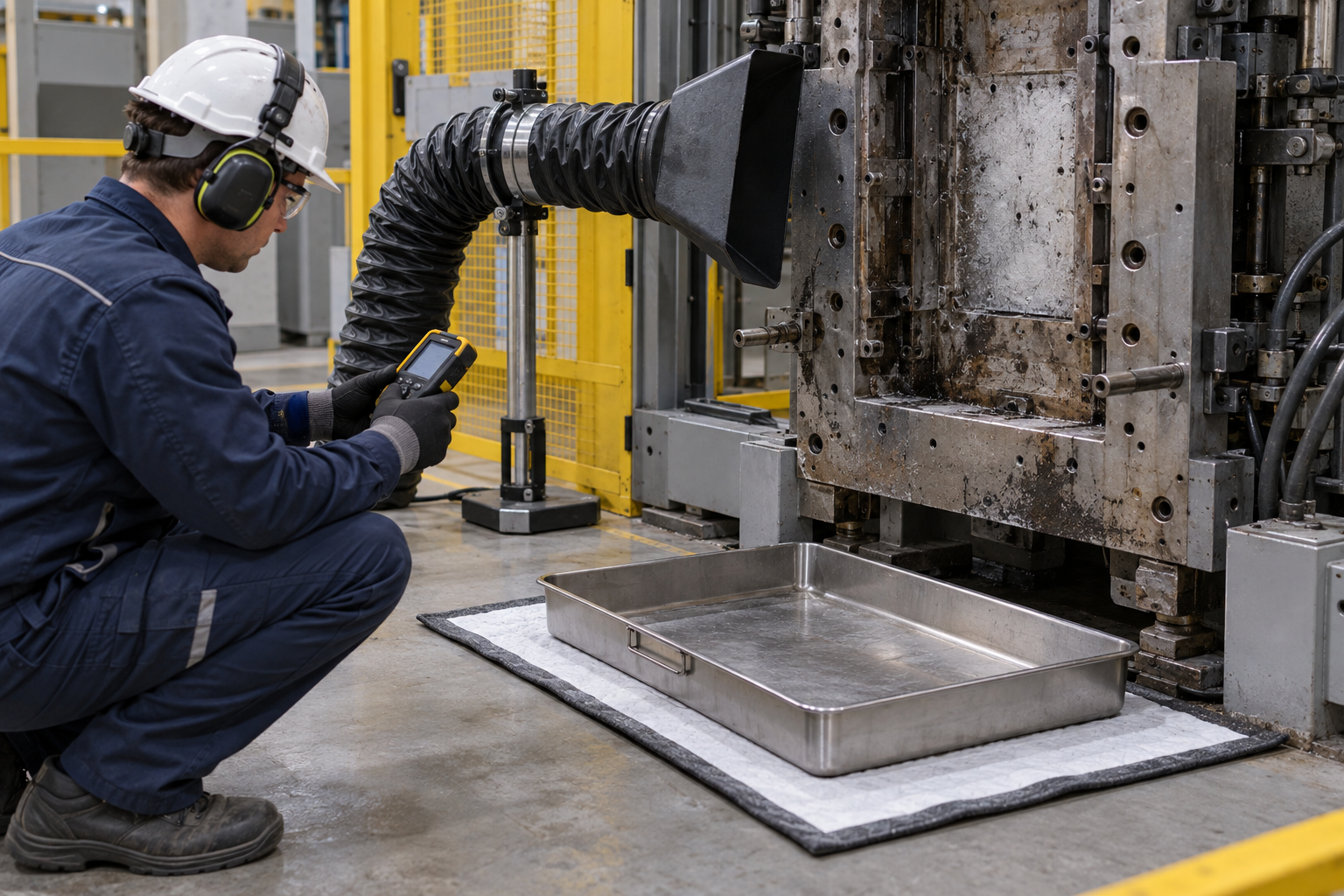
Dry ice becomes carbon-dioxide gas as it sublimates. It is not safe to infer adequate ventilation from the absence of visible fog or odor. The NIOSH carbon-dioxide entry identifies inhalation and asphyxiation hazards and gives occupational exposure limits. Use a site-specific assessment to determine airflow, monitoring, access control, and whether the proposed space is suitable at all. A small enclosure, pit, or low-lying area deserves particular attention; do not apply a generic air-change number as a universal approval criterion.
Dry ice blasting also creates task-dependent noise and flying debris. Assess the actual work zone, choose eye and face protection, hearing protection, gloves and clothing suited to the job, and keep observers outside the exclusion boundary. The broader DryIceSys safety guide covers the operator checklist; the site plan must add the specific location, other trades, and emergency response.
5. Give the removed material somewhere to go
Sublimation means the dry ice does not leave a pile of spent blasting media. It does not make oil, dust, paint flakes, carbon, adhesive, or other dislodged contamination disappear. Protect drains and adjacent equipment, position collection trays or sheeting where appropriate, and choose a method for collecting and identifying the residue. Confirm who will clean the area after blasting and how the waste will leave the site.
Waste classification depends on the material removed and the jurisdiction. For US small businesses, the EPA hazardous-waste guide is a starting point for determining generator responsibilities. A dry process is not automatically a zero-waste process. If the site cannot contain the target contaminant, redesign the work before starting.
6. Run a small qualification trial
Once the site gates pass, select a representative durable test area away from protected components. Record the nozzle, delivered air, pellet size and feed, hose arrangement, distance, angle, dwell time, ventilation state, and residue-collection method. Begin within the machine’s operating instructions and adjust one variable at a time.
Inspect the surface after the test. The result must meet the pre-agreed cleaning endpoint and preserve the specified coating and nearby parts. Stop for coating lift, texture change, marking loss, seal disturbance, uncontrolled residue movement, pressure drop, or a ventilation problem. A successful patch qualifies only the documented combination of surface, contamination, setup, and site controls; changing those conditions requires another decision.
The most useful handover is a short job card containing the five gate decisions, a photo of the test area, measured utilities, accepted setup, exclusion map, stop conditions, and sign-off. It makes the next shift’s work reproducible and gives a supplier a concrete basis for equipment selection.
FAQ
Is a large compressor enough by itself?
No. The relevant measurement is clean, dry air delivered at the blaster during the actual duty cycle. Hose loss, filters, simultaneous users, and the chosen nozzle can change the result.
Does dry ice blasting require ventilation outdoors?
Outdoor work still needs a site assessment for enclosed recesses, pits, nearby openings, worker position, and local air movement. There is no universal outdoor exemption from evaluating carbon-dioxide exposure.
Can the same approved setup be used on a different surface?
Only after reviewing that surface and contaminant. A passed trial on durable metal does not establish compatibility with paint, seals, electrical parts, labels, or another coating.
Is there no cleanup because the pellets sublimate?
The pellets do not remain as solid blast media, but the removed contamination remains. Collection and waste handling must be planned before work starts.