
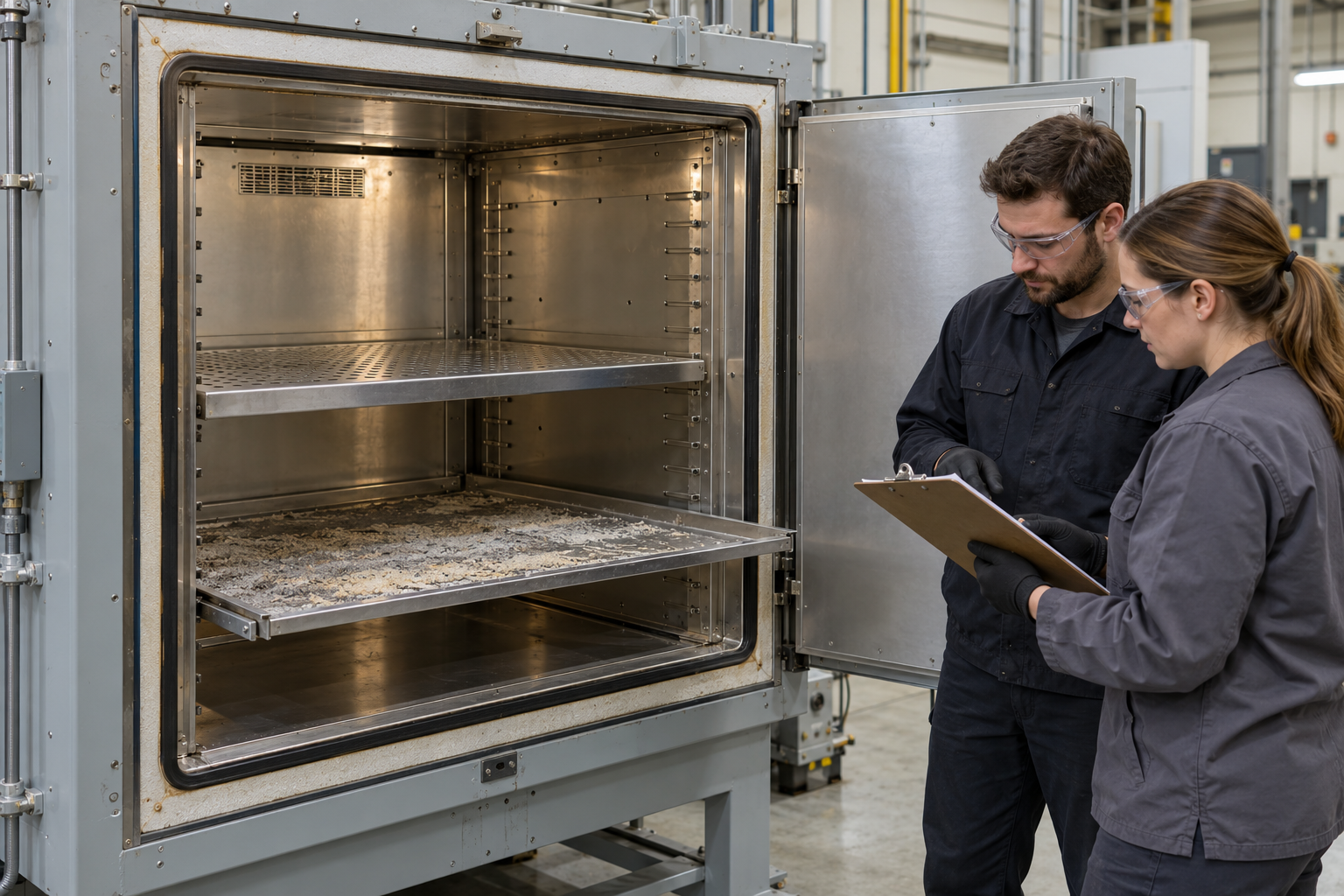
Industrial ovens accumulate different residues in different zones. A removable tray with baked-on product, an insulated wall, a fan guard, and a sensor housing do not share the same cleaning limit. Dry ice blasting can be evaluated for selected industrial oven trays, racks, and robust metal fixtures only after the oven is cooled, isolated, ventilated, residue hazards are assessed, and a representative test patch plus collection plan pass site review. A successful patch qualifies the defined surface and deposit, not the whole oven.
This guide is for maintenance planners, process engineers, and EHS teams deciding whether to trial dry ice cleaning. The oven maker’s manual, process chemistry, lockout procedure, and waste classification control the final method.
Start with a surface and residue map
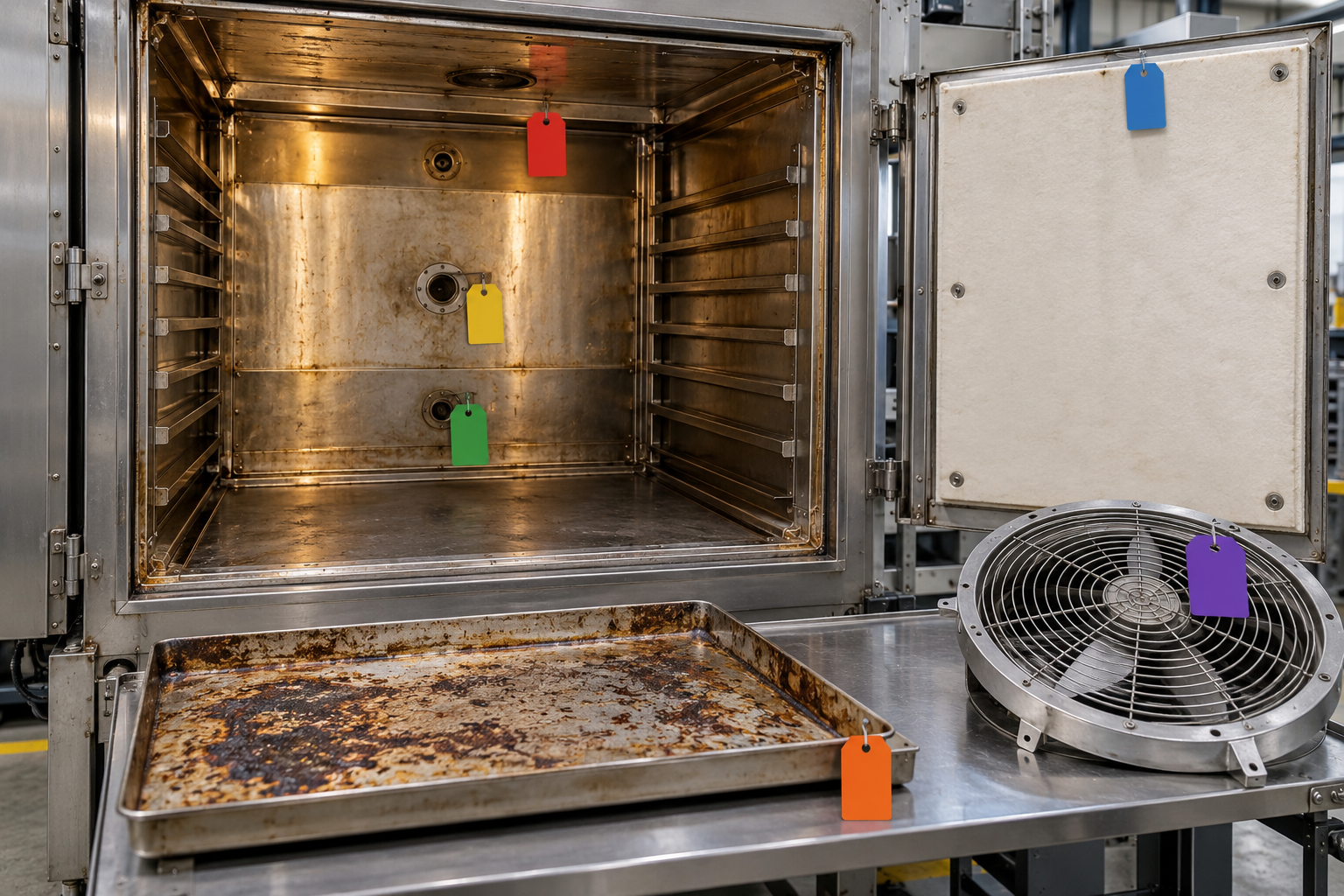
Record what the oven does before selecting a nozzle. Powder-coating ovens, food process ovens, composite cure ovens, and heat-treatment equipment can leave very different deposits. Note whether the residue is oily, carbonized, polymerized, powdery, or mixed with product fragments. Identify the substrate beneath it: stainless steel, painted steel, insulation, gasket material, aluminum, or a coated panel.
A removable tray or rack is often the most practical first candidate because it can be taken to a controlled work area, inspected on both sides, and weighed before and after the trial. A fan guard may need a different approach because bent fins can change airflow. Treat insulation, heaters, thermocouples, seals, electrical boxes, and filter media as separate risk categories until the manufacturer or responsible specialist approves a method.
The DryIceSys nozzle-selection guide helps organize access and coverage questions. It does not establish that a particular residue will release at a particular setting. Photograph the starting condition and retain a residue sample when the site’s process requires it.
Cool, isolate, and control the work area
Do not treat a closed oven as safe because its controller is off. Follow the oven maker’s cool-down sequence and verify stored heat at the work surface. Isolate electrical, pneumatic, hydraulic, gas, and conveyor energy under the site’s approved procedure. OSHA’s hazardous-energy standard, 29 CFR 1910.147, addresses servicing and cleaning where unexpected startup or stored energy could injure workers in covered US workplaces.
Ventilate the chamber and surrounding work area according to the residue and process assessment. If the prior process involved solvents, coatings, food soils, resins, or combustible dust, identify the atmosphere and ignition controls before bringing in a portable blaster or collection device. The OSHA combustible-dust resources explain why dust accumulation and dispersion need process-specific controls. Dry ice does not make a combustible residue harmless, and the pellets’ sublimation does not remove the dislodged solids.
Plan where the residue will go. Protect fan housings, filters, bearings, heaters, and downstream ducting from re-entrainment. If the oven is large enough for a person to enter, apply the site’s confined-space assessment rather than assuming an open door is sufficient. Keep the maintenance window separate from product production and restart checks.
Use a small test patch
Select a representative area on the actual tray, rack, or fixture. Document the surface finish, deposit thickness, nozzle, air supply, pellet condition, distance, angle, dwell time, and collection method. Start within the equipment manufacturer’s instructions and stop after a short pass. Inspect the cleaned patch and the surrounding area under good light.
Look for scratches, changed gloss, exposed corrosion, distortion, displaced seals, residue pushed into perforations, and contamination of nearby components. Inspect the underside of a tray and the back of a rack. If the deposit resists removal, reassess chemistry and mechanical limits instead of increasing energy indefinitely. A bright patch can still be a failed trial if the base finish has changed or residue has moved into a protected zone.
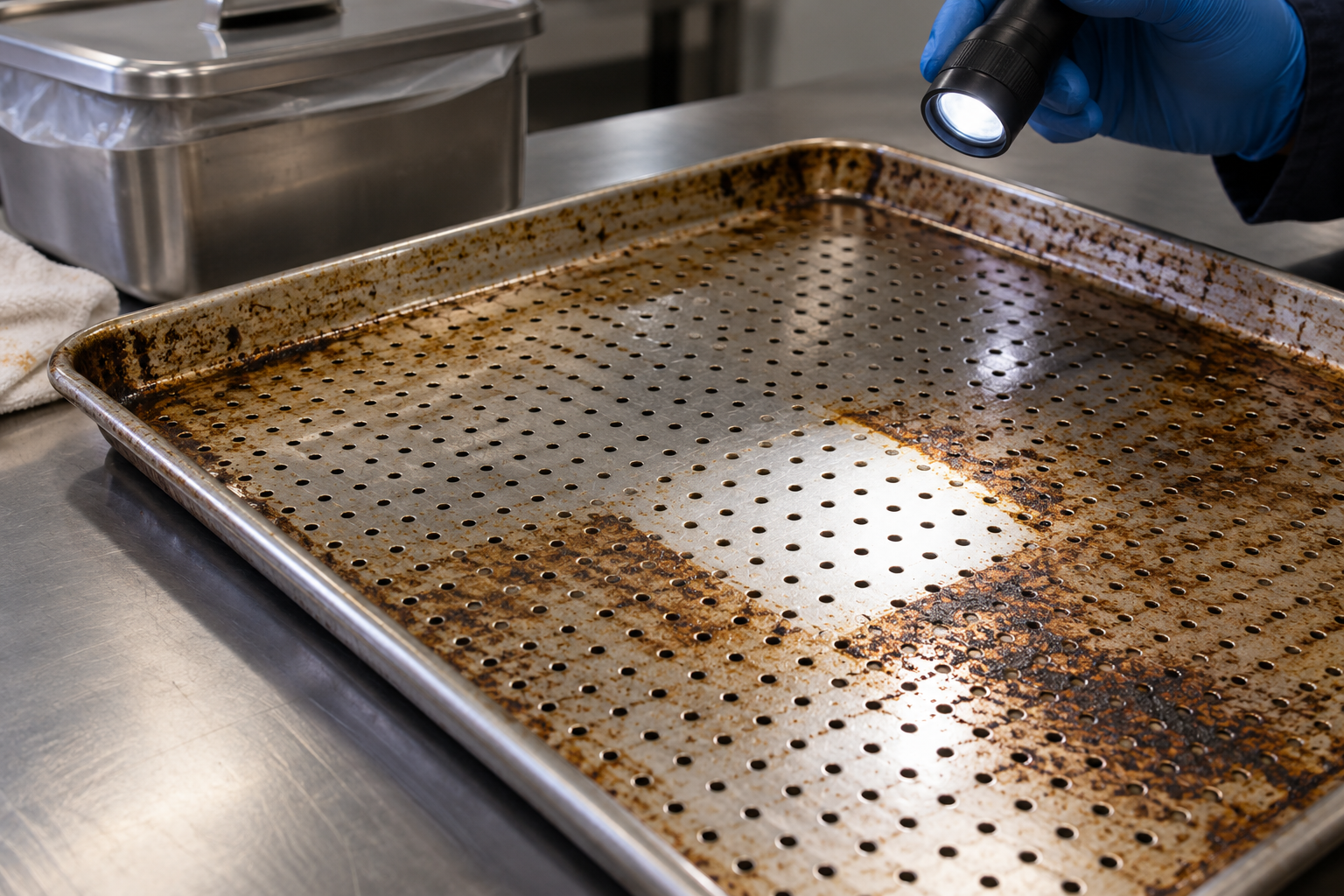
Define the acceptance gate before expanding. A reasonable gate might require removal of the identified residue from the selected area, no substrate or coating damage, no contamination of protected parts, and complete capture of dislodged material. The DryIceSys site-readiness checklist can help structure air, access, containment, and restart questions.
Manage residue and carbon dioxide
The dry ice becomes carbon-dioxide gas, but baked-on product, coating, carbon, and dust remain. Use the facility’s waste classification and disposal route; do not sweep material into a drain or blow it into an exhaust path. Keep collection equipment compatible with the residue and prevent settled material from being re-entrained when the oven door closes.
The NIOSH carbon-dioxide pocket guide describes exposure limits and symptoms such as headache, dizziness, and breathing difficulty. Evaluate low areas, enclosed chambers, adjacent occupied spaces, and the amount of dry ice used. Monitor where the site’s assessment requires it, and do not rely on visible fog as a safety test. Follow the DryIceSys machine-safety guide for general controls, then adapt them to the oven and crew.
Before restart, verify that residue has been collected, fan guards and filters are restored, sensors and heaters are unobstructed, doors and seals are correctly fitted, and the oven passes its normal prestart checks. Product quality validation remains a separate step.
A go/no-go table for an oven trial
| Observation | First decision | Trial gate |
|---|---|---|
| Removable stainless tray with identified baked residue | Confirm chemistry, substrate and waste route | Small patch releases residue without scratching or distortion |
| Perforated rack or fixture | Check both faces and trapped-residue paths | No residue is pushed into holes or protected joints |
| Fan guard or air path | Review airflow and balance limits | Responsible specialist confirms no fin damage or re-entrainment |
| Heater, thermocouple, sensor, gasket, or insulation | Obtain maker guidance | Exclude from a general trial until specifically approved |
| Oven still hot, energized, or poorly ventilated | Stop and complete shutdown and atmosphere controls | No blasting until the work area is cleared |
| Unknown mixed residue | Identify material and disposal route | Pause until hazards and collection are defined |
The table is a screening tool, not an operating recipe. Delivered air, nozzle geometry, residue chemistry, and substrate determine the result.
Frequently asked questions
Can a dry ice trial start while the oven is cooling?
Wait for the site’s defined cool-down and isolation checks. The team must control stored heat, hazardous energy, atmosphere, and access before blasting begins.
Does dry ice remove every baked-on deposit?
No. Deposit chemistry, cure history, thickness, substrate, and settings change the result. Test the defined residue instead of making a universal removal claim.
Is there no waste because pellets disappear?
No. Carbon dioxide leaves the chamber, while dislodged solids remain. Capture and dispose of them under the site’s procedure.
Does a tray test approve the oven’s fan and sensors?
No. Trays, fan guards, heaters, seals, sensors, and insulation have different failure modes. Each needs its own review.
Sources and scope
The safety discussion uses OSHA 29 CFR 1910.147, OSHA combustible-dust resources, and the NIOSH carbon-dioxide pocket guide. DryIceSys links provide equipment and planning context. The oven maker’s manuals, process records, EHS review, waste classification, and test result govern the final method.