

Battery plants combine clean production areas, guarded automation, precision tooling, sensors, and materials that cannot be treated as one cleaning surface. A fixture plate, draw-chain guide, sensor housing, and electrical interface have different contamination and damage limits. Dry ice blasting can be evaluated for selected battery-manufacturing fixtures and robust metal guides only after the line is stopped, the area is isolated and assessed for electrical and material hazards, contamination controls are defined, and a representative test patch passes inspection. A successful patch qualifies the defined surface and deposit, not the whole line.
This guide is for manufacturing engineers, maintenance planners, EHS leads, and equipment buyers. The plant’s process specifications, dry-room rules, battery safety program, and equipment manuals govern the final method.
Map tooling, contamination, and sensitive zones
Begin with the source of the residue. Dust from dry powders, adhesive transfer, separator fibers, lubricant film, and metal fines can look similar while behaving differently under impact. Record the process step, the material handled, the substrate, and whether the residue is loose, tacky, cured, or electrostatically held.
Removable aluminum tooling, stainless fixtures, and accessible guide surfaces may be reasonable candidates for a controlled trial. Sensor windows, connectors, busbar interfaces, exposed cells, seals, and guarded motion components require separate decisions. The DryIceSys site-readiness checklist helps frame access, air, containment, and restart questions, but it does not replace the battery maker’s contamination limits.
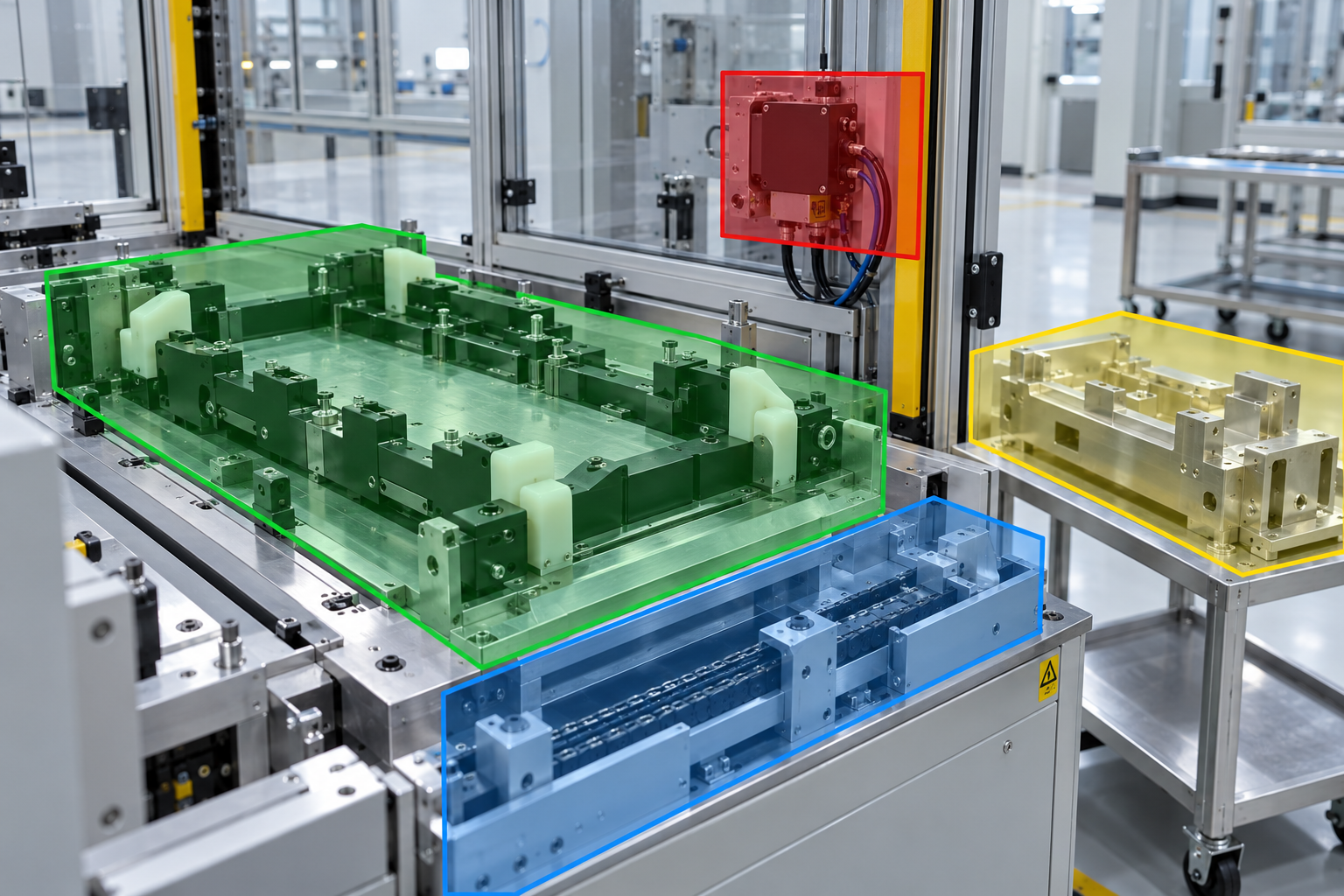
Define what “clean” means before a trial. It may mean removal of a particular adhesive film without changing anodized finish, or removal of loose process dust without moving it into a guarded cavity. It should also state what must remain untouched and how the result will be inspected or sampled.
Stop the line and protect the process
Use the line’s approved shutdown, lockout, and battery safety procedure. Isolate electrical, pneumatic, hydraulic, servo, and conveyor energy. Prevent automatic restart and secure carriers, nests, and tooling. OSHA’s hazardous-energy standard, 29 CFR 1910.147, covers servicing and cleaning where unexpected startup or stored energy could injure workers in covered US workplaces.
Treat the work area as a contamination-control problem. Protect open cells, electrolyte-contact surfaces, dry-room filters, cameras, encoders, and clean tooling from dislodged material. If the process handles combustible powders or fine dust, review the site’s hazard assessment and the OSHA combustible-dust resources. Dry ice does not neutralize powder chemistry, and its sublimation does not remove the solids released by cleaning.
Review grounding, bonding, electrical-area classification, and the compatibility of collection equipment. Carbon dioxide can accumulate in enclosed or low areas. The NIOSH carbon-dioxide pocket guide describes exposure limits and symptoms; the plant determines ventilation, monitoring, and work authorization.
Test one fixture before touching the line
Choose a removable fixture or a robust guide with the actual contamination. Record the finish, residue, dimensions, nozzle, air supply, pellet condition, distance, angle, dwell time, and capture setup. Start with a short pass under the blaster and tooling maker’s limits. Inspect the cleaned patch under suitable light and magnification if the process requires it.
Check for scratches, coating loss, changed dimensions, burr movement, embedded particles, residue pushed into holes, and contamination of nearby sensors or seals. Wipe or sample the area using the plant’s approved method, then compare against the process cleanliness requirement. If the residue does not release, change the trial design or stop; escalating energy without understanding the failure mode can damage precision tooling.
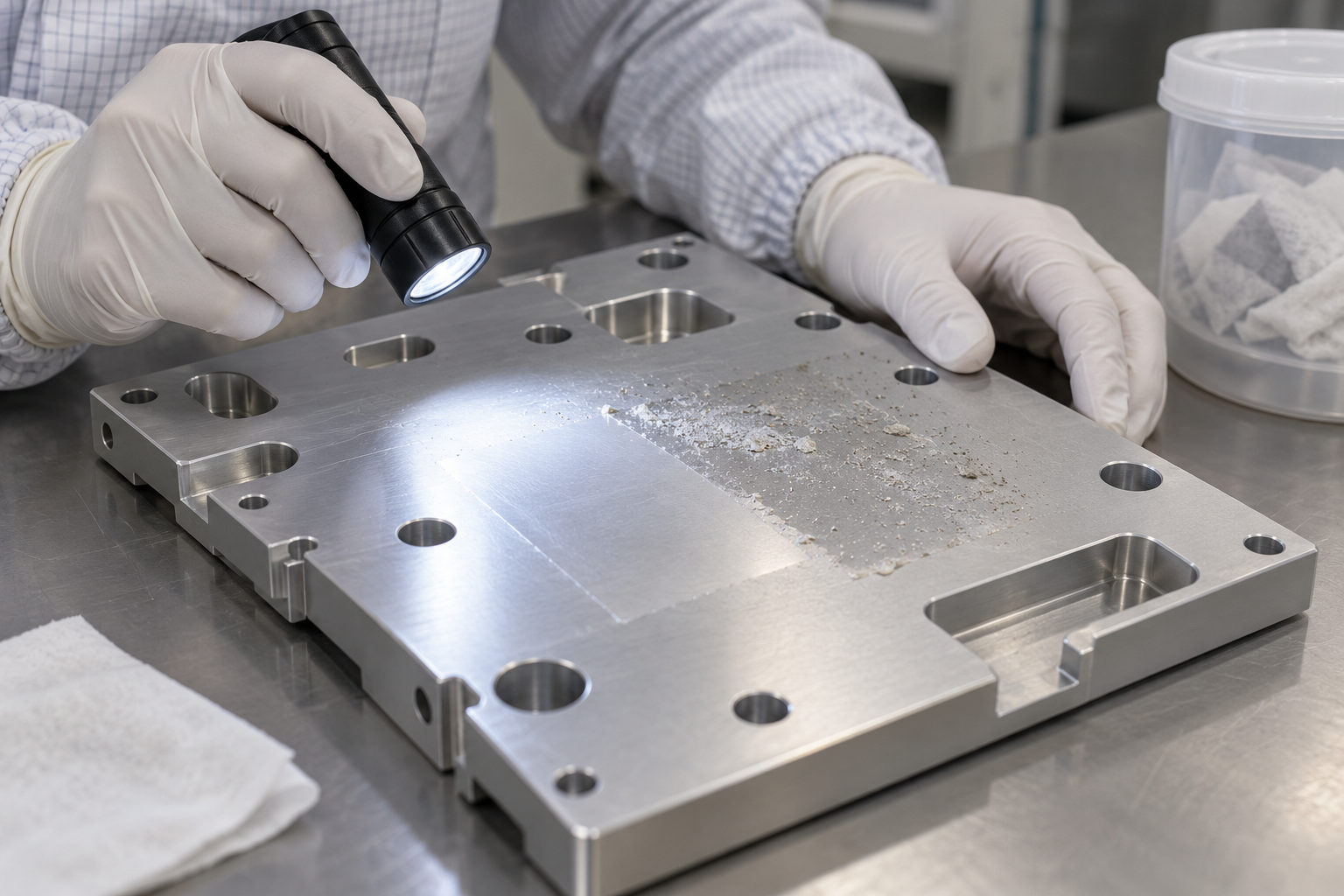
A successful patch should answer four questions: Was the target residue removed? Did the substrate and dimensions remain acceptable? Did the residue stay out of protected interfaces? Can the plant collect and dispose of it without breaking its contamination controls? The answer must be documented before expanding to a mounted fixture.
Control residue, carbon dioxide, and restart risk
The pellets disappear, while adhesive, powder, fibers, and metal fines remain. Capture them at the source and protect filters, nests, bearings, sensors, and electrical interfaces. Do not drive contamination into a guarded cavity or rely on a later wipe to make an unapproved process acceptable. Use the plant’s waste and contamination route for the collected material.
The DryIceSys machine-safety guide provides general handling controls, but the plant must add battery-specific restrictions. Review gloves, eye and hearing protection, compressed-air quality, grounding, and the location of dry ice storage. Verify that no cell, electrolyte path, or energized interface is exposed to the trial.
Before releasing the line, remove tools and temporary covers, inspect the fixture and sensors, restore guards, check carrier alignment, and complete the normal dry-room and equipment prestart checks. Product-quality and electrical-safety checks remain separate acceptance gates.
A go/no-go table for battery tooling
| Observation | First decision | Trial gate |
|---|---|---|
| Removable aluminum fixture with identified adhesive film | Confirm finish, dimensions and waste route | Patch removes target film without coating or dimensional change |
| Stainless guide with loose process dust | Check collection and re-entrainment paths | Dust is captured without moving into the nest or sensor area |
| Sensor window, encoder, connector, or seal | Obtain maker and process guidance | Exclude from a general trial until specifically approved |
| Open cell, electrolyte path, busbar, or energized interface | Stop and escalate to battery safety owner | No exposure until the plant’s method is authorized |
| Fine powder or unknown mixed residue | Identify chemistry and combustible-dust controls | Pause until containment and disposal are defined |
| Line still energized or capable of automatic motion | Complete lockout and restart prevention | No blasting until isolation is verified |
This table screens a method; it does not approve a production recipe. Tool geometry, contamination chemistry, clean-room controls, and inspection requirements determine the result.
Frequently asked questions
Can a mounted battery fixture be cleaned during a short line pause?
Only if the plant’s shutdown, isolation, contamination, and restart procedures authorize it. A short pause does not remove electrical, motion, material, or CO2 hazards.
Does dry ice blasting make a fixture sterile or particle-free?
No. It can be evaluated for a defined residue and surface, but the plant must specify its own cleanliness test and acceptance limit.
Can the same setting be used on sensors and aluminum tooling?
No. Precision tooling, coatings, sensor windows, seals, and electrical interfaces have different limits. Review each surface separately.
Is there no waste because the pellets sublimate?
No. Removed powders, adhesive, fibers, and fines remain and need controlled capture and disposal.
Sources and scope
The safety discussion uses OSHA 29 CFR 1910.147, OSHA combustible-dust resources, and the NIOSH carbon-dioxide pocket guide. DryIceSys planning and safety pages provide equipment context. The DryIceSys nozzle-selection guide can help frame access and coverage questions. The plant’s battery safety program, process specifications, equipment manuals, contamination test, and EHS review govern the final method.