
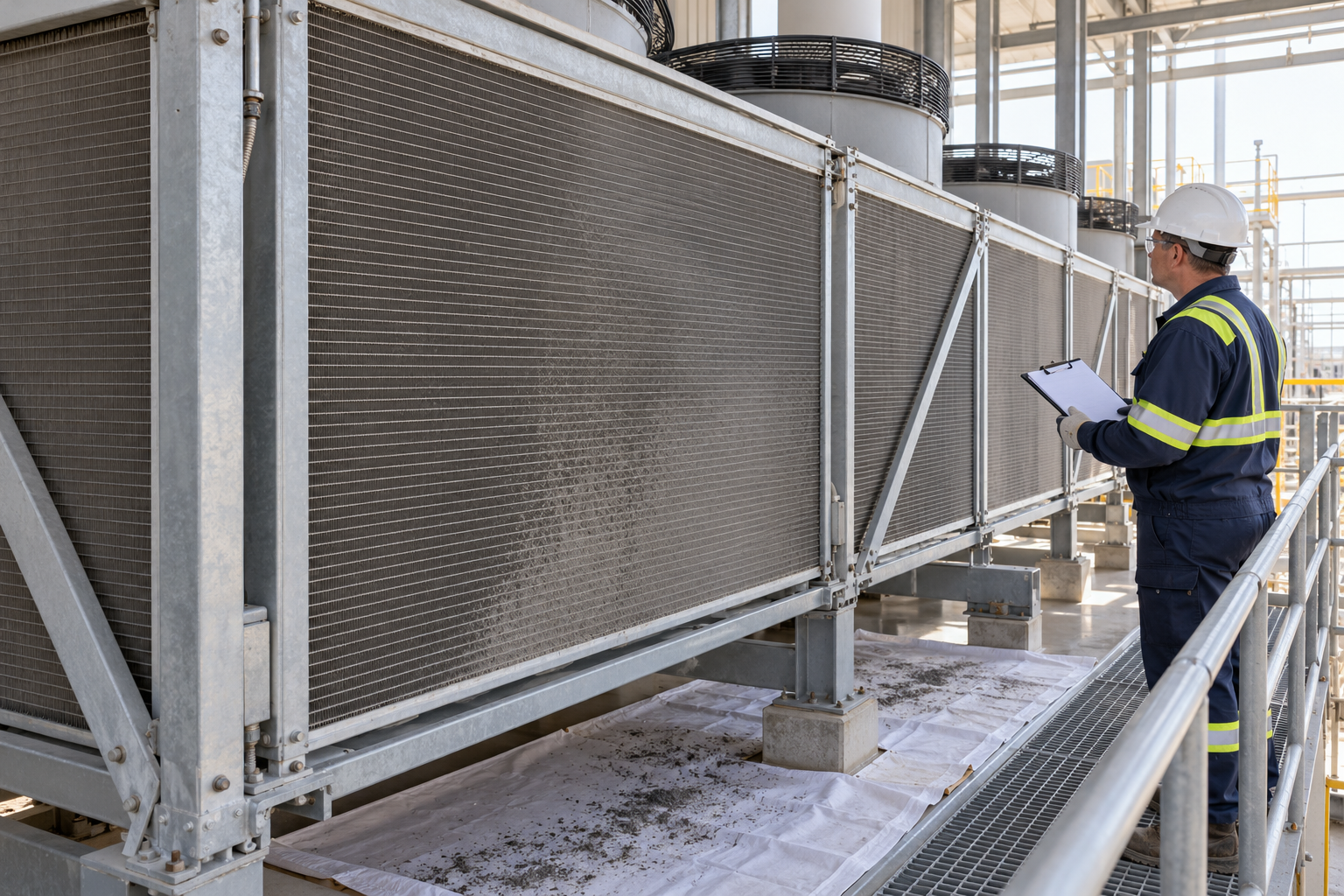
When a fin-fan cooler or air-cooled heat exchanger begins to collect dust, lint, or oily airborne debris, the maintenance question is often whether a dry process can clear the external fin passages without bending thin metal. Dry ice blasting can be trialed on accessible air-side fin deposits when the unit is isolated, the fin material and coating tolerate the selected settings, and removed debris can be captured; it is not a remedy for scale inside tubes or a substitute for measured performance verification. That boundary matters more than a generic claim that blasting “restores efficiency.”
This guide is for maintenance teams evaluating exterior fin cleaning on an industrial air-cooled exchanger. The exchanger manufacturer, site procedure, and condition of the unit control what can be done. A small trial and a before-and-after inspection should precede a full cleaning scope.
Is the problem actually on the air side?
An air-cooled exchanger transfers heat through tubes and a large fin area exposed to moving air. Dust, lint, insects, and process residue can obstruct external passages. The same equipment can also suffer from internal deposits, flow restrictions, control faults, fan problems, or changes in process conditions. A dirty-looking face is a clue, not a diagnosis.
The US Department of Energy’s operations and maintenance guide recommends trending temperatures and other operating information to help determine when heat-exchanger cleaning is needed. In practice, compare a unit with its own baseline under comparable load and ambient conditions. Capture process temperatures, airflow or fan state, pressure information where instrumented, and the visual condition of the fin pack. If the data point to internal scaling or a failed fan, cleaning the external fins alone will not solve the problem.
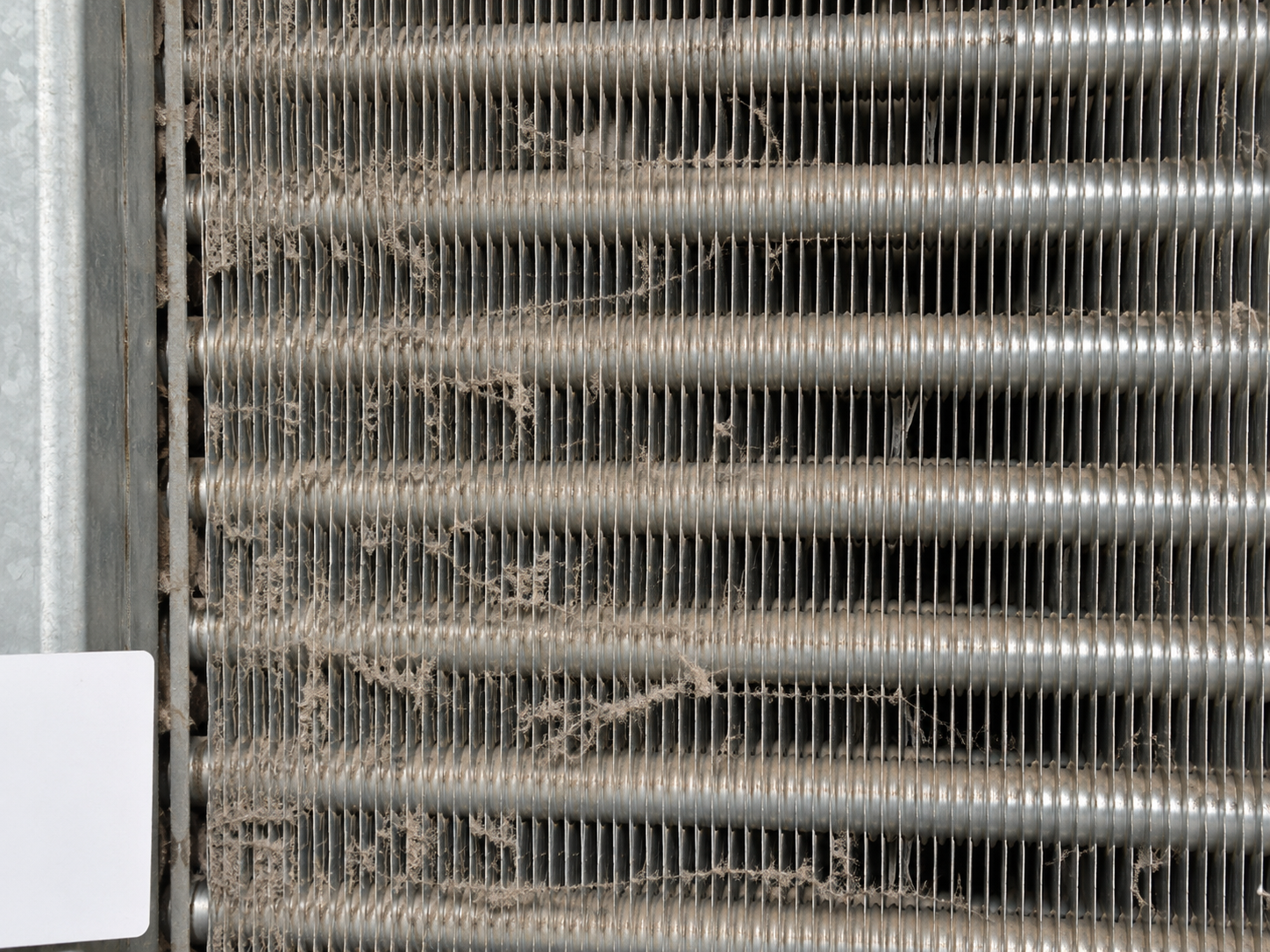
Map the access before selecting a method. Is the deposit on the entering-air face, trapped deep in the fin pack, or behind guards and supports? Can removed debris be caught on the far side, or might it be driven deeper into the bundle? The answer determines the cleaning direction and whether a small nozzle can reach the target without touching the fins. Our dry ice blasting nozzle selection guide explains why coverage, access, and stand-off distance should be chosen together.
Why consider dry ice, and where are its limits?
Dry ice pellets are accelerated through a nozzle and sublimate after impact. This means the blast medium itself does not remain as grit or liquid. Cold Jet lists fin-fan exchangers and radiator fins among its application examples. That is evidence that the use case exists, not proof that every exchanger, coating, or deposit will respond the same way.
The dislodged dirt still has to go somewhere. Lint, oil, corrosion products, paint fragments, and other contamination remain after the dry ice disappears. On an exchanger, careless nozzle direction could move debris through the fin pack or into a fan compartment. Arrange collection, screening, or extraction for the actual material. If the deposit may contain a hazardous substance, have the site EHS team classify it and specify controls before blasting.
Fin damage is another boundary. Thin fins can bend, separate, or lose coating under inappropriate force or direct mechanical contact. Start with conservative settings chosen for a representative test patch, then inspect the geometry under good light. Do not turn a vendor description of a “non-abrasive” process into a guarantee of no damage. Similarly, an external blast cannot remove mineral scale on the inside of tubes or repair an underperforming motor, belt, bearing, damper, or control loop.
Prepare the exchanger for a controlled trial
The first decision is whether the unit can be made safe to access. A fan that appears stopped may restart automatically. Isolate the fan and other relevant energy sources under the facility procedure, verify the isolation, and account for stored or residual energy. The OSHA hazardous-energy standard includes cleaning where unexpected startup or energy release could expose workers. Work on elevated fin-fan platforms may require separate access and fall-protection controls under the site’s rules. Do not infer that cleaning can be done while a unit operates because a supplier describes an online application elsewhere.
Next, inspect the material and nearby components. Photograph already bent fins, corrosion, coating loss, loose fasteners, instruments, seals, and electrical items. Confirm with the exchanger OEM which surfaces may be blasted and which must be masked. Define the accepted fin condition after cleaning: open passages, no new bending, no coating loss beyond the agreed tolerance, and no debris left in inaccessible areas. Set a stop rule for fin deformation, unexpected coating removal, or dirt migration.
The dry ice system also needs adequate compressed air and suitable pellets. Do not assume that a plant air point can supply the required pressure and flow at the nozzle. The DryIceSys air-requirements guide shows how to evaluate supply quality and delivered capacity for a specific machine. Confirm hose routing, safe access, media staging, and operator communication before the crew enters the work zone. The site-readiness checklist provides a broader handover for the job.
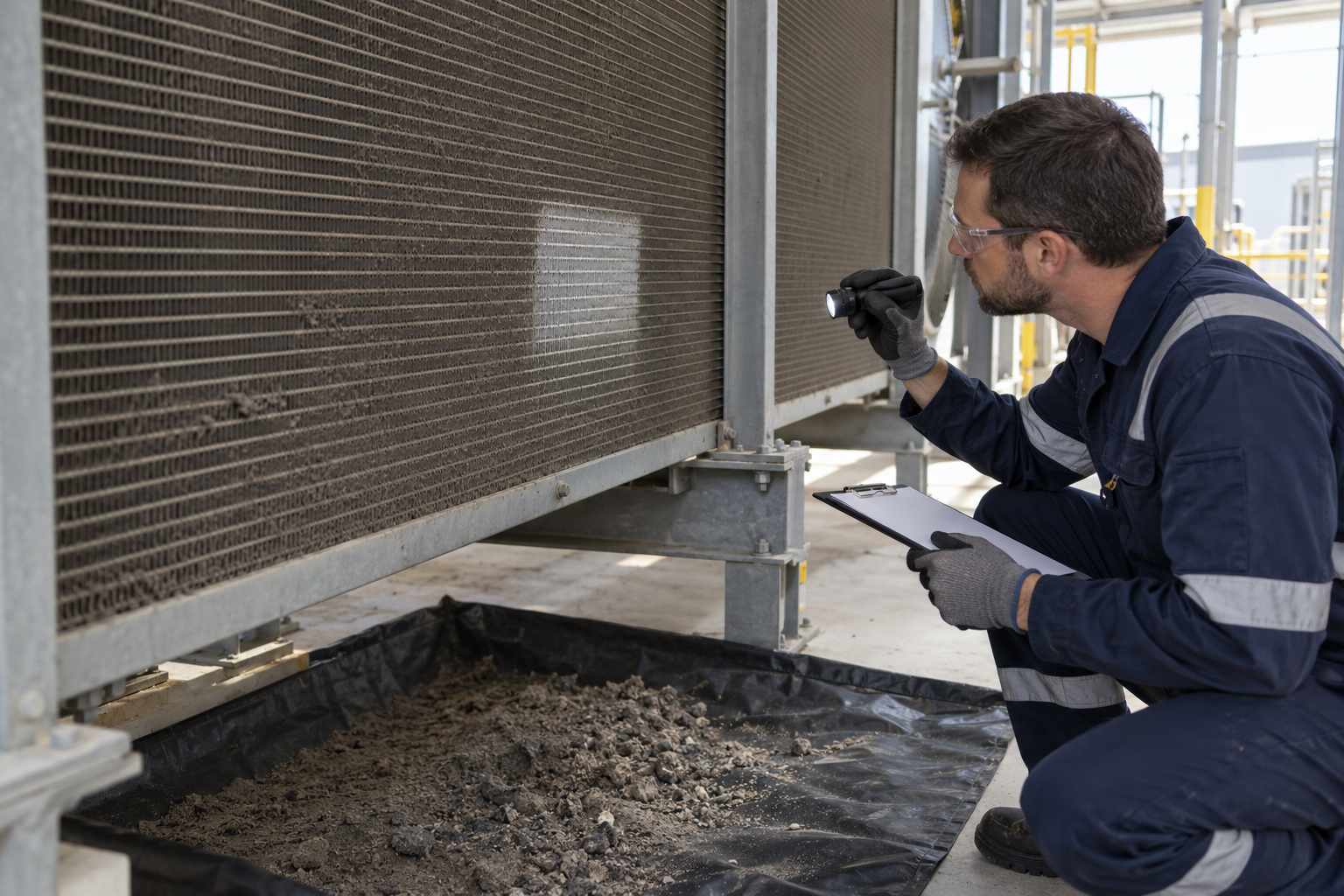
How should the test patch be judged?
Choose a small area that represents the deposit and fin geometry, including any particularly fragile section. Record the starting condition and the settings used: pellet size, nozzle, pressure, stand-off, angle, dwell time, and pass count. Keep the nozzle clear of the fins. After one pass, stop and inspect before increasing intensity. If debris is pushed deeper, change direction or collection method rather than simply adding pressure.
Use more than a photo of a visibly cleaner patch. Check whether the air passages are open through the depth that matters, whether fins remain straight, whether any protective coating changed, and whether the downstream face or fan compartment has collected residue. Compare with a control area left untouched. If the unit is returned to service, compare operating readings only under reasonably similar ambient and process conditions. A single temperature reading taken on a cooler day does not establish a cleaning benefit.
The DOE guide’s performance-trending approach is useful here: log the same parameters before and after, then look for a sustained change that fits the operating context. The trial may still justify cleaning for inspection or reliability reasons even if an energy-saving figure cannot be isolated. Conversely, a clean-looking face is not enough to claim restored exchanger duty.
What safety and waste controls belong in the plan?
Dry ice becomes carbon-dioxide gas. The NIOSH carbon-dioxide reference identifies exposure limits and symptoms of overexposure. Evaluate ventilation and, where the site risk assessment requires it, CO2 monitoring around enclosed bays, pits, air intakes, and low points. Keep unprotected people out of the blast zone and select eye, hearing, cold-handling, and respiratory protection based on the actual deposit and task. A dry process does not remove airborne-dust or CO2 hazards.
Contain the material removed from the exchanger. Place catch sheets or suitable extraction where debris will travel, and protect drains, fan housings, and nearby equipment. If the fins carry oil or process contaminants, collect the waste according to the site’s rules. Dry ice removes the need to recover spent pellets, but it does not make the removed deposit disappear.
Before restarting, inspect the fin pack and downstream area, remove coverings and tools, confirm guards are restored, and have the authorized team release isolation according to procedure. Document the cleaning settings and observations so the next maintenance interval can be compared with the same baseline.
A go/no-go checklist for the maintenance planner
| Question | Proceed when | Pause when |
|---|---|---|
| Deposit location | External air-side fouling is accessible | The suspected problem is inside tubes or elsewhere |
| Equipment condition | OEM limits and existing fin damage are documented | Fragile fins or coating condition are unknown |
| Energy control | Fan and relevant energy sources are isolated and verified | Automatic restart or stored energy is unresolved |
| Trial result | Deposits clear without unacceptable fin or coating change | Debris moves deeper or fins deform |
| Exposure and waste | CO2, dust, access, and residue controls are in place | Ventilation or collection cannot be demonstrated |
| Acceptance | Before/after inspection and comparable operating data are planned | Success is defined only as a visually bright surface |
For machine selection, use the DryIceSys dry ice cleaning machine page to confirm the model and available accessories, then test the actual combination on the exchanger. The table is a scope decision, not a universal operating recipe.
Frequently asked questions
Can dry ice blasting clean the inside of heat-exchanger tubes?
This article covers accessible external air-side fins. Internal scale, biological fouling, or deposits inside tubes need a separate diagnosis and a method approved for that exchanger. External blasting should not be sold as a substitute for internal cleaning.
Will dry ice blasting bend thin fins?
It can if the setup or technique is unsuitable for that fin pack. A low-impact test patch, adequate stand-off, careful nozzle angle, and close inspection are more reliable than a general “no damage” claim. Stop if fins move or coating changes outside the acceptance criteria.
Does a cleaner exchanger always use less energy?
Not necessarily. A fouled air path may contribute to poor performance, but fan condition, process load, ambient temperature, controls, and internal fouling also matter. Compare representative operating data before and after and avoid claiming a percentage gain without measurement.
Sources and scope
The application example comes from Cold Jet’s fin-fan and heat-exchanger material. Maintenance measurement guidance comes from the US DOE operations and maintenance guide. The OSHA hazardous-energy standard and NIOSH CO2 reference support the US safety discussion; facilities elsewhere must apply their own requirements. Site-specific trial and OEM instructions control the final cleaning decision.