
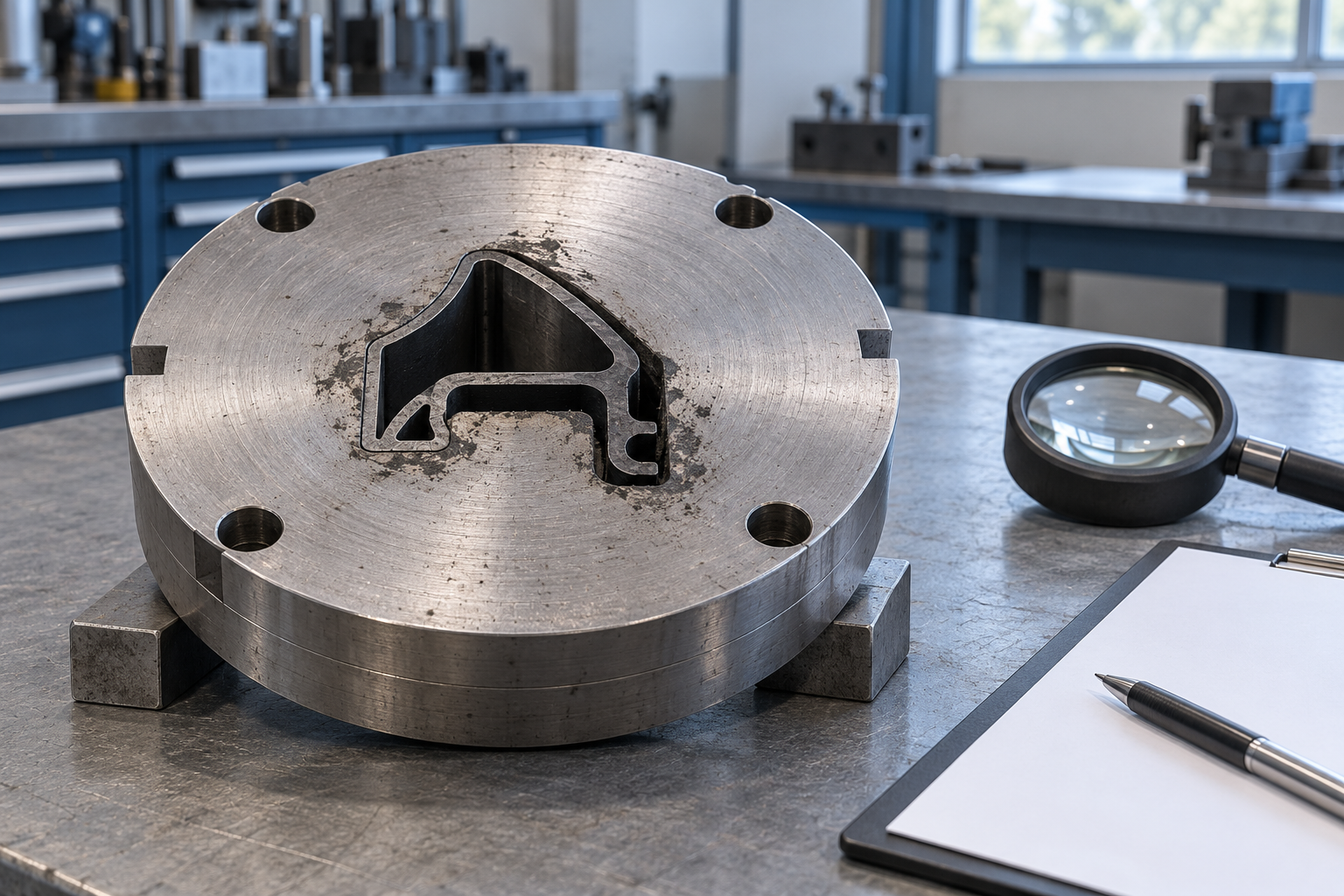
Can a rubber-profile manufacturer in Great Britain replace part of a die-cleaning routine with dry ice blasting? Dry ice cleaning is a candidate for removing accessible rubber residue from an approved detached steel extrusion die, but suitability must be demonstrated on the actual compound, tooling finish and profile geometry. Acceptance requires residue inspection, dimensional checks where specified, and a controlled production restart; a clean-looking face alone is insufficient.
This guide concerns a detached, securely supported steel profile die, with its temperature and handling condition approved by the toolmaker. It does not authorise blasting an operating extruder, reaching into its head, or treating a fragile coating. The illustrations show a proposed inspection setting, not a customer installation or measured cleaning result.
Start with the profile and residue, not the blaster
An extrusion die shapes material as it passes through a flow opening. Its cleaning decision therefore differs from cleaning a tyre mould: the engineer must consider flow surfaces, the die land and the dimensions that help establish the extruded profile. The HSE introduction to rubber processing describes the machinery context; it is not an approval of dry ice cleaning.
Record the compound identifier, the residue location and the toolmaker’s cleaning instructions. Distinguish removable deposits from intentional surface treatments. Identify polished or coated areas, narrow flow passages, inserts and precision edges. A method that removes residue from an accessible face has not necessarily cleared an internal passage.
Manufacturer information gives a reason to investigate, rather than a universal process setting. Kärcher describes rubber residues among dry ice cleaning targets. That statement does not establish compatibility with a particular extrusion die, its coating or compound. Claims about shorter changeovers or preserved dimensions must be tested on the proposed tooling.
For the broader mechanism and tooling context, compare our injection-mould cleaning guide, while keeping extrusion flow geometry as a separate acceptance problem.
What must be agreed before a trial?
Use a written scope that identifies both the intended removal and the surfaces that must remain unchanged.
| Decision | Evidence to prepare | Reason to pause |
|---|---|---|
| Cleaning target | Compound and deposit description, photographs and permitted removal areas | Unknown residue or unidentified surface treatment |
| Tool condition | Existing damage record and toolmaker instructions | Loose coating, cracked insert or damaged precision edge |
| Access | An accessible test area and inspection plan for other passages | A hidden passage cannot be inspected or cleared |
| Required result | Residue criteria and drawing-based checks chosen by the tooling engineer | Appearance is the only proposed acceptance measure |
| Restart | Approved reassembly and first-off profile inspection plan | No defined responsibility for production release |
This is an editorial trial framework, not a certified test method. The tooling engineer decides which measurements matter and which surfaces can be exposed. Cleaning must not be used to conceal wear, round an edge or compensate for a damaged die.
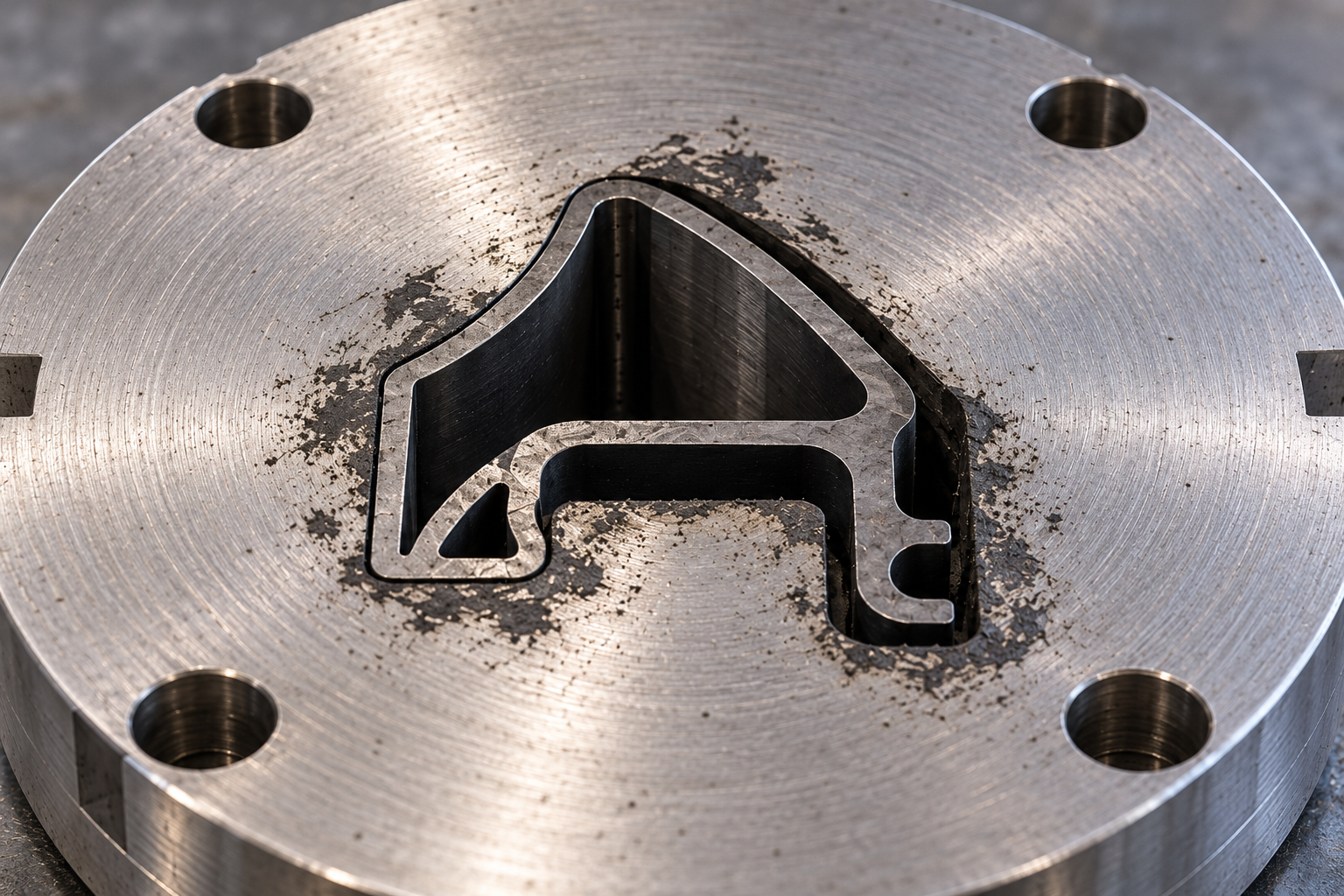
AI-generated tooling illustration; not a before-and-after result or an actual customer trial.
Isolate the extruder before removing tooling
Detaching the die is itself a maintenance task. Have competent personnel follow the manufacturer’s procedure for stopping the equipment, isolating relevant energy, making stored pressure safe and handling hot components. This article supplies no die-removal sequence.
For Great Britain, HSE guidance on work-equipment maintenance addresses planning, competent staff, isolation, stored energy and cooling. Its principles inform the work plan; they do not establish the correct isolation points for a particular extruder. A detached die must also be supported against movement under the cleaning jet. Keep unqualified staff outside the work area.
For the cleaning station itself, review our site-readiness checklist. Confirm the available compressed-air supply at operating flow, compatible nozzle and media handling arrangements with the equipment supplier. Do not select pressure solely from another application or an online video.
Control both carbon dioxide and removed residue
Dry ice becomes carbon dioxide gas; the removed rubber residue still needs collection. A proposal that addresses only pellet supply leaves two different exposure questions unresolved: gas accumulation and airborne contaminants from the deposit.
The HSE rubber-industry dust and fume guidance supports assessing the substances and choosing effective controls. It does not specifically validate this cleaning process. The site should evaluate whether blasting could disperse compound residue, and select capture and waste arrangements suited to that material. Do not move deposits into adjacent machinery or ventilation intakes.
Carbon-dioxide assessment must separately consider the actual gas source, work area and ventilation. The NIOSH carbon-dioxide entry is a US technical reference for inhalation and cold-contact hazards, not a substitute for Great Britain’s exposure requirements or the site’s assessment. A dust filter does not remove carbon dioxide. Noise, cold handling, eye and face protection, and hose restraint also belong in the approved work plan.
How should the cleaning recipe be accepted?
Begin on a representative area authorised by the tooling engineer. Record the die condition, temperature, media specification, nozzle, supplied air conditions, feed setting, distance, angle and exposure time. Use the equipment manufacturer’s permitted range and stop if the agreed limits are exceeded. There is no universal pressure recipe in this article.
Inspect after a short trial interval. Check deposit removal and the tool features identified in the scope, using suitable lighting or magnification. Where the tooling plan requires measurements, compare them with the approved drawing and baseline record. Do not infer dimensional preservation from a photograph. Stop for unexpected coating release, new surface marking, residue driven into a passage, uncontrolled debris or an exposure-control fault.
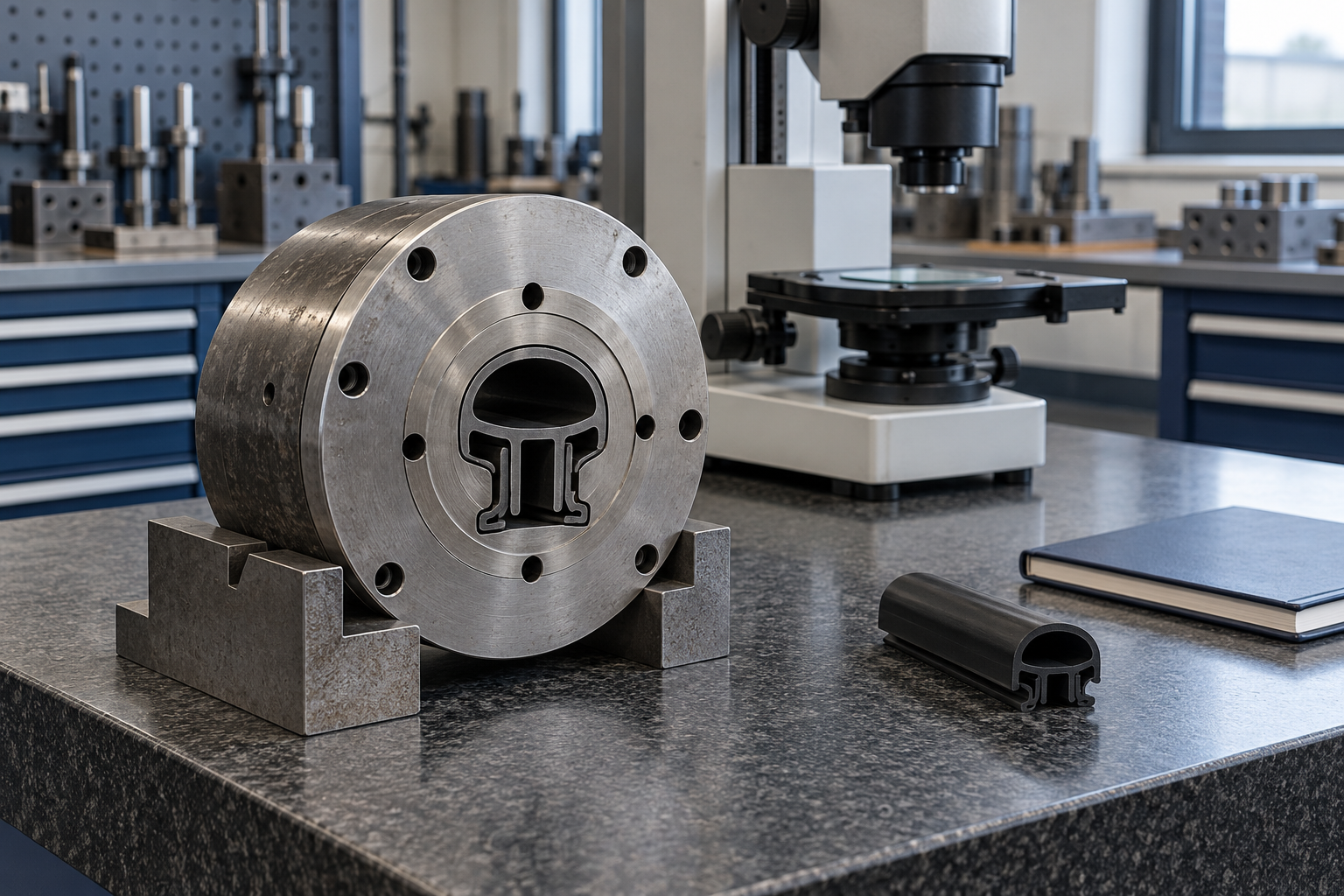
AI-generated inspection illustration; no dimensional conformity or production result is implied.
After cleaning, account for removed debris and any masking. Check that inspected passages are clear. Reassemble only under the toolmaker’s procedure, then perform the required first-off profile checks during the controlled restart. Record the result against the agreed acceptance criteria. If the profile fails, investigate tooling, material and process causes; do not simply increase cleaning aggression.
What should a buyer ask a supplier to demonstrate?
Request a trial on representative tooling and residue, with the site and supplier agreeing who will inspect, measure and release the die. Compare the complete changeover: isolation, handling, cleaning, inspection, reassembly and restart. A nozzle-on time alone does not describe production downtime.
Ask for air demand, media logistics, access limits, containment requirements and the recorded settings associated with the accepted sample. Our air-requirements guide helps structure the utility discussion. Treat any saving as provisional until the full workflow is measured at your site.
Can we clean the die while the extruder is running?
This article does not cover that task. An operating extruder introduces separate intervention hazards and requires a machine-specific engineered procedure. The detached-tool trial described here cannot authorise it.
Does an apparently clean opening prove the profile will be correct?
No. Appearance does not prove passage cleanliness, dimensional conformity or acceptable production. Use the tooling inspection plan and first-off product checks.
Is dry ice cleaning guaranteed to preserve every coating?
No. Identify the coating and obtain the toolmaker’s permission before testing. Unknown or fragile treatments remain outside the proposed trial until compatibility is established.
To discuss equipment, bring the die drawing where shareable, residue photographs, compound information, current cleaning sequence and acceptance criteria to DryIceSys. These inputs allow a bounded supplier discussion without assuming a result before a trial.