
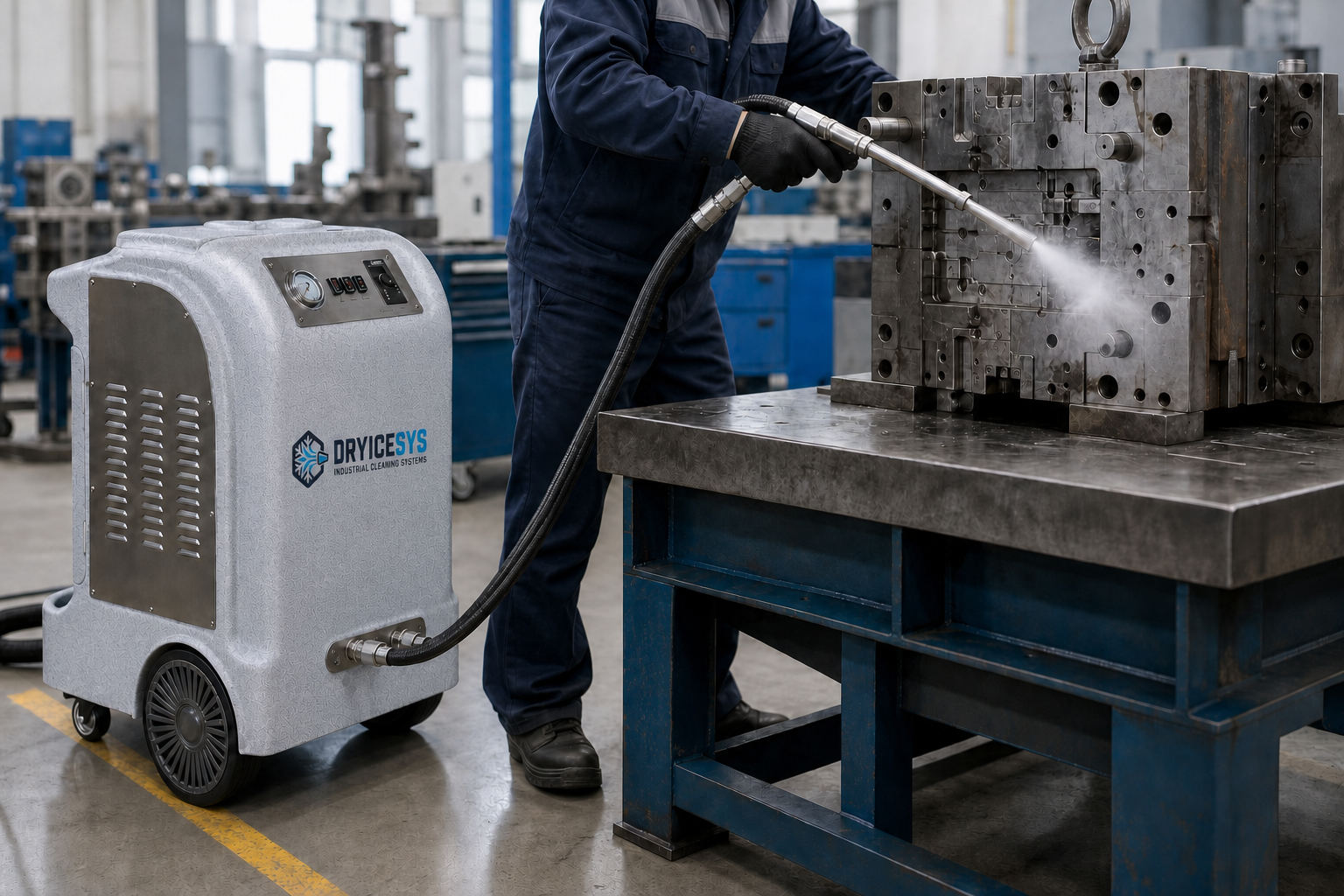
Dry ice blasting is a practical candidate for removing exposed fouling from injection mold cavities, vents and accessible details. It is not a complete mold maintenance method. Internal cooling-circuit scale, worn steel, damaged edges, blocked passages and process drift require their own diagnosis and repair route.
That distinction should control both the cleaning trial and the machine purchase. The question is not whether dry ice can reach a dirty mold. It is whether a defined setup can restore the mold’s documented production condition without unsafe access, surface change or hidden maintenance work.
Use Dry Ice for a Defined Cleaning Scope
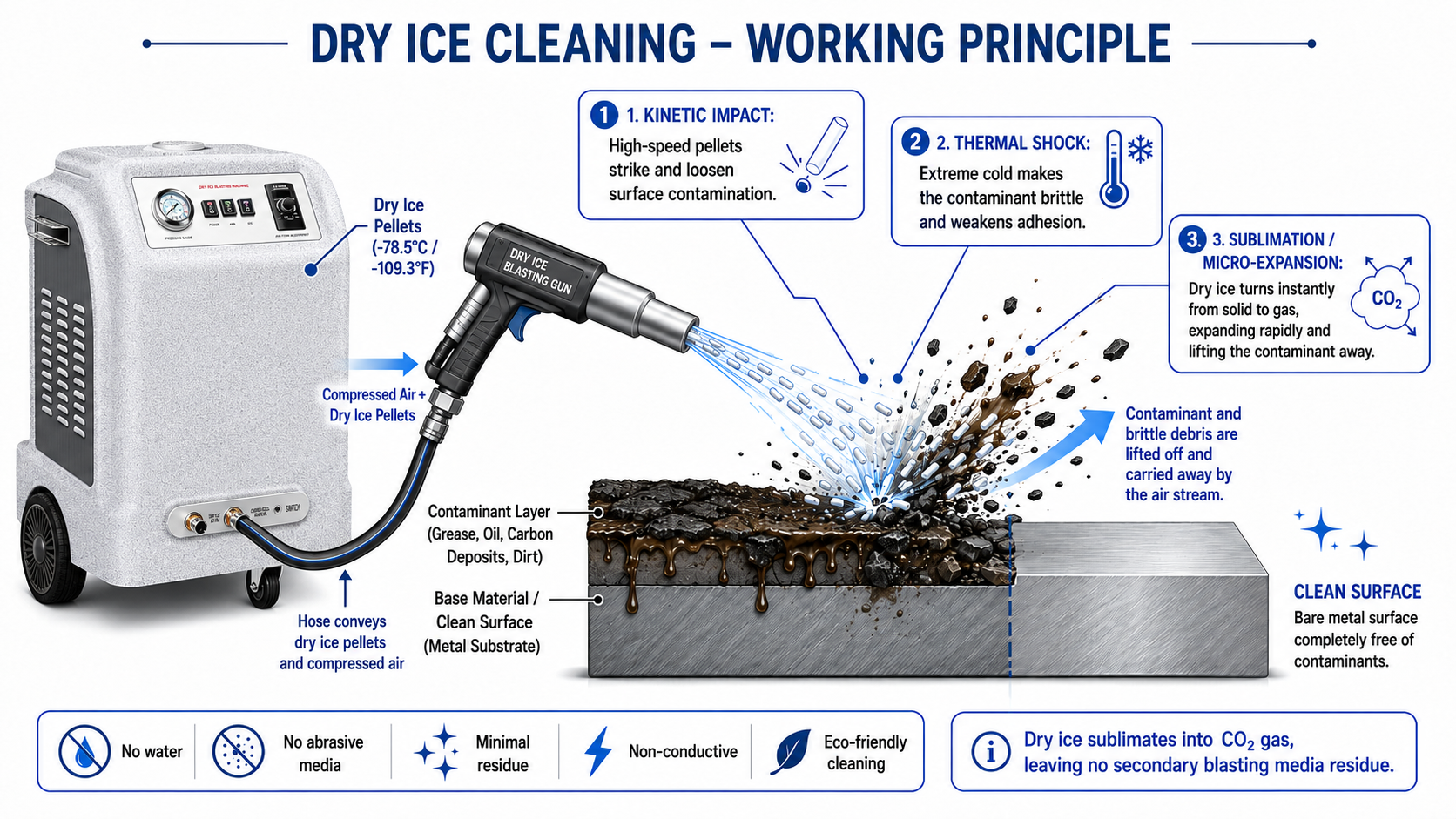
Start with the condition to remove. Supplier and trade sources describe dry ice blasting for exposed resin deposits, off-gas residue, cured material and release-agent buildup. Compressed air accelerates solid carbon-dioxide particles toward the surface. The particles sublimate, so spent dry ice does not remain as blast medium. Dislodged contamination still remains and needs collection.
This makes the process useful when water, liquid chemistry or abrasive media would add an unwanted step. It does not prove every mold, coating, texture or setup is safe. Suitability requires testing the actual contaminant, surface and acceptance criteria together.
Separate Surface Fouling from Mold Faults
One symptom can have several causes. Classify it before assigning a cleaning method.
| Observed condition | Dry ice blasting role | Separate action |
|---|---|---|
| Residue on an accessible cavity, vent face or textured surface | Candidate for a controlled trial | Confirm the contaminant and acceptable finish |
| Restricted cooling flow or uneven mold temperature | No direct internal-cleaning role | Inspect, map and service the water circuit |
| Worn parting line, damaged edge, corrosion or mechanical play | Cleaning may expose the condition but cannot repair it | Route to tooling inspection and repair |
| Repeated short shots, burns, flash or surface defects | May help only when verified fouling is causal | Check process, venting and tooling data before concluding |
| Unknown coating, polish or critical texture | Do not assume compatibility | Test a representative low-risk area and inspect the result |
MoldMaking Technology’s water-circuit guidance treats flow, pressure, scaling and temperature control as an internal maintenance system. An external blast stream is not evidence that a restricted cooling passage has been corrected.
Do Not Turn In-Press Capability into Permission
Current search results repeatedly promote cleaning a hot mold while it remains in the press. That may reduce disassembly for a suitable machine and work cell, but it is a process capability—not authorization to enter a danger zone.
OSHA’s horizontal injection molding machine eTool states that lockout/tagout is required when service or maintenance requires removing or bypassing a guard or placing any part of the body in the mold area or an associated danger zone. It also notes a limited minor-servicing exception for qualifying routine, repetitive and integral work when effective alternative protection is provided.
The site must decide which rule applies through its energy-control program, machine instructions and risk assessment. An interlock, open operator gate or supplier demonstration does not replace that decision. If the approved method cannot maintain safe nozzle access, hose routing, guard function and exclusion from the danger zone, stop and move the task to a controlled maintenance state.
Control the Setup That Reaches the Surface
“Non-abrasive” is too broad to function as an acceptance criterion. The cleaning result comes from a coupled setup: machine, delivered air, particle size, feed rate, nozzle, standoff, angle, dwell, mold temperature and contaminant condition.
A dry-ice cleaning experiment published by the Japan Society of Mechanical Engineers found that residual contamination changed with blasting pressure and pellet diameter. The experiment concerned an electrode, not an injection mold, so it does not prescribe mold settings. It establishes the important boundary: settings affect the result.
Record the complete setup that passes. A later change in air delivery, particle size, nozzle or dwell is a process change, not an equivalent clean. Begin at the least aggressive setup capable of progress, inspect frequently and stop if the surface, coating, texture or edge condition moves outside the approved limit.
Trigger Cleaning from Evidence
Do not clean only because a calendar date arrives, and do not wait until a defect becomes routine. Link the trigger to the mold and product.
Useful records include cycle count, resin and release system, defect type, cavity or vent location, unscheduled stops, cleaning method, blast setup, inspection result and performance after release. A Plastics Technology mold-maintenance case shows why centrally recorded operating and maintenance data matter when repeated stops must be diagnosed.
The first cleaning interval is a hypothesis. Shorten it when recorded fouling returns early. Extend it only when inspection and part data support the change. Dry ice consumption and operator preference are not the source of truth.
Run One Representative Mold Trial
Choose a mold that represents the real contaminant, finish, geometry and access condition. Do not use a flat steel coupon to approve a polished cavity or narrow vent.
- Photograph and inspect the pre-cleaning condition. Record the defect or maintenance trigger.
- Define what must be removed and what must remain, including coating, polish, texture, vent dimensions and protected lubricant.
- Approve the machine state, guarding, energy control, ventilation, hose route and debris collection plan.
- Record the blaster, delivered air, particle size, feed, nozzle, distance, angle, dwell and mold temperature.
- Clean a bounded area, inspect it, then expand only if the acceptance condition holds.
- After cleaning, inspect the surface and vents, remove loosened contamination and produce enough parts to evaluate the defined quality indicators.
- Release the setup only when the mold condition, part result and work method all pass.
Stop if cleaning is not progressing, contamination is being driven into an inaccessible area, the surface changes, the nozzle cannot be controlled or the approved exposure and guarding conditions cannot be maintained.
Keep the Safety Cases Separate
The injection molding machine and the cleaning process create different hazards. Control both.
For the press, follow the site’s guarding and hazardous-energy procedure. Account for platen movement, stored hydraulic or pneumatic energy, hot surfaces and access to the mold area. The equipment owner—not the blaster supplier—authorizes the work state and return to production.
For dry ice blasting, NIOSH identifies dry ice as solid carbon dioxide and lists inhalation, asphyxia and frostbite hazards. The work plan needs ventilation and exposure assessment, insulated handling, eye and face protection, hearing protection, compressed-air controls and containment for flying debris and the removed material. A visible vapor cloud is not a carbon-dioxide measurement.
Specify the Machine from the Accepted Process
After a trial passes, convert the setup into a purchase specification. Confirm that the machine and nozzle can reproduce the accepted particle range, feed and air condition; that the facility can supply the required air quality and flow at the operating point; and that the hose and applicator can reach the authorized work area without defeating safeguards.
Also specify operator training, setup records, preventive maintenance, wear parts and service responsibility. For occasional demand, compare ownership with rental or contract service on the same accepted-work boundary. Do not compare only machine price or nozzle-on time.
The decision rule is simple: use dry ice blasting for verified, accessible mold fouling when an approved work state and recorded setup can meet the release criteria. Route internal circuits, damaged tooling and unresolved process defects elsewhere. The mold’s production condition is the invariant; the cleaning machine is one controlled means of restoring it.
Sources
- Google: dry ice blasting injection mold cleaning
- Cold Jet: Dry Ice Cleaning Equipment for Plastic Molds & Rubber Molds
- Nitrofreeze: Dry Ice Cleaning for Injection Molds
- Plastics Technology: Cleaning Molds-Part II Blasting with Dry Ice
- Plastics Technology: Dry-Ice Blasting Aims To Freeze Out Competition in Industrial Cleaning
- MoldMaking Technology: Cleaning Molds: Part I
- Plastics Technology: More Effective Mold Maintenance: It’s All About the Data
- MoldMaking Technology: How to Map Mold Water Circuits
- OSHA: Horizontal Injection Molding Machines
- NIOSH: Carbon Dioxide
- Japan Society of Mechanical Engineers: The Effect of Blasting Conditions on Dry-Ice Blast Cleaning