
Dry Ice Blasting vs Sandblasting: Choose by Surface Finish
Dry ice blasting is usually the better candidate when the job is to remove contamination while preserving an existing surface. Abrasive blasting is usually the better candidate when the job must remove strongly bonded material or create a specified profile for a new coating. Neither method is universally better. The correct choice starts with the required condition after cleaning, not with the name of the machine.
That distinction matters because “sandblasting” is not one fixed process. OSHA’s abrasive-blasting guidance lists silica sand, slags, garnet, glass, steel shot, steel grit and other media. Each combination of medium, pressure, nozzle, substrate and coating can produce a different finish and hazard case.
Choose the Finish Before the Blasting Method
Write an acceptance statement before requesting a demonstration. It should answer four questions:
- What must be removed: oil, grease, adhesive, soot, corrosion, paint or scale?
- What must remain: base material, dimensions, an original coating, markings or a polished finish?
- Is a new coating going on, and does its specification require a measured surface profile?
- How will cleanliness, profile and surface preservation be inspected?
The third question is the decisive split. AMPP’s surface-preparation committee develops standards intended to improve coating and lining performance. ASTM D4417 treats profile height as a field measurement to compare with the coating manufacturer’s or job specification. If that specification requires profile creation, a process selected mainly to preserve the existing surface may not complete the preparation step.
Compare What Reaches—and Leaves—the Surface
Dry ice blasting
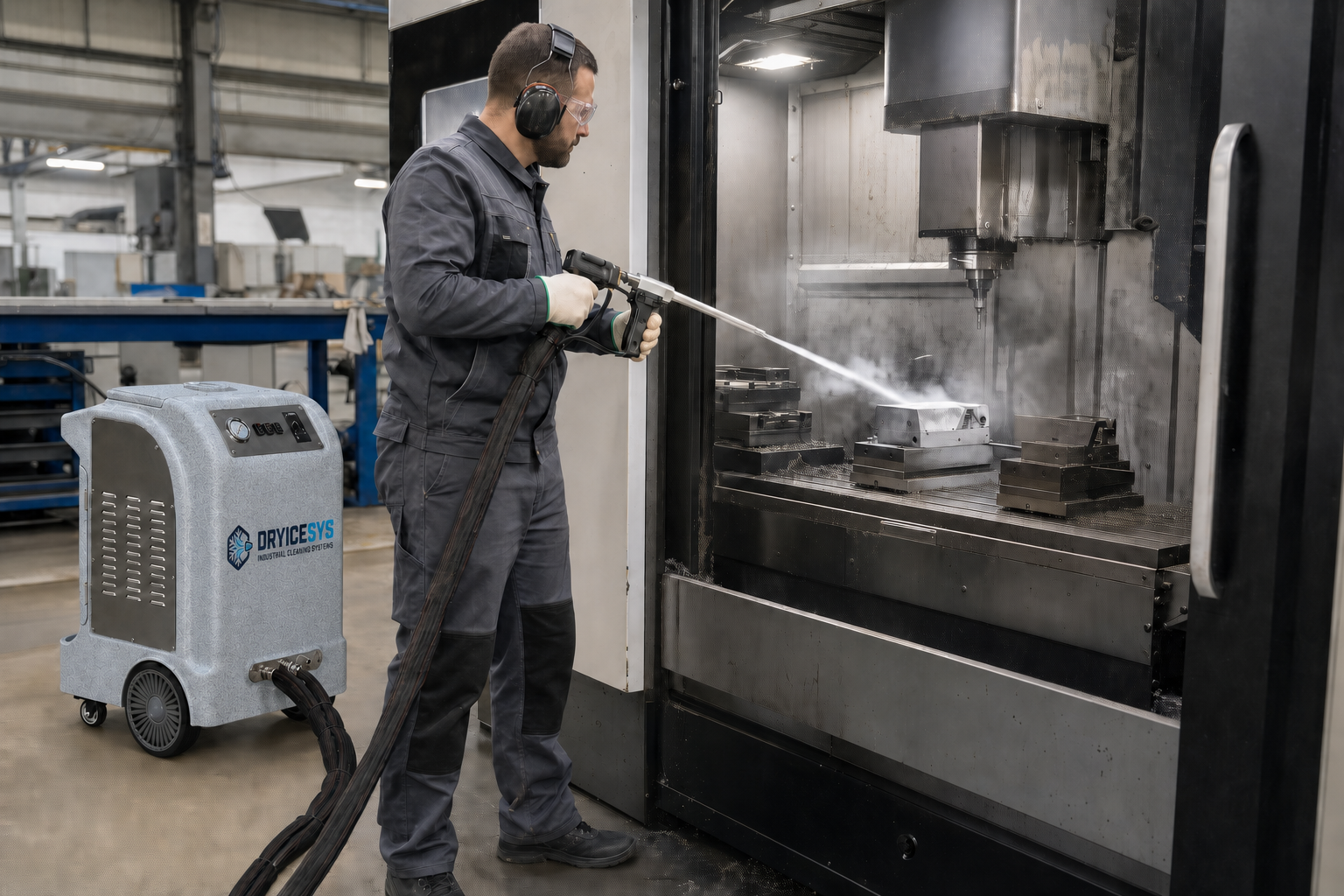
A dry ice cleaning machine accelerates solid carbon-dioxide particles in compressed air. Impact, localized cooling and sublimation help break the bond between contamination and the surface. The dry ice becomes gas, so it does not remain as spent blast medium. Removed paint, oil, soot or corrosion products do remain and need a controlled destination.
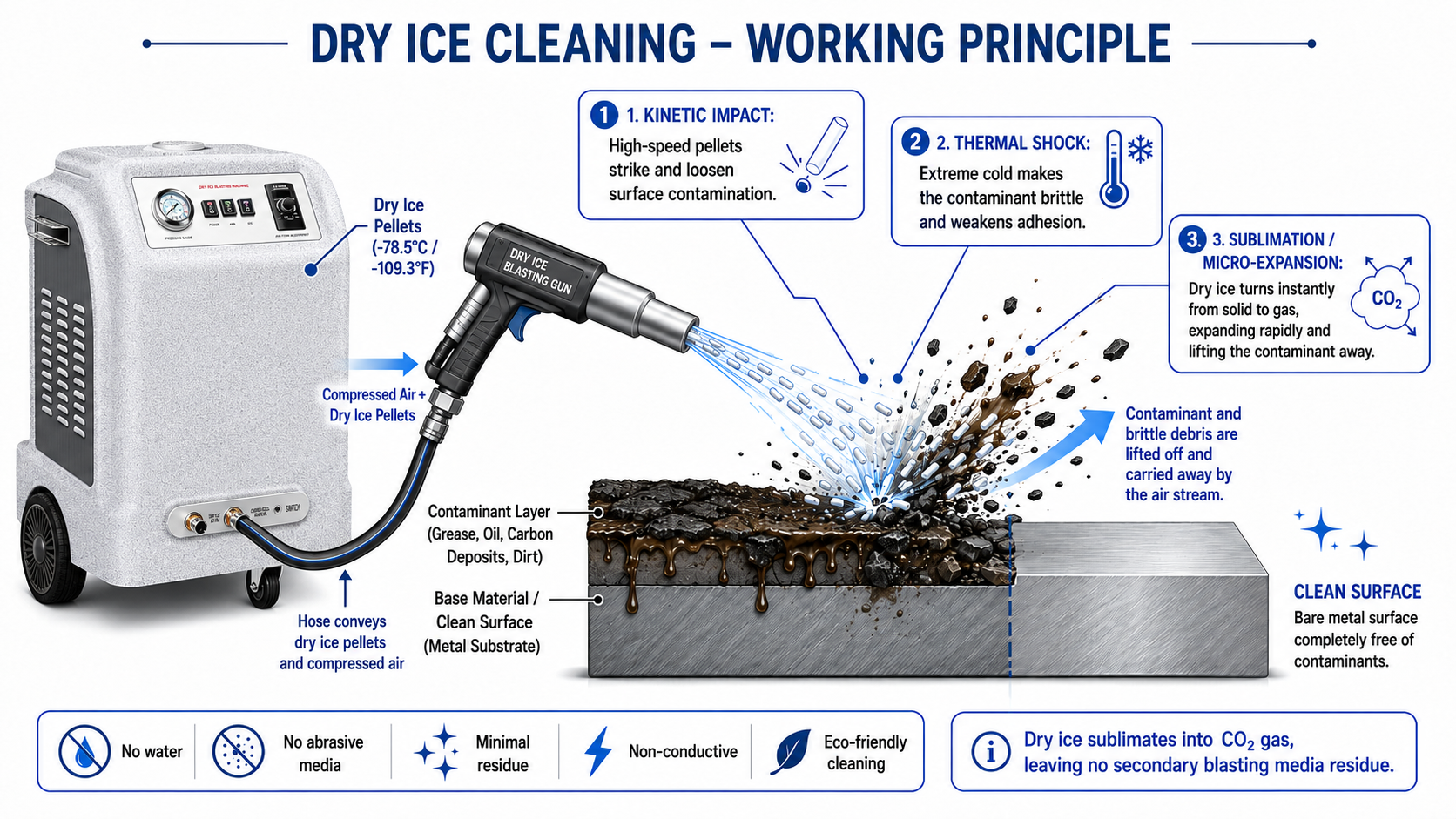
Dry ice blasting normally does not create the deliberate anchor pattern associated with abrasive surface preparation. That can be an advantage for molds, machinery, electrical components or restoration work where the existing finish should remain. It is a limitation when the next coating requires a defined profile. “Non-abrasive” also does not prove that damage cannot occur: a peer-reviewed study has examined erosive wear during dry-ice paint stripping. The safe conclusion is application testing, not an absolute promise.
Abrasive blasting
Abrasive blasting propels a solid medium at the workpiece. OSHA defines its purposes broadly: cleaning, deburring, applying texture and preparing a surface for paint or another coating. Media type and size, air pressure, nozzle, angle, distance and dwell determine how aggressively the process removes material and what profile it leaves.
Calling every abrasive process “sandblasting” hides those variables. A procurement specification should name the permitted medium, cleanliness grade, required profile range, prohibited substrate change, dust controls and waste route. Silica sand is not a generic default; OSHA identifies crystalline-silica exposure as a serious health hazard and recommends considering less toxic materials and engineering controls.
Use the Endpoint as the Decision Matrix
| Required result | Better first candidate | Reason to verify |
|---|---|---|
| Remove oil, grease, soot or production residue while preserving an existing finish | Dry ice blasting | Confirm the contaminant releases and sensitive surfaces remain acceptable |
| Clean complex equipment with minimal added blast-media residue | Dry ice blasting | Plan for carbon dioxide, compressed air and collection of removed debris |
| Strip adherent coating to a specified bare-surface condition | Abrasive blasting | Select media and settings that meet the cleanliness and substrate limits |
| Create a measured anchor profile for recoating | Abrasive blasting | Measure the profile; do not infer it from appearance |
| Preserve original automotive or historic finishes | Dry ice blasting trial | Existing corrosion or failed paint may still require a separate treatment |
This matrix starts a test; it does not approve production. The Hagerty practitioner account illustrates the preservation use case, while also distinguishing it from abrasive preparation used in complete restoration.
Compare Complete Systems, Not Only Blast Guns
Both methods need compressed air unless a particular abrasive system uses another propulsion design. Dry ice adds pellet quality, storage loss and just-in-time supply. Abrasive blasting adds media delivery, recovery or disposal, dust collection and often more extensive containment. Neither process eliminates the removed contaminant.
A useful cost comparison includes:
- machine, compressor and air treatment;
- blast media, delivery and storage;
- nozzle, hose and protective-equipment wear;
- isolation, ventilation, containment and collection;
- setup, cleaning, inspection and waste handling;
- rejected work, surface repair and production interruption.
Do not compare one supplier’s dry-ice cleaning time with another supplier’s abrasive cycle unless both include the same preparation, containment, cleanup and inspection boundary. Cost per accepted part, area or maintenance event is more defensible than machine price or nozzle-on time.
Keep the Safety Cases Separate
Dry ice blasting controls
Dry ice is solid carbon dioxide. NIOSH’s carbon-dioxide guidance identifies inhalation, asphyxia and frostbite hazards. The work plan must address ventilation, carbon-dioxide monitoring where the assessment requires it, insulated handling, noise, compressed-air energy, flying debris and hazards in the material being removed. Lockout, isolation and return-to-service rules still belong to the target equipment owner.
Abrasive blasting controls
Abrasive blasting can generate dust and noise from the medium, substrate and existing coating. OSHA’s ventilation standard and abrasive-blasting fact sheet address exhaust ventilation, isolation, containment, respiratory protection, hearing protection and other PPE. Lead paint, crystalline silica or other toxic material changes the control plan. Substituting a different abrasive does not remove the need to assess the coating and substrate being disturbed.
Run One Trial Against One Acceptance Standard
Use representative parts and normal contamination. Record the complete setup for each candidate: machine, medium, media condition, pressure and flow at the operating point, nozzle, standoff, angle, dwell, passes, containment and collection method.
Then apply the same gates:
- Did the process meet the defined cleanliness endpoint?
- Did the substrate, dimensions and retained coating stay within tolerance?
- If recoating is planned, did the measured profile meet the coating specification?
- Were debris, dust and carbon dioxide controlled by the approved work plan?
- What was the total labor, media, air, cleanup and production time per accepted output?
Stop if the required removal is not progressing, the surface changes beyond tolerance, profile moves outside specification, visibility or containment fails, or exposure controls cannot hold the approved condition. Changing the medium or adding abrasive to a dry ice stream creates a different process and requires a new safety and acceptance review.
The Decision Rule
Choose dry ice blasting to test contamination removal where preserving the existing surface and limiting added media residue matter. Choose abrasive blasting to test aggressive removal or specified profile creation. If the job contains both outcomes, design separate steps rather than asking one process label to solve two different problems.
The purchase decision should follow an accepted surface, a recorded setup and a complete-system cost—not a universal “better” claim.
Sources
- OSHA: Protecting Workers from the Hazards of Abrasive Blasting Materials
- OSHA: 1910.94 Ventilation
- AMPP: Standards Committee—SC 05 Surface Preparation
- ASTM International: D4417 Surface Profile of Blast Cleaned Steel
- Cold Jet: Dry Ice Blasting Solutions
- Cold Jet: Dry Ice Blasting Frequently Asked Questions
- NIOSH: Carbon Dioxide
- Hagerty Media: Dry Ice Cleaning for Rust, Grime and Undercoating
- Materials Letters: Erosive Wear Caused by Dry-Ice Blasting