
Yes, dry ice blasting can remove some paint and coatings. It is most plausible when the layer is loose, peeling, failed or otherwise susceptible to the combined impact, cooling and sublimation effects. That answer does not extend to every well-adhered paint system, and it does not mean the cleaned surface will meet a repaint specification.
Define the required endpoint first. Removing flakes from production equipment, stripping every layer from steel and preparing a controlled surface profile for a new coating are different jobs. A useful trial keeps that endpoint fixed while the coating, substrate and blasting process are evaluated.
The answer depends on what removed means
The current Google result page gives a broad yes. First-page sources then narrow it. Cold Jet and CK Supply both say the outcome depends on the paint, primer, surface and adhesion, and that dry ice alone can be too gentle or slow. A facilities application from Nitrofreeze focuses specifically on peeling paint.
That distinction is operationally useful. Write one of these endpoints before choosing equipment:
- Remove loose and flaking coating while retaining sound material.
- Strip a named coating system to a defined substrate condition.
- Prepare the surface for a specified repair or complete recoating system.
These endpoints can require different methods. AMPP’s surface-preparation summary distinguishes loose from adherent paint in several steel preparation standards. A process that removes visible flakes may therefore succeed as maintenance cleaning and fail as complete coating removal.
Where dry ice-only blasting is a reasonable trial
Dry ice-only blasting deserves a representative test when the required endpoint, coating condition and substrate align.
| Screen | Reasonable trial candidate | Reject or escalate |
|---|---|---|
| Required endpoint | Loose or failed coating removal; selective cleaning | Unverified full-strip or surface-profile requirement |
| Coating condition | Peeling, flaking, aged or locally failed layer | Sound, flexible or strongly adhered multi-layer system |
| Substrate | Known, sound material with an accessible test area | Thin, soft, brittle, historic or unknown substrate without test coupons |
| Geometry | Visible surfaces with controlled nozzle movement | Blind joints, delicate edges or cavities that cannot be inspected |
| Acceptance | Written retained-coating, cleanliness and damage criteria | A vague instruction to make it ready for paint |
Coating labels alone are not enough. Adhesion, age, thickness, primer, previous repairs and environmental exposure can change the response. The substrate also matters because settings aggressive enough to lift one coating can alter another material.
A peer-reviewed conservation paper, Dry ice blasting in the conservation of metals, demonstrates the boundary. Under its specific machine, metal coupons, settings and durations, abrasion risk was low, but removal effectiveness varied substantially among coating types. The authors recommend sample testing and consideration of the object’s structure, coating, time and resources. That is evidence for controlled qualification, not proof of universal surface preservation.
Abrasive assistance is a different process
When dry ice alone cannot reach the endpoint at an acceptable rate, some suppliers add an abrasive. Treat that as a process change, not a stronger machine setting.
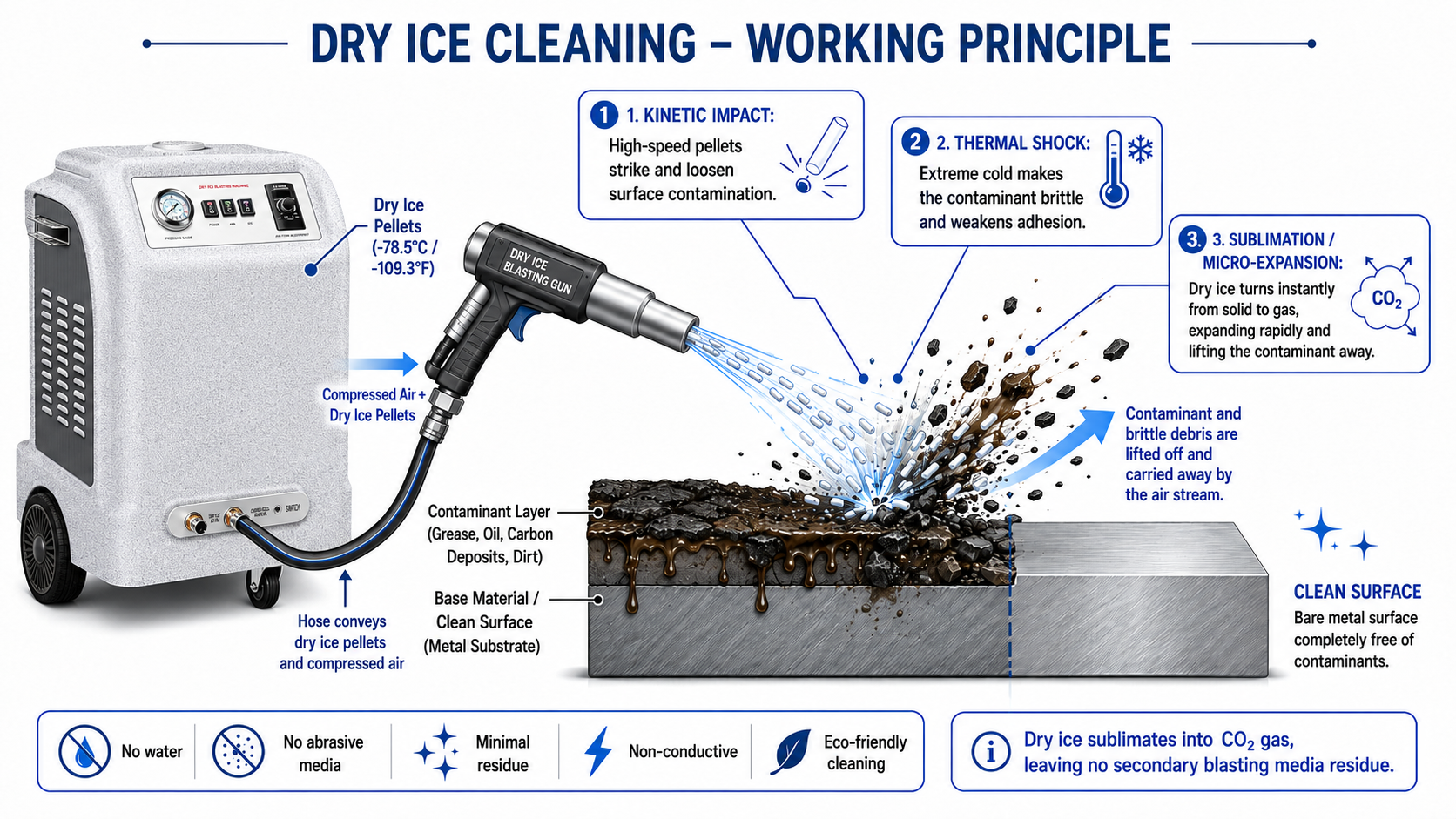
The abrasive changes the contact mechanics, residual material, containment, operator exposure and equipment configuration. It may be a candidate for well-adhered coating or a specified preparation task, but it gives up part of the simple dry-ice-only material balance. Removed paint and the added media must both be controlled.
The other alternative may be a qualified abrasive, power-tool, waterjet or chemical process selected against the coating specification and site constraints. The method name is secondary. The invariant is the accepted surface condition.
Do not assume that visible paint removal creates the anchor profile required by a new coating. If the coating manufacturer or project specification requires a cleanliness grade, profile range, soluble-contaminant limit or retained-coating condition, inspect and measure those properties separately.
Run a representative coating-removal trial
Test the actual coating system on the actual substrate, or on a defensible coupon that reproduces both. Start conservatively and document each change. Record:
- Coating and primer identity, known age, thickness, adhesion and defects.
- Substrate material, condition, thickness, geometry and sensitive features.
- Machine, media form, nozzle, delivered air, feed rate, angle, standoff and dwell.
- Masking, containment, ventilation, debris collection and inspection method.
- Removal endpoint, acceptable retained coating and required surface condition.
- Stop conditions for gouging, polishing, texture change, distortion, cracking or unacceptable temperature response.
Inspect after each controlled pass. A larger test area should follow only after the small area meets both removal and substrate criteria. Published studies on polymer substrate damage and erosive wear in dry-ice paint stripping are reminders that the word non-abrasive cannot replace this test.
The trial also establishes productivity. Public pages cannot supply one credible stripping rate for a different coating, geometry, air supply and acceptance criterion. If the endpoint is reached only with excessive dwell, repeated passes or unacceptable surface change, reject the dry ice-only process.
The pellets disappear; the paint does not
Dry ice sublimates after impact. The removed paint, primer, rust, dirt and any added abrasive remain. Plan collection and disposal around that output rather than calling the job waste-free.
Characterize old or unknown coatings before blasting. If lead or another hazardous constituent may be present, exposure assessment and controls belong in the work plan. OSHA’s lead overview routes US employers to applicable general-industry and construction requirements; other jurisdictions require their own review. The blast can disperse small coating fragments, so containment, respiratory protection, hygiene and waste handling must follow the assessed hazard and local rules.
Normal dry ice blasting controls also remain: carbon-dioxide ventilation, noise, cold-contact protection, compressed-air safety, hose restraint and restricted access. Refer to the exact machine manual and the site’s safety program.
Buy the process window, not the headline claim
After a successful trial, convert the result into a purchasing or service specification. Ask the supplier to demonstrate:
- Stable control at the accepted pressure, feed and particle configuration.
- Nozzle access and coverage for the real geometry.
- Compatibility with the site’s delivered compressed-air capacity and quality.
- Repeatable recording of settings and inspection hold points.
- Required containment and debris-recovery equipment.
- Clear separation between dry ice-only and abrasive-capable configurations.
- Training, wear-part, troubleshooting and service boundaries.
Maximum pressure is not the buying criterion. The useful machine is the one that can reproduce the accepted window without crossing the substrate or safety limits.
Define the surface before choosing the method
Dry ice blasting can remove selected paint. The decision becomes reliable only after “remove” is converted into a measurable surface condition.
Use dry ice alone when a representative trial proves that it removes the target layer and preserves the substrate. Consider abrasive assistance or another preparation method when bonded coating, production rate or a specified surface profile falls outside that window. Keep hazardous-coating controls and final coating acceptance independent of the equipment claim.
DryIceSys can configure a machine for a documented paint-removal trial through the project enquiry form. The asset owner and coating specifier remain responsible for the required surface condition, hazardous-material controls and approval for recoating.
Sources and further reading
- AMPP: Surface Prep Standards – A Quick Summary
- American Institute for Conservation: Dry ice blasting in the conservation of metals
- Cold Jet: Can dry ice blasting remove paint?
- CK Supply: Paint and Coating Stripping with Dry Ice Blasting + Abrasive
- nexAir: Using Dry Ice Blasting to Remove Paint
- OSHA: Lead