
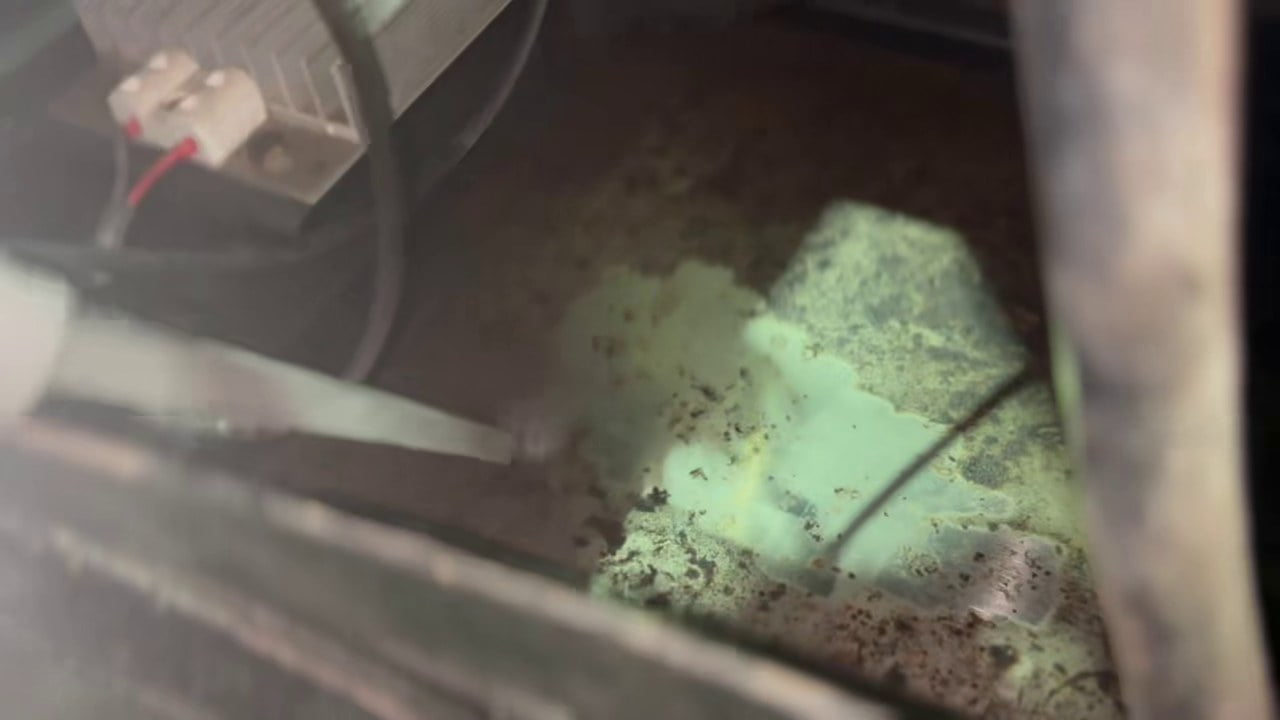
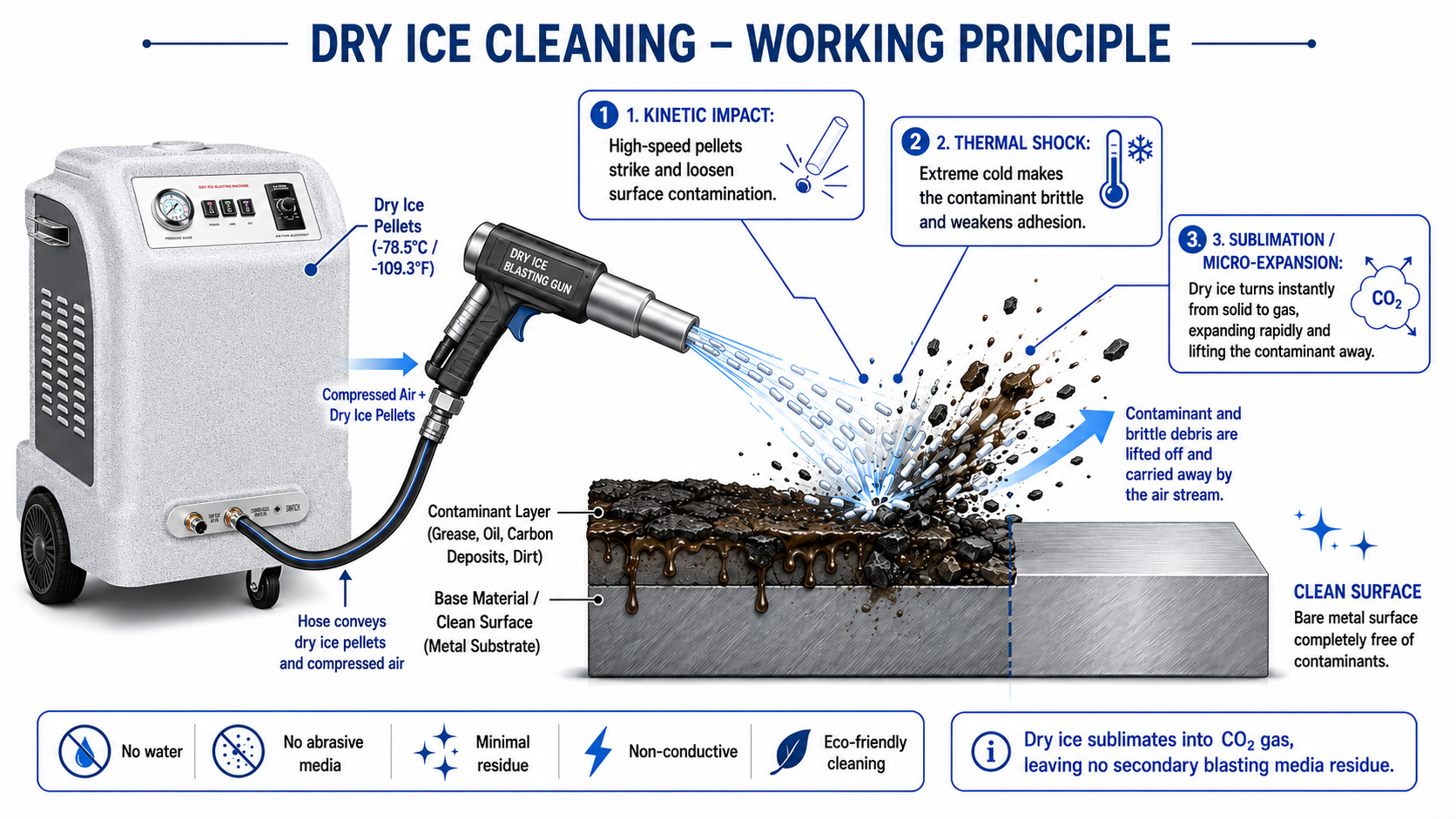
Dry ice blasting and laser cleaning solve different versions of the same problem. Dry ice sends solid carbon-dioxide particles through a compressed-air stream. Laser cleaning uses controlled light energy to separate or alter a contaminant layer. Neither mechanism is universally better.
The useful question is: which process can remove the specified contamination while preserving the required substrate and finish, fitting the part geometry, and meeting the site’s production and safety constraints? That question can be tested. A claim that one machine is simply faster, safer or cheaper cannot.
Choose the job before the machine
Start with a cleaning specification, not a technology preference. Record five facts:
- the contaminant, its thickness and how strongly it is bonded;
- the substrate, coating and surface finish that must remain;
- the accessible angles, recesses and line-of-sight limits;
- the cleanliness or adhesion result that will be accepted;
- the available time, utilities, ventilation and extraction.
This stable specification prevents a common comparison error. Current search results contain laser suppliers that favor laser cleaning and a dry ice supplier that favors dry ice blasting. Their pages expose useful decision variables, but they do not test the same part under the same acceptance standard. One supplier’s “best” result can therefore be irrelevant to another factory’s job.
Match the contaminant and required finish
Where dry ice blasting fits
Dry ice blasting combines particle impact, cooling and sublimation. The media changes from solid to gas, so it does not remain as grit or water. The removed grease, coating, carbon or other contamination does remain; collect or extract it according to the material and work area.
The process is a strong candidate when a nozzle can follow irregular equipment, molds or assemblies and when avoiding added blast media or liquid is important. Aggression can be changed through the machine, particle, feed, pressure, nozzle, distance and angle settings. Those variables also mean that “non-abrasive” is not an acceptance result. A coating or delicate surface still needs a controlled test, as explained in the surface-damage validation guide.
Dry ice also has a removal boundary. Cold Jet’s current guide states that tightly bonded paint can be too slow or ineffective and that deep or pitted corrosion may require a more aggressive process. If the job requires a defined profile or complete removal of strongly bonded oxide, test that outcome instead of assuming more air pressure will create it.
Where laser cleaning fits
Laser cleaning is a candidate when the contaminant or coating can be removed through a controlled laser-material interaction and the beam can reach the target predictably. It can be attractive for repeatable paths, selective layer removal and cells where the part position, focus and extraction can be engineered.
The substrate response is not automatically neutral. A 2026 peer-reviewed review describes possible changes to surface integrity, microstructure, mechanical properties and chemical composition during laser cleaning. The relevant wavelength, pulse characteristics, energy density, scan strategy, focus and material combination must therefore be validated against the required finish. Reflective features, edges, mixed materials, deep recesses and variable standoff can change both process control and the hazard case.
Compare the production system, not only the cleaning head
The machine purchase is one line in a larger system. Compare the complete operating boundary:
| Decision factor | Dry ice blasting | Laser cleaning |
|---|---|---|
| Process inputs | Suitable dry ice, compressed air and usually power | Electrical power plus the specified cooling and control system |
| Geometry | Flexible nozzle access can suit irregular shapes; hose and standoff still matter | Requires a controlled optical path, focus and access to the target |
| Residue | No spent dry ice media; removed contamination remains | No physical cleaning media; plume, particles or vapor still require assessment and extraction |
| Integration | Manual, fixture-guided or automated blasting | Manual or automated scanning with laser-specific guarding and controls |
| Main operating variables | Pellet condition, feed, delivered air, nozzle, distance and angle | Wavelength, pulse, energy, focus, scan speed, overlap and extraction |
Cost follows these differences. For dry ice, include the blaster, compressor capacity, air treatment, pellets, storage loss, labor and ventilation. For laser cleaning, include the source and scanner, cooling, guarding, interlocks, extraction, trained oversight and maintenance. For both, include setup, inspection, rejected parts, waste handling and production interruption.
A universal payback figure is not defensible. A laser may avoid a recurring media purchase yet require a materially different protected cell. Dry ice may have a lower equipment boundary yet depend on air and pellet logistics. The correct comparison uses cost per accepted part or accepted cleaning cycle at the site’s real utilization—not machine price alone.
The safety cases are different, not smaller
Laser cleaning is not reduced to wearing glasses. OSHA identifies eye and skin exposure hazards and treats laser controls according to class and wavelength. Its technical manual also addresses reflections, enclosures or controlled areas, fire, and ventilation for fumes and vapors created by laser interaction with the target. The contaminant matters because the plume comes from what the beam removes.
The blasting process has a different hazard structure. The task combines compressed air, high-velocity debris, noise, cold media and carbon dioxide. NIOSH identifies dry ice as solid carbon dioxide and lists inhalation, asphyxia and frostbite hazards. Ventilation and, where the assessment requires it, carbon-dioxide monitoring belong in the work plan. The DryIceSys pre-start safety checklist covers that operating boundary.
Do not rank safety from a marketing comparison. Build two hazard assessments for the actual location, contaminant, equipment configuration and operator access. A fully engineered laser cell and an open manual laser are not the same case. Neither are outdoor dry ice blasting and blasting inside a poorly ventilated enclosure.
Run one trial with one acceptance standard
Use representative parts with typical contamination, difficult geometry and the surface condition that production must protect. Before either trial, define the pass and stop criteria. Then record each process without translating one method’s settings into the other’s.
For dry ice, record pellet type and condition, feed rate, delivered air under load, nozzle, distance, angle, passes and time. For laser cleaning, record the source and wavelength, pulse and energy settings, focus or standoff, scan pattern, overlap, passes, extraction and time. The equipment supplier must define the valid operating fields; the buyer must define acceptance.
Inspect the same outcomes after both trials:
- contaminant removal and cleanliness at edges and recesses;
- substrate, coating, texture, dimensions and appearance;
- any required adhesion or functional result;
- cycle time, setup, cleanup and production access;
- measured utilities, consumables and captured waste;
- control measures, operator exposure boundaries and stop conditions.
Reject a method if it meets visual cleanliness but changes a critical surface, cannot reach the geometry, or cannot be controlled safely in the intended production environment. If both pass, compare total cost per accepted cycle and the stability of the result over repeated parts.
That evidence turns dry ice blasting versus laser cleaning from a brand argument into an engineering decision. DryIceSys can help define a dry ice trial against the same documented part, contaminant and acceptance criteria through the project enquiry form.
Sources and further reading
- OSHA: Laser Hazards Overview
- OSHA Technical Manual: Laser Hazards
- NIOSH Pocket Guide: Carbon Dioxide
- Springer Nature: Research Progress of Laser Cleaning Technology and Its Impact on Substrate
- Cold Jet: The Definitive Guide to Dry Ice Blasting
- ICS: Laser Cleaning vs. Dry Ice Blasting
- KEYENCE: Dry Ice Blasting vs. Laser Cleaning
- Laserflux: Dry Ice Blasting vs. Laser Cleaning