
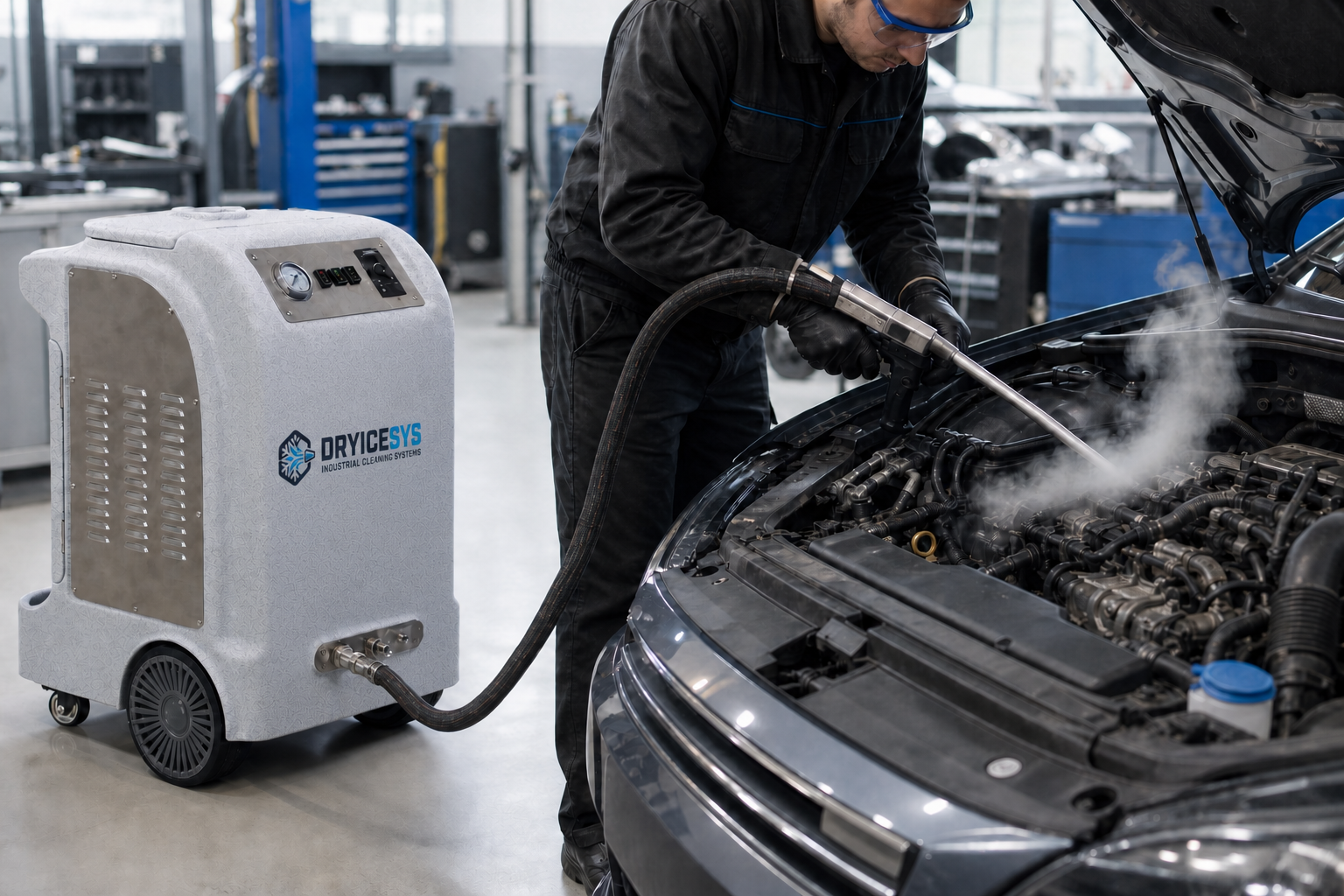
When a dry ice blasting machine blows air but delivers no pellets, the feeder is only one possible cause. Wet or aged dry ice can bridge in the hopper. A transport hose can be twisted. Water ice can form in the feeder or nozzle. The air system can also look adequate at idle and fail under load.
The reliable response is to classify the symptom, trace the pellet and air paths, and stop at the machine-specific service boundary. Do not increase pressure or dismantle the feed system until the cause is known.
Start with the symptom, not the suspected part
Record what the machine does before changing any setting. Four observations narrow the fault without opening the machine:
- No blast air and no pellets: start with the air supply, power or pneumatic controls, emergency stop, safety interlocks and connections defined in the operator manual.
- Air flows but no pellets appear: check whether the hopper contains usable dry ice, the feed setting is enabled and the machine’s normal feeder or hopper-agitation indication is present.
- Pellet flow starts and stops: look for clumped media, a bridged hopper, a twisted hose, a partial restriction or moisture freezing in the delivery path.
- The blast begins normally and weakens: compare air pressure under sustained blasting, inspect condensate controls and check whether the remaining dry ice has become soft, powdery or clumped.
These are diagnostic classes, not repair instructions. One manufacturer may use a pneumatic feed wheel; another may use an electric feeder, vibrator, thumper or different control logic. Even a machine marketed with an anti-clogging feed can stop delivering media for reasons outside that mechanism.
Trace the pellet path from hopper to nozzle
Treat the hopper, feeder, feed hose, gun and nozzle as one material path. The invariant is continuous movement of dry, correctly sized media through that path. The location of the first abnormal condition determines the next check.
Pellet condition
Use the pellet size specified by the machine manufacturer. Reject dry ice that is visibly wet, clumped, powdery, contaminated or outside that size range. Nu-Ice and Cold Jet operator manuals both warn that poor pellet condition interferes with feeding. ICS also notes that dry ice loses quality as well as mass during storage and transport.
Freshness is not a fixed number of hours. Container design, handling, ambient conditions and delivery distance change the result. A practical acceptance check is physical: the media should match the specified size and remain free-flowing when loaded.
Hopper and feeder entrance
With the machine in the safe inspection state defined by its manual, confirm that the hopper is dry, clean and free of packaging fragments or other foreign material. Keep the lid closed between fillings when the manual requires it. Do not leave unused media in the hopper longer than the model allows; sublimation, cooling and humidity can turn a free-flowing load into a bridge or frozen mass.
Do not reach through the hopper toward a feed wheel, auger or airlock. If the normal external feeder indication is absent, or foreign material may have entered the mechanism, move to the service boundary.
Hose, gun and nozzle
Inspect the accessible hose run for a sharp bend, twist, crush point or damaged coupling. Record whether the symptom changes with the hose laid out as the manufacturer specifies. A restriction inside the gun or nozzle cannot be distinguished safely by inserting a tool from the outside. Locate the suspected section, then use only the clearing method assigned to that machine and component.
Check the air while the machine is working
Compressed air has two separate jobs in this diagnosis: provide transport energy and arrive in the condition required by the blaster.
First, observe delivered pressure while the trigger is held under a normal blasting load. An idle gauge only shows that the system can build pressure; it does not prove that the compressor, piping, hose and filters can sustain the required flow. A falling reading can indicate insufficient supply or a restriction, depending on the system. Use the machine’s air requirement and a measurement at the intended connection point. The dry ice cleaning machine air requirements guide covers that sizing boundary.
Second, inspect the air-treatment system according to the compressor and blaster manuals. Cold Jet’s AeRO 75 manual explains that incoming moisture can freeze at the feeder, accumulate through the hose and lodge at the nozzle. Nu-Ice likewise connects moisture-contaminated pellets and blocked delivery with water separation and aftercooling.
Moisture is therefore a credible mechanism, not the answer to every clog. A recent supplier troubleshooting article correctly notes that old pellets, a restricted hose, a blocked nozzle and a machine fault can produce similar symptoms. Air treatment cannot repair foreign material in a feeder, and fresh pellets cannot correct an undersized air supply.
Clearing is model-specific; depressurization is not
There is no universal purge sequence. The reviewed Cold Jet manual assigns air-only blasting to one nozzle symptom and sends a foreign object in the feeder to manufacturer support. The Nu-Ice manual gives a different sequence for a blockage in its hose and gun. Combining those procedures would create unsafe shared logic.
The cross-machine rule is simpler: before disconnecting or opening a hose, gun, nozzle or feed component, shut down the machine, isolate its energy sources and verify depressurization exactly as its manual requires. Never loosen a coupling to “see if it clears.” Never bypass a trigger, interlock, relief device or guard.
Keep the area ventilated while blocked dry ice sublimates. NIOSH identifies dry ice as solid carbon dioxide and lists inhalation, asphyxia and frostbite hazards. A stopped machine does not remove those hazards, and a closed service area can still accumulate carbon dioxide. The existing dry ice cleaning machine safety checklist remains the boundary for ventilation, PPE and hazardous-energy controls.
Stop the troubleshooting attempt when the safe state cannot be verified, a pressurized component will not isolate, a guard must be removed without an approved procedure, or the suspected blockage is inside a feeder or control enclosure.
Prevent recurrence and know the service boundary
Record the cause, not just the restored output. A useful service entry includes pellet supplier and condition, pellet size, time since loading, hopper condition, air pressure under load, observed condensate, filter or dryer status, hose layout, nozzle identification, feed setting and the component where normal flow stopped.
Prevention follows the same paths: use correct fresh media, keep the hopper dry and free of debris, limit unnecessary pellet residence, inspect the hose route and maintain the specified air-treatment equipment. The interval and exact procedure still belong to the applicable manuals.
Escalate when the feeder does not move after approved external checks, a foreign object may be lodged inside, a feed wheel or other internal part appears damaged, a fuse or control repeatedly trips, or the symptom returns without an identified external cause. Repeatedly raising pressure is not a diagnosis and must never exceed the rating of the machine, hose, gun or nozzle.
The defensible troubleshooting result is a located fault class: media, hopper entrance, transport path, compressed-air delivery or internal machine function. DryIceSys can use that record to help define the next model-specific check through the project enquiry form.
Sources and further reading
- Nu-Ice Age: Operation Manual for an All-Pneumatic Dry Ice Blasting Machine
- Cold Jet: AeRO 75 Series Operator Manual
- Cold Jet: Dry Ice Blasting Frequently Asked Questions
- AIOLITH: Why Your Dry Ice Blaster Clogs or Feels Weak
- ICS: Dry Ice Cleaning and Production Equipment
- Cold Jet: Service and Repair for Dry Ice Blasters
- NIOSH Pocket Guide: Carbon Dioxide