

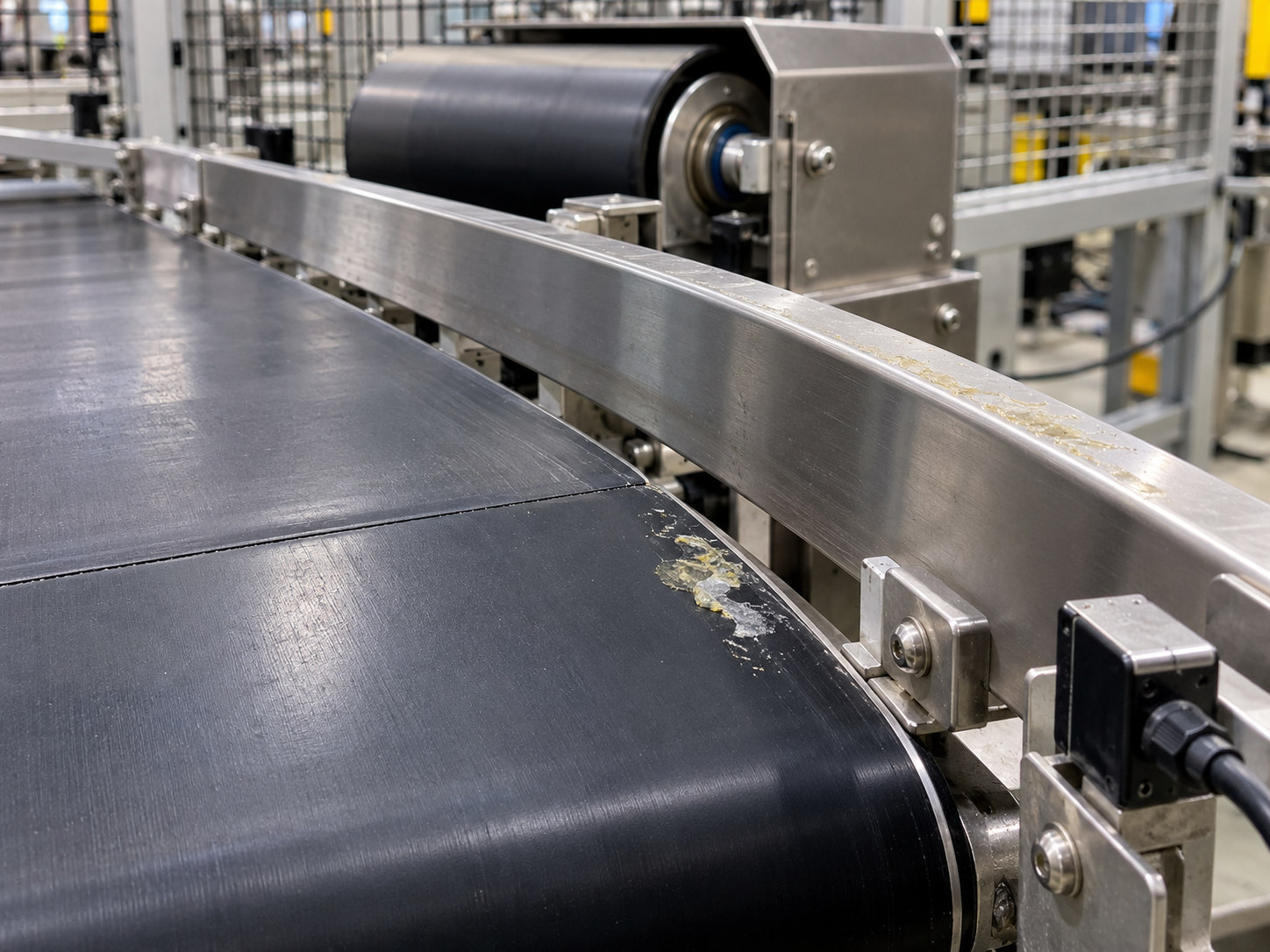
A conveyor may have a sticky belt, a coated roller, a dirty guide rail, and loose debris beneath the frame. Those are four different cleaning decisions, even when they belong to one line. Use dry ice blasting on a conveyor only after the belt is stopped and isolated, the residue and belt material are identified, and a small test patch confirms cleaning without surface change or debris migration. The goal is a qualified maintenance method for a defined surface, not a promise that every belt can be blasted.
This guide is for industrial maintenance and equipment buyers considering a controlled trial on a packaging or material-handling conveyor. It does not authorize work on a moving conveyor or replace the belt maker’s cleaning limits, the site’s energy-control procedure, or any food-contact sanitation program.
Which conveyor parts are candidates for dry ice cleaning?
Start with a map of the deposit and its substrate. A metal frame or removable guide rail carrying bonded adhesive is different from a soft belt, a coated pulley, or a sensor. Record belt material, surface texture, seam type, coating, age, and any manufacturer’s prohibition before selecting a nozzle. Identify whether the soil is pressure-sensitive adhesive, oil, product residue, paint overspray, or simply loose dust. Loose material may be better collected without a high-velocity jet.
Cold Jet’s facility-maintenance page lists conveyor belts, chains, rollers, frames, and drive assemblies as possible dry ice blasting applications. It is a useful application example, but a vendor example does not establish compatibility with a particular belt, cleaning speed, or wear rate. The plant must establish those points on its own machine.
For an initial assessment, sort the line into three groups: robust accessible metal parts that may be straightforward test candidates; belt and coated components that need especially careful material checks; and excluded zones such as bearings, open motors, sensor faces, electrical enclosures, lubricated joints, and inaccessible nip points. Mark the boundaries on a photograph so the operator and reviewer agree on the trial area. The DryIceSys nozzle-selection guide can help plan access, while the actual trial determines whether a nozzle is suitable.
Why must the conveyor be stopped and isolated?
A stopped belt is not necessarily an isolated belt. A drive may restart from a remote command, stored energy can remain in a tensioner or pneumatic actuator, and adjacent conveyors can move material into the work zone. The US OSHA hazardous-energy standard covers servicing and maintenance when unexpected energization, startup, or release of stored energy could injure workers. Its details apply to covered US workplaces; facilities elsewhere should follow their own governing rules and equipment-specific procedures.
OSHA’s machine-guarding guide specifically discusses conveyor servicing and maintenance under an energy-control program when the work exposes people to hazardous areas. It also describes a narrow minor-servicing exception for certain routine production tasks. A planned dry ice blast trial around a belt, roller, or drive should not be casually treated as that exception. Have the authorized site team isolate and verify the relevant drives and stored energy before opening guards or bringing a nozzle into the area.
Keep a documented boundary around the trial. Protect adjacent product, workers, sensors, and uncleaned surfaces from dislodged soil. Do not aim the jet into a nip point, bearing, vent, or enclosure. If access requires removing a guard, the site must manage that change under its own safe-work procedure and restore it before restart. An in-place cleaning claim from a supplier is not permission to clean a particular machine while it runs.
How should a belt-material test patch be run?
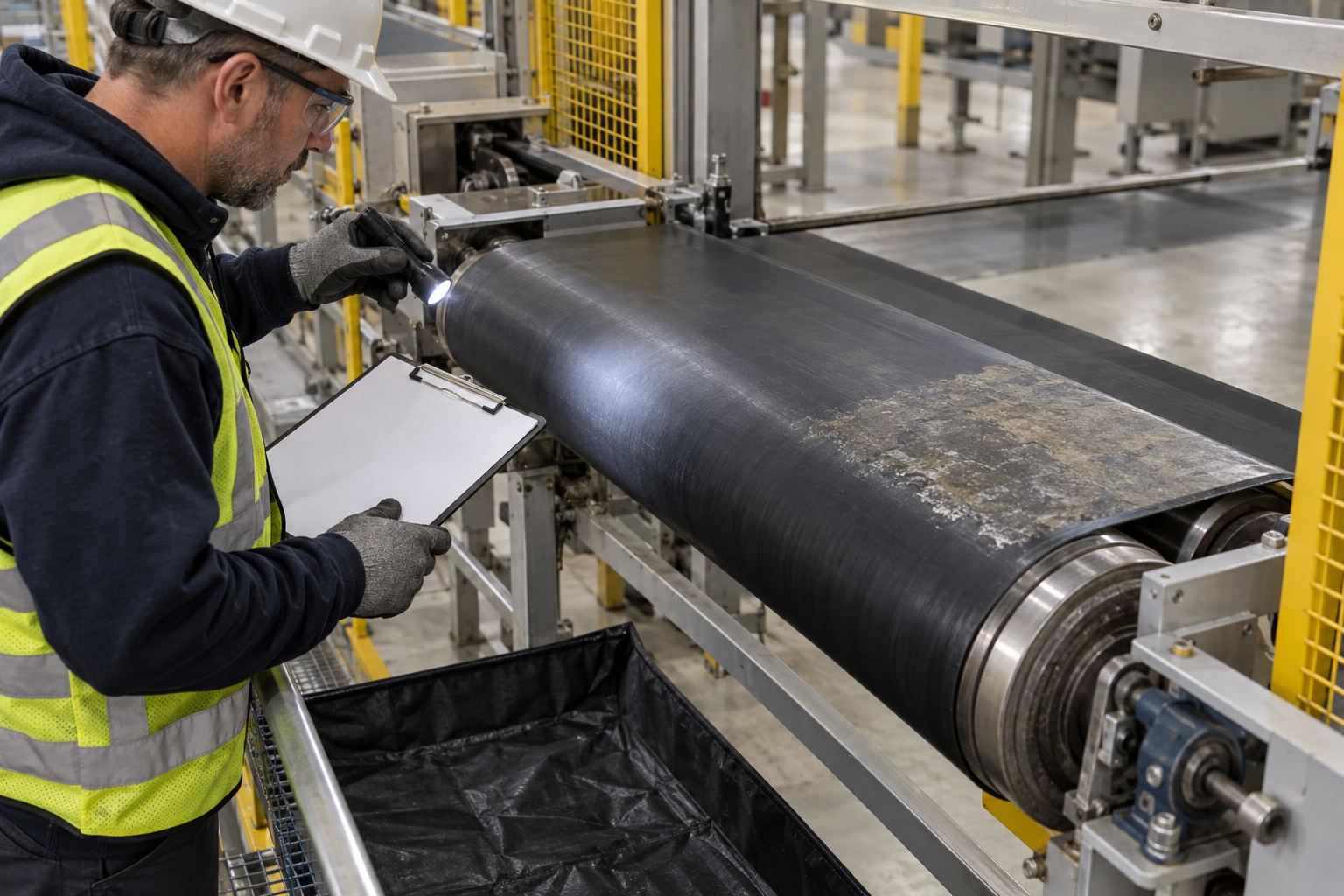
Choose a small representative area with the real deposit, preferably where any surface change can be inspected before production resumes. Photograph and describe the starting condition. Note the belt maker and grade, seam, coating, deposit, pellet size, nozzle, air supply, distance, angle, dwell time, and collection method. Trial one variable at a time; a clean-looking patch alone is insufficient evidence.
Begin with the least aggressive setup consistent with the machine instructions. After a short pass, stop and inspect under good light. Compare the patch with an adjacent untreated area and with a clean baseline if one exists. Look for whitening, gloss change, pitting, edge lift, seam movement, exposed reinforcement, altered texture, coating removal, and residue driven into belt joints or under guards. Check the opposite side or return run where practical. If a part changes, stop the trial rather than increasing exposure to chase a spotless appearance.
Do the same for rollers and rails separately. A result on stainless steel does not qualify a polymer belt; a result on the belt top surface does not qualify its seam or underside. If the deposit can be removed more safely from a removable rail on a bench, start there. The DryIceSys site-readiness checklist covers work-area questions before a dry ice trial, and the machine air-requirements guide explains why delivered air capacity must be checked under actual flow.
What happens to the removed contamination and carbon dioxide?
The dry ice medium sublimes, but adhesive, oil, coating fragments, dust, and product residue do not disappear. Plan a capture or collection route before blasting, especially near the belt return, underside, transfer point, and nearby product. Avoid pushing contamination into rollers, drains, sensors, or a neighboring line. A post-clean photograph should show the defined surface and surrounding protected areas, not just the most attractive patch.
Sublimation also adds carbon dioxide to the work area. The NIOSH carbon-dioxide pocket guide identifies exposure limits and symptoms, including headache, dizziness, and breathing difficulty. Assess ventilation and occupied low or enclosed spaces; use monitoring when the site’s exposure assessment calls for it. Visible fog is not a reliable exposure indicator. Dry ice handling also requires protection against cold contact. The DryIceSys safety guide provides general operator considerations to adapt to the specific site.
If the conveyor carries food or pharmaceutical product, the cleaning trial does not by itself demonstrate hygienic readiness. The site must apply its separate cleaning, inspection, and verification program to product-contact parts. Likewise, if the removed soil is hazardous or combustible, its capture and disposal follow the facility’s controls. Dry ice blasting should be evaluated as a residue-removal step, not as a substitute for all downstream verification.
A practical go/no-go table for maintenance teams
| Finding on the line | First decision | Dry ice trial outcome to require |
|---|---|---|
| Loose dust or crumb on an accessible frame | Collect it with an approved low-dispersal method | Blasting may be unnecessary |
| Bonded adhesive on a removable metal guide | Identify adhesive and protect nearby parts | Controlled patch removes residue without changing finish |
| Sticky patch on a polymer belt | Confirm belt and seam limits with the maker | No texture, coating, seam, or edge change after inspection |
| Soil beside a roller or drive | Isolate energy and assess access | No debris migration into bearings or guards |
| Unknown coating or weakened belt | Identify material and failure mode | Pause until compatibility criteria are defined |
| Enclosed work area with limited ventilation | Assess CO2 accumulation and worker exposure | Pause if controls and monitoring are inadequate |
Set an acceptance criterion before the test. It might be removal of a defined adhesive patch without change to belt texture or seam, no new contamination in protected areas, and a documented clean area after collection. A supervisor can then decide whether to extend the method to a specified length of belt or to use another cleaning technique. Record the time and media used, but avoid extrapolating a small test to a whole production line without checking interruptions, geometry, and collection work.
Frequently asked questions
Can dry ice blasting clean a conveyor without removing the belt?
Some supplier applications clean conveyors in place, but that does not establish that a specific belt is accessible or safe to clean in place. The line must be stopped and isolated for the planned trial where hazardous energy is present, and its guards, product, sensors, and collection path must be addressed. A removable component may be easier to inspect and protect.
Will dry ice damage a rubber or polyurethane belt?
No universal answer follows from the cleaning medium alone. Belt formulation, age, coating, seam, temperature, nozzle, air setting, angle, and dwell time all matter. Obtain the belt maker’s limits and run a representative patch with acceptance criteria that can detect subtle surface or seam change.
Does dry ice blasting eliminate conveyor cleanup?
No. The pellet sublimates, while dislodged adhesive, oil, dust, and coating still need collection. The area around rollers and beneath the belt needs inspection before restart.
Is a successful rail test enough to approve the belt?
No. A stainless guide and a polymer belt have different materials and failure modes. Qualify each surface and deposit separately, including the belt seam and coated parts.
Sources and scope
The potential conveyor applications come from Cold Jet’s facility-maintenance description, whose performance statements are not generalized here. Energy-control discussion is based on OSHA 29 CFR 1910.147 and its machine-guarding guide for covered US work. Carbon-dioxide hazards are grounded in the NIOSH pocket guide. The equipment maker, belt maker, facility risk assessment, and test results govern the actual cleaning decision.