
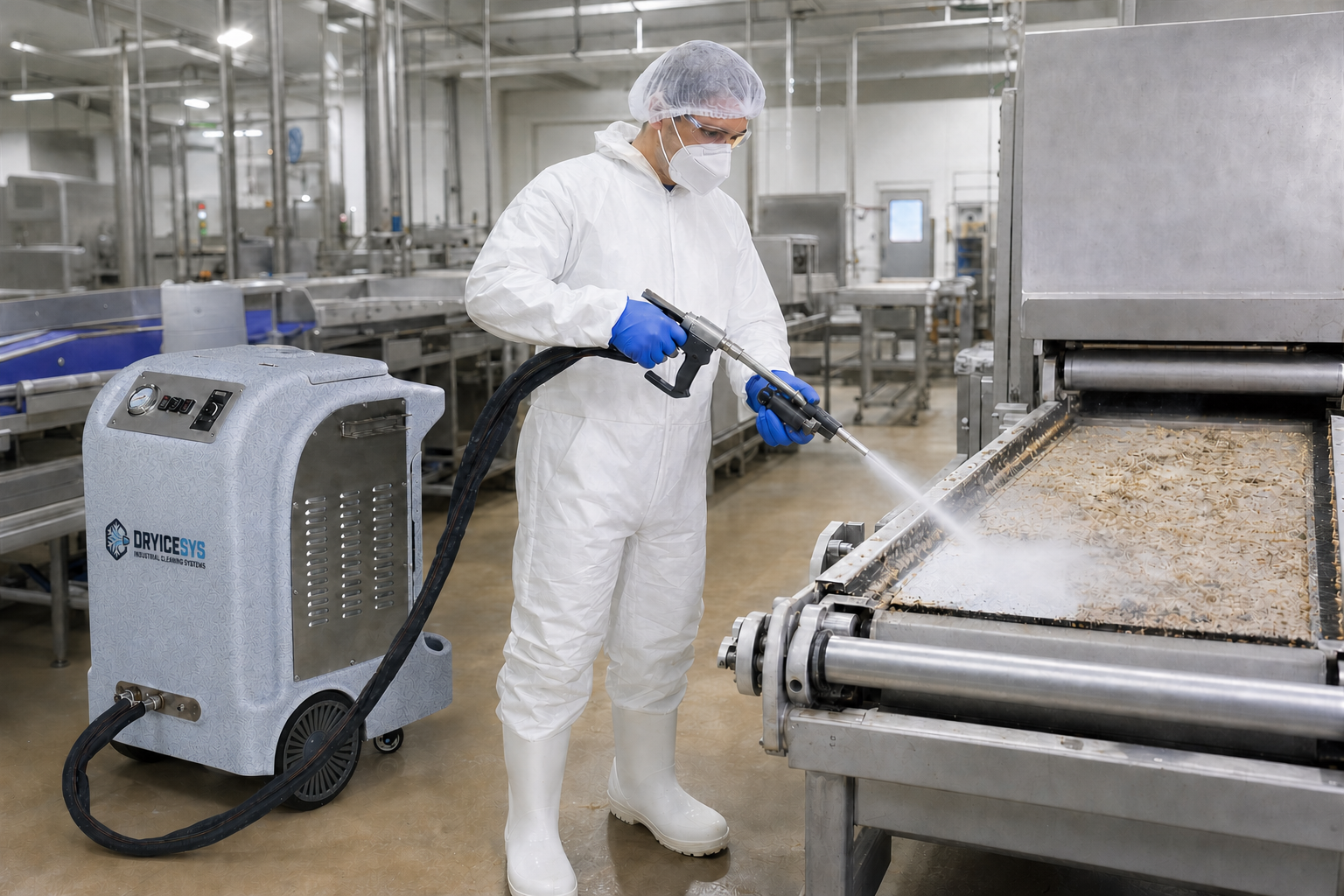
Dry ice blasting can remove baked-on food, grease, carbon and other soil from selected food-processing equipment. It should not be assumed to sanitize or disinfect that equipment. The plant must first define the required hygienic endpoint, then validate the blast step and any treatment that follows it.
Current search results describe waterless cleaning, food-grade dry ice, bacterial reduction and regulatory compliance together. They are not one fact. Carbon-dioxide grade concerns an input. Cleaning concerns soil removal. Sanitizing or disinfection concerns a defined microbial result. Release concerns the complete, verified procedure.
Dry ice blasting can clean food equipment; it does not automatically sanitize it
US food-manufacturing rules illustrate the boundary. Under 21 CFR 117.35, food-contact surfaces must be cleaned as often as necessary to protect against contamination and allergen cross-contact. Wet-processing operations may also require cleaning and sanitizing before use. Federally inspected meat and poultry establishments operate under a separate rule that requires food-contact surfaces to be cleaned and sanitized as frequently as necessary to prevent insanitary conditions and product adulteration.
Neither rule approves a machine by category. The required outcome remains authoritative.
Independent evidence supports that caution. A 2017 study found that dry ice blasting removed bacterial cells, but the reduction was below the study’s disinfection criterion. It also identified recontamination risk from viable bacteria spread during blasting and recommended cleaning followed by disinfection. A 2026 scoping review concluded that performance depends on the surface, cleanliness and environment, with realistic plant testing and standardized protocols still needed.
The useful conclusion is limited but strong: evaluate dry ice blasting as a controlled cleaning step. Do not rename it sanitation before the complete process meets the plant’s acceptance criteria.
Classify the target before selecting a nozzle
Start with three separate facts: what the surface touches, what soil is present, and what condition permits release. The industry name alone is not a specification.
| Classification | Primary question | Trial implication |
|---|---|---|
| Direct food-contact surface | What cleaning and sanitizing outcome does the written program require? | Include the complete post-blast treatment and release test |
| Non-food-contact equipment surface | Could remaining or displaced soil contaminate food or a contact surface? | Measure containment, cleanup and inspection access |
| Allergen-controlled surface | What verified removal criterion applies to the specific allergen and product change? | Use the plant’s qualified sampling method; visual cleanliness alone is insufficient |
| Heat, grease or carbon buildup | Can the soil be removed without changing the substrate, coating, seal or geometry? | Record the whole blast setup and define damage stop conditions |
| Open product or exposed packaging | Can the work be isolated from food, ingredients and packaging? | Reject online cleaning unless the plant’s hazard analysis and procedure explicitly control it |
This classification prevents a scope error. A machine may clean an oven frame successfully and remain unsuitable for a food-contact belt under the same settings. A result on stainless steel does not establish a result on a polymer seal. A different soil, geometry or downstream treatment is a process change.
Control the inputs and the removed soil
“Food-grade dry ice” is not a complete control plan. US regulation recognizes carbon dioxide as generally recognized as safe for use in food under current good manufacturing practice. That ingredient status does not certify the pellet supply, blaster, hose, nozzle, compressed air or cleaning result for a specific plant.
Specify every process input. Confirm dry ice identity, handling and supplier documentation. Define which machine parts can enter the hygiene zone and how they are cleaned. Verify that hose and nozzle condition cannot introduce foreign material.
Under 21 CFR 117.40(g), compressed air or other gases used to clean food-contact surfaces or equipment must be treated so food is not contaminated with unlawful indirect food additives. Pressure and flow do not close the air-quality question. Filtration, oil carryover, condensate, piping and the point of use belong in the plant assessment.
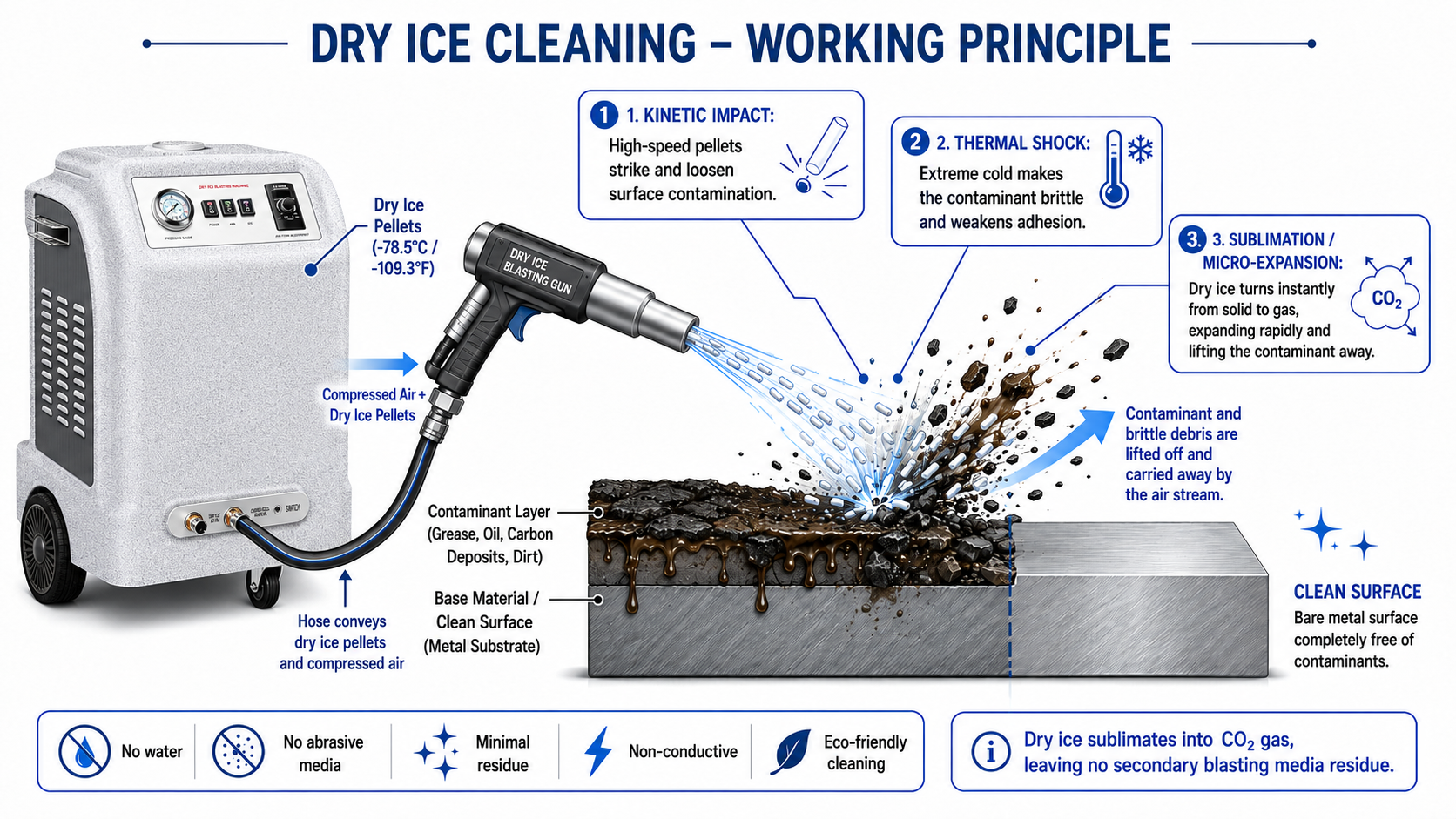
The output side is just as important. Dry ice sublimates, but grease, carbon, crumbs, allergens and microorganisms do not. A practitioner discussion found through the live search page asks the practical question directly: where do the food particles and grease go? The work plan needs an answer through isolation, barriers, capture, vacuuming or other plant-approved cleanup. “No secondary blast media” must never be shortened to “no debris.”
Validate the process, not the machine label
Choose a representative test area, not the easiest visible patch. The trial should use the actual soil, surface, geometry and access restrictions expected in production. Record the machine model, nozzle, delivered air, pellet specification, feed setting, standoff, angle, pass method and cleaning time. Also record isolation, debris capture and the treatment that follows blasting.
Define acceptance before the trigger is pulled:
- The target surface and food-contact status match the validation scope.
- The specified soil is removed to the written cleaning criterion.
- The substrate, coating, seals, sensors and adjacent parts remain within condition limits.
- Displaced material stays inside the controlled work zone and can be completely collected.
- Any required sanitizing or disinfection step remains effective after blasting.
- The plant’s qualified visual, allergen, ATP or microbiological verification method meets its release limit.
- Unexpected residue, surface change, aerosol spread, unstable air or pellet flow, or a failed release test stops the trial.
Use verification tools only for their qualified purpose. An ATP reading is not automatically an allergen or pathogen result. A clean photograph is not a release record. If the plant changes the product soil, target material, nozzle, air treatment, pellet supply, settings, cleanup method or downstream sanitizer, assess whether revalidation is required.
Food safety and operator safety are separate cases
A hygienically acceptable result does not prove that the job was safe. Isolate the production equipment according to its energy-control procedure. Do not rely on claims that equipment can be cleaned while hot, assembled or running; moving parts, stored energy, hot surfaces and exposed product require their own authorization and controls.
The process adds compressed-air, hose, projectile, noise, visibility and cold-contact hazards. Sublimation releases carbon dioxide. OSHA publishes exposure limits and monitoring information, but the site must apply them to room volume, pellet rate, enclosure and occupancy. A hygiene barrier must not create an unassessed carbon-dioxide accumulation zone.
Turn the trial into a purchase specification
Once the process is validated, the machine requirement becomes clearer. Ask suppliers to address the validated operating window rather than offering a generic “food-grade” label:
- Can the machine, hose and applicator be cleaned and inspected for the intended hygiene zone?
- Which materials and lubricants are exposed near the blast stream?
- What treated air quality is required at the machine inlet and at the point of use?
- Which nozzle delivers the accepted result at the available airflow?
- How are pellet feed, pressure and other critical settings recorded and controlled?
- What maintenance prevents contamination, unstable feed or foreign-material release?
- What training and service boundaries apply to sanitation operators and maintenance staff?
Public evidence does not establish one microbial, allergen, productivity or cost result across all soils, surfaces and layouts. A supplier demonstration is useful only when it reproduces the plant’s acceptance conditions.
Release the equipment only against the plant standard
The decision hierarchy is simple. The sanitation program defines the endpoint. Surface and soil classification define the trial. The validated configuration defines the operating window. Input, debris and safety controls govern execution. The plant’s verification method decides release.
DryIceSys can configure a machine for a representative food-equipment cleaning trial through the project enquiry form. The plant remains responsible for its hazard analysis, sanitation procedure, treated utilities, worker protection and release decision.
Sources and further reading
- 21 CFR 117.35: Sanitary operations
- 9 CFR 416.4: Sanitary operations
- 21 CFR 117.40: Equipment and utensils
- 21 CFR 184.1240: Carbon dioxide
- Witte et al.: Dry ice blasting for cleaning and disinfection in food production
- Shahbazi et al.: Dry Cleaning and Post-Cleaning Strategies in Food Processing Facilities
- OSHA: Carbon Dioxide