
+8613986122400
DryIceSys dry ice cleaning equipment
Blog

Australian Solar Laminator Tooling: Dry Ice Trial

DryIceSys Team 3 min read
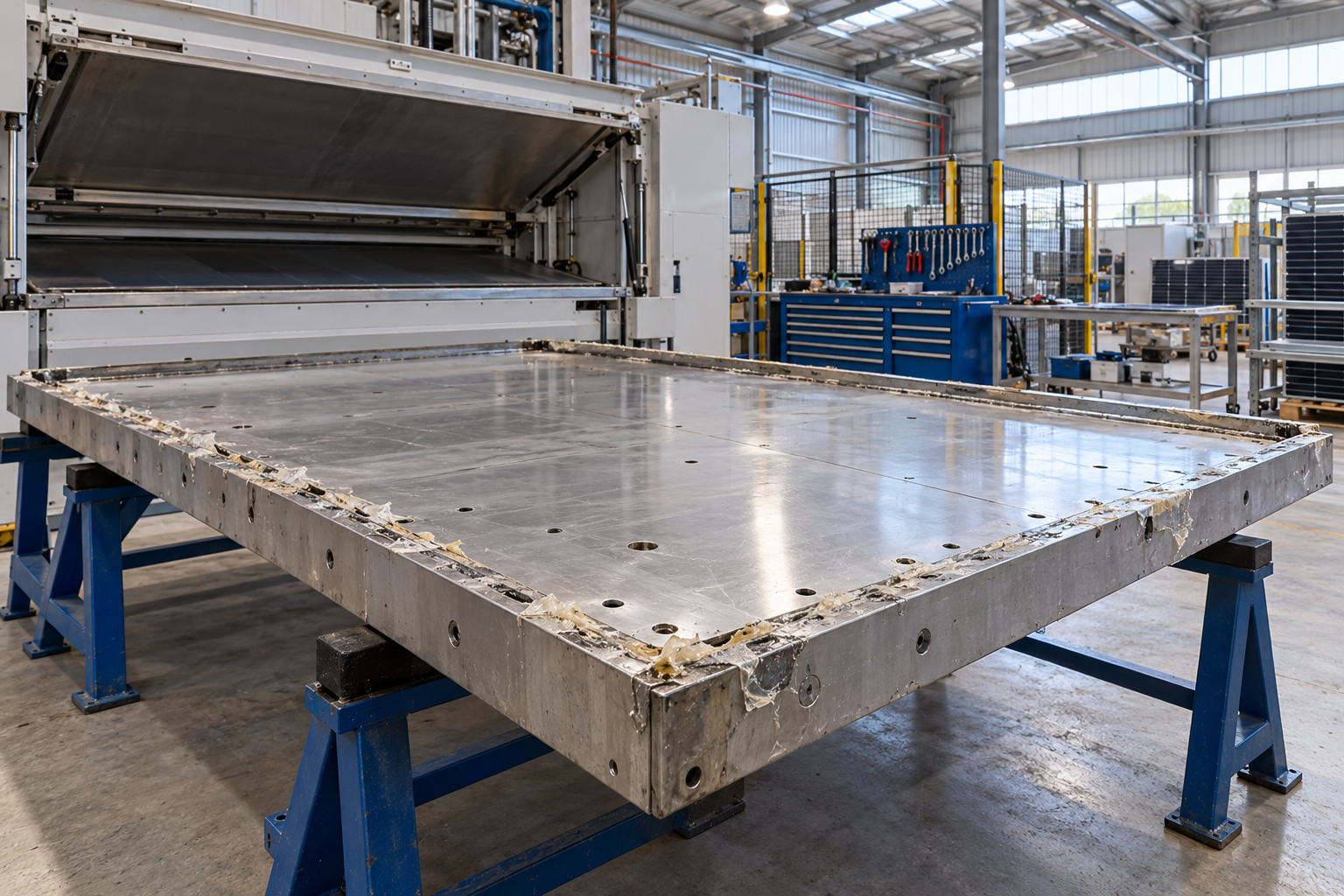
AI illustration of detached solar laminator tooling supported in a maintenance bay

Australian Solar Laminator Tooling: Dry Ice Trial Checks

Should an Australian solar-module factory trial dry ice blasting on detached laminator tooling?

An Australian solar-module factory may trial dry ice blasting on a detached, supported laminator tooling plate or edge fixture with cured encapsulant residue, provided the actual tooling finish tolerates the process and the production line is isolated. The decision should rest on a defined test area, residue capture, dimensional and surface inspection, and an approved restart—not on a visual cleaning claim alone.

The target here is a removable plate or edge fixture, not a solar cell, module glass or live laminator. The Australian Renewable Energy Agency’s PV-Mate report discusses encapsulant and lamination details that show why module geometry and material placement matter. It does not evaluate this proposed dry ice cleaning method. The plant must establish its own compatibility evidence for the specific plate material, coating and cured residue.
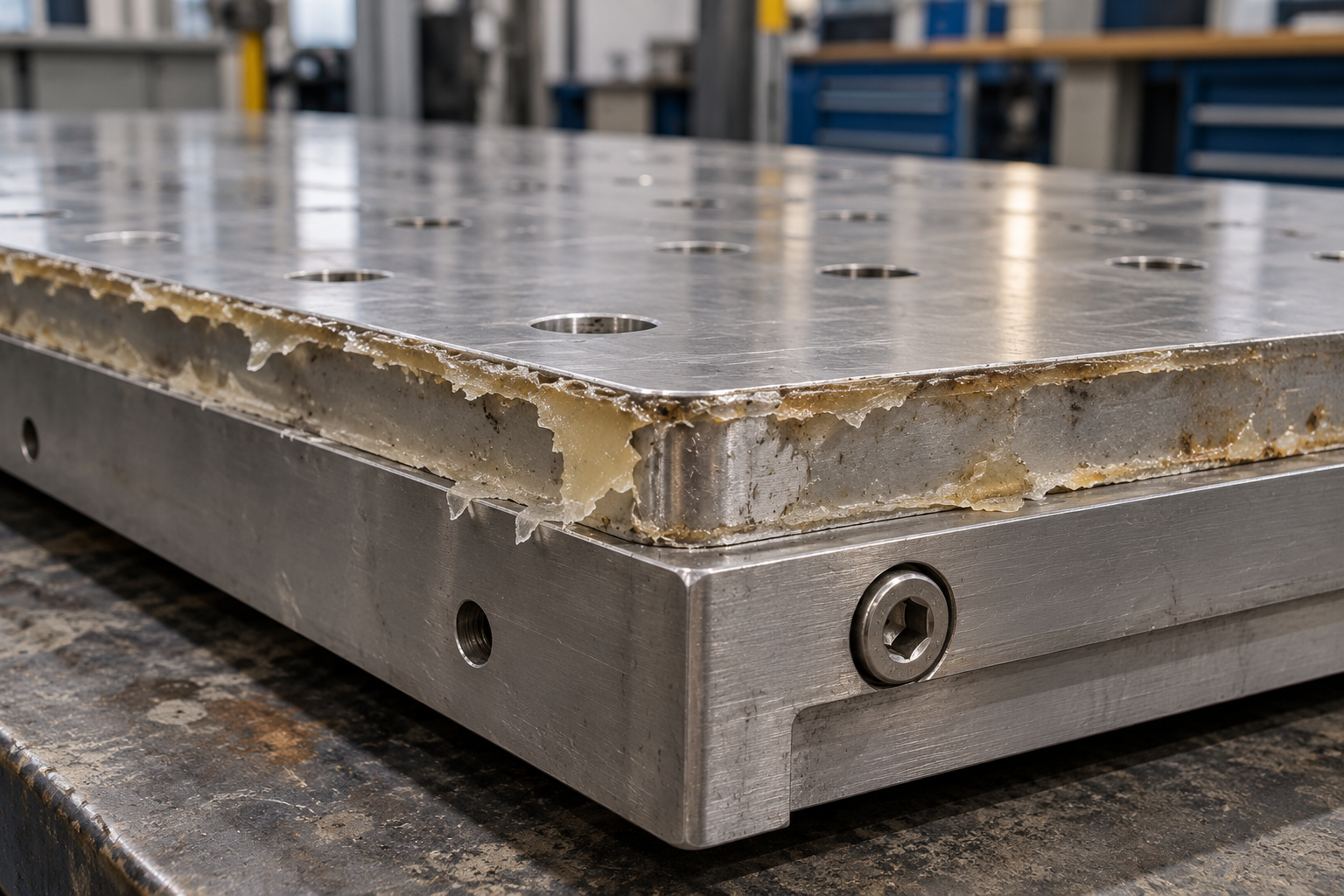
Illustrative close view of cured encapsulant residue on a detached laminator tooling edge

What belongs in the trial boundary?

Photograph the fixture before removal and mark the intended residue patch. Support the detached component on a stable bench so blasting force cannot shift it. Mask precision edges, soft seals, locating features and any surface whose finish determines module alignment. Identify the residue: cured EVA, release-agent buildup and mixed dust may behave differently. If the deposit cannot be characterized, start with a very small test coupon or noncritical edge rather than a full fixture.

Use a simple trial sheet to record nozzle distance, angle, air pressure, media feed, pass count and treatment time. Inspect the treated area under consistent light. Note whether residue has merely moved into slots or under hardware. Compare dimensions and surface condition against the plant’s tooling criteria; do not describe the outcome as a successful production method until a representative module run confirms no process harm.

How should the line and work area be controlled?

The Safe Work Australia model code for managing plant risks explains isolation of plant for cleaning and maintenance, including multiple energy sources. Follow the site’s lockout process for electrical, pneumatic, thermal and stored energy before removing tooling. A warm laminator, moving platen or spring-loaded fixture adds hazards unrelated to the cleaning media.

Dry ice becomes carbon dioxide gas while displaced residue remains solid. Review ventilation and possible gas accumulation near low or enclosed workspaces. Safe Work Australia’s airborne-contaminant guidance describes asphyxiant considerations, including carbon dioxide. Include local measurement and controls in the site’s risk assessment instead of assuming open doors are sufficient.
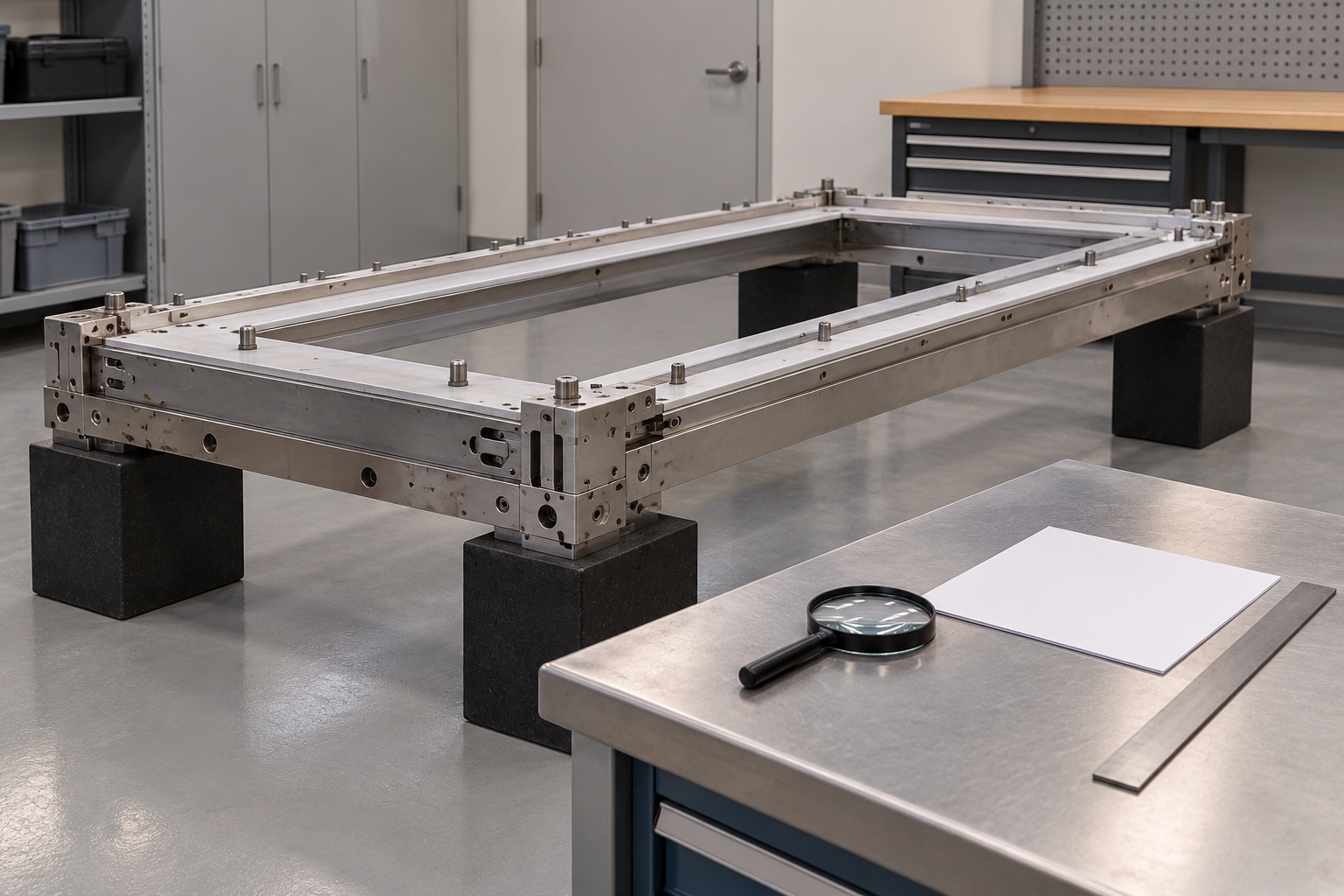
Illustrative inspection bench with detached solar laminator tooling and unmarked measuring tools

What should procurement compare?

Separate the cleaning trial from the equipment-purchase case. First verify that the selected setup can reach the residue without damaging a tooling finish; then estimate media consumption, compressor capacity, fixture handling time, noise and residue collection. The DryIceSys air-requirements guide helps frame compressor questions. The site-readiness checklist helps record space, electrical and logistics constraints. Compare this controlled test against the plant’s current manual or chemical approach rather than assuming a universal time saving.

What is the acceptance gate?

The maintenance owner should sign off on residue removal in the defined area, no observable finish or edge damage, no trapped debris, and restored fixture fit. The process engineer should then review the first production run under existing module-quality checks. If inspection shows damage or inconsistent performance, revise the method or reject the application. DryIceSys machine-safety guidance is a useful general reference, while the plant’s approved work instruction governs the actual job.

This bounded evaluation asks whether one detached fixture is a good candidate. It does not claim that dry ice blasting is approved for every encapsulant, laminator or module design.

Images are AI-generated editorial illustrations, not photographs of an Australian customer or a proven cleaning outcome.

Loading a short question...

By submitting, you agree that DryIceSys may contact you about this enquiry.

We currently use only essential cookies. If Google Ads, Meta advertising or analytics are added later, non-essential cookies will remain disabled until you consent. View more
Cookies settings
Accept
Decline
Privacy & Cookie policy
Privacy & Cookies policy
Cookie name Active
Our website address is: https://www.dryicesys.com.

Comments

When visitors leave comments on the site we collect the data shown in the comments form, and also the visitor's IP address and browser user agent string to help spam detection. An anonymized string created from your email address (also called a hash) may be provided to the Gravatar service to see if you are using it. The Gravatar service privacy policy is available here: https://automattic.com/privacy/. After approval of your comment, your profile picture is visible to the public in the context of your comment.

Media

If you upload images to the website, you should avoid uploading images with embedded location data (EXIF GPS) included. Visitors to the website can download and extract any location data from images on the website.

Cookies

If you leave a comment on our site you may opt-in to saving your name, email address and website in cookies. These are for your convenience so that you do not have to fill in your details again when you leave another comment. These cookies will last for one year. If you visit our login page, we will set a temporary cookie to determine if your browser accepts cookies. This cookie contains no personal data and is discarded when you close your browser. When you log in, we will also set up several cookies to save your login information and your screen display choices. Login cookies last for two days, and screen options cookies last for a year. If you select "Remember Me", your login will persist for two weeks. If you log out of your account, the login cookies will be removed. If you edit or publish an article, an additional cookie will be saved in your browser. This cookie includes no personal data and simply indicates the post ID of the article you just edited. It expires after 1 day.

Embedded content from other websites

Articles on this site may include embedded content (e.g. videos, images, articles, etc.). Embedded content from other websites behaves in the exact same way as if the visitor has visited the other website. These websites may collect data about you, use cookies, embed additional third-party tracking, and monitor your interaction with that embedded content, including tracking your interaction with the embedded content if you have an account and are logged in to that website.

Who we share your data with

If you request a password reset, your IP address will be included in the reset email.

How long we retain your data

If you leave a comment, the comment and its metadata are retained indefinitely. This is so we can recognize and approve any follow-up comments automatically instead of holding them in a moderation queue. For users that register on our website (if any), we also store the personal information they provide in their user profile. All users can see, edit, or delete their personal information at any time (except they cannot change their username). Website administrators can also see and edit that information.

What rights you have over your data

If you have an account on this site, or have left comments, you can request to receive an exported file of the personal data we hold about you, including any data you have provided to us. You can also request that we erase any personal data we hold about you. This does not include any data we are obliged to keep for administrative, legal, or security purposes.

Where your data is sent

Visitor comments may be checked through an automated spam detection service.
Save settings
Cookies settings